Transforming ICP Pain into Demo Intent: A Guide to SaaS Landing Page Copy
How to write SaaS PPC landing page copy that connects ICP pain to urgency, proof, and a clear next step to drive demo intent.

Your PPC campaign did its job. The targeting was tight, the ad earned the click, and the visitor landed on your page ready to find out whether you solve their problem. Then the copy opens with “The all-in-one platform for modern teams,” and they are gone in eight seconds.
That is where most demo intent dies, not in the ad account, but in the gap between the click and the copy. The best SaaS landing page copywriting tips all point to the same thing: a page that names the buyer's pain, makes it feel urgent, proves you can fix it, and asks for one clear next step. Get that sequence right and you increase demo requests with effective landing page copy rather than more spend.
This guide is about how to address pain points in B2B landing pages so the right buyer converts and the wrong one leaves. It matters because the numbers are unforgiving. SaaS Hero's 2026 analysis puts the median B2B SaaS landing page conversion rate at 3.8%, while top-quartile pages clear 10%. That spread is rarely a traffic problem. It is a copy problem.
What makes SaaS landing page copy convert
SaaS landing page copy that drives demo intent is copy that connects a specific ICP pain point to urgency, credible proof, and a single clear next step, so the right buyer requests a demo and the wrong one self-selects out.
Every high-converting page runs the same four-part spine in order:
- Name the ICP pain in the buyer's own words.
- Raise urgency by making the cost of inaction concrete.
- Prove the claim with specific, credible evidence.
- Point to one clear next step, almost always the demo.
Miss any link and the chain breaks. Pain without proof reads as empty empathy. Proof without pain is a feature list nobody asked for. The rest of this guide works through each link, then covers testing, measurement, and the mistakes that quietly cost you demos.
Start with ICP pain, not your feature list
The single biggest lever in software landing page copy is whose problem you lead with. Most pages lead with the product. High-converting pages lead with the reader.
This is the emotional and psychological core that separates a page that converts from one that just describes. A buyer clicking a PPC ad is not looking for a feature tour. They arrived carrying a specific frustration, a metric their boss is unhappy about, a process that keeps breaking, a tool that promised the world and under-delivered. Your opening copy has to show you understand that frustration better than they can articulate it themselves.
Two practical rules make this work. First, message match: the pain your copy names should be the exact pain implied by the ad and keyword that brought them there. A visitor from a “reduce SaaS onboarding time” ad should not land on a generic homepage. Mismatch between ad promise and page content is one of the most common reasons paid traffic bounces. Second, use their language, not yours. Pull the phrasing from sales calls, support tickets, and review sites, not from your internal positioning deck.
Understanding the ideal customer profile is what makes this precise. The sharper your grasp of the ICP's actual pain, the more your copy reads like it was written for one person rather than a market. That is also why the same product often needs different pages for different campaign intents. For the wider structural picture of how these pages fit together, see our saas landing pages hub.
The four-part spine: pain, urgency, proof, next step
Name the pain in the buyer's words
Open with the problem, stated plainly and specifically. “Still stitching attribution together in three spreadsheets every Monday?” beats “Powerful analytics for growing teams” because it describes a Monday the reader recognises. Specific beats clever. Hero sections built on a clear, concrete value proposition tend to outperform ambiguous, clever ones by a wide margin, and specificity is what makes copy feel true.
Make the cost of inaction urgent
Urgency in B2B is not a countdown timer. It is the cost of staying still. Show what the pain is quietly costing in wasted spend, slow pipeline, or hours lost each week, and what compounds if nothing changes this quarter. Honest urgency, tied to the buyer's own metrics, moves people without the cheap tricks that erode B2B brand marketing credibility. Fake scarcity on a demo request page does the opposite of what you want.
Back it with credible proof
Once you have named the pain and raised the stakes, the reader's next question is “can I trust you to fix it?” Answer it immediately with proof: named customer logos, a specific outcome with a real number, a short testimonial from someone in their role. Proof placed near the call to action reduces hesitation at the moment of decision. Around three quarters of high-converting demo pages put customer logos or testimonials above the fold, and vague proof (“trusted by industry leaders”) does almost nothing. Specific proof (“cut reporting time 60% for a 200-seat RevOps team”) does the work.
Give one clear next step
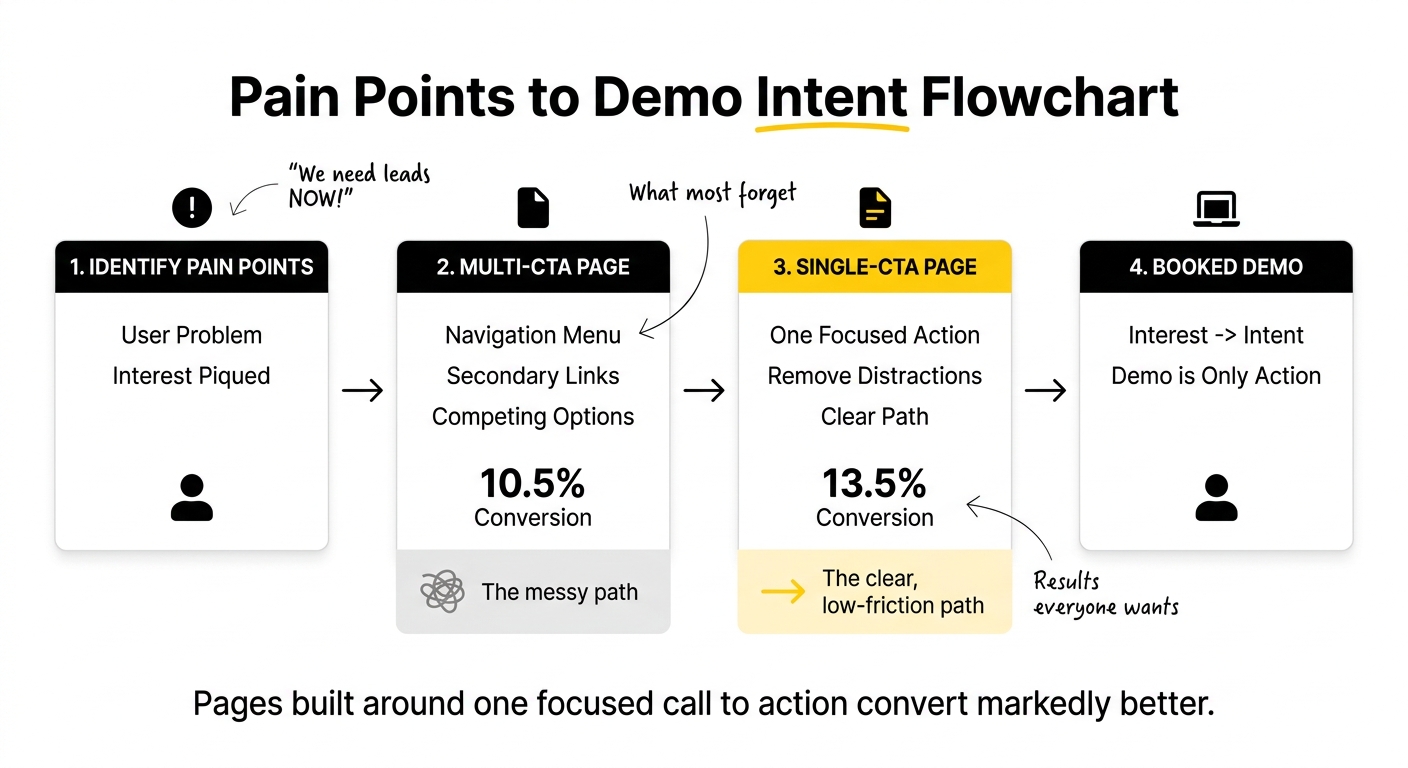
End every section with the same, single next step. Pages built around one focused call to action convert markedly better than pages offering several competing options: single-CTA pages have been measured at roughly 13.5% versus 10.5% for multi-CTA pages. Remove the navigation menu, cut secondary links, and make the demo the only meaningful action on the page. A clear, low-friction path is what turns interest into a booked demo. The copy on that demo destination is its own discipline, which we cover in Demo Page Copy for Sales-Ready SaaS Conversations.
Writing copy that increases demo requests
Beyond the spine, a few craft decisions do most of the heavy lifting for lead generation.
The headline carries the page. It should pass the five-second clarity test: a visitor understands what you do, who it is for, and what to do next within five seconds. Specific, number-led headlines consistently outperform vague ones, so “Cut CAC 30% in 90 days” beats “Grow smarter.”
Subheads should each advance the argument, not decorate it. A reader who skims only your headline and subheads should still get the full pain-urgency-proof-next-step story. Microcopy around the form matters too: reassuring text near the button (“15-minute demo, no prep required”) lifts completion, and shorter forms convert better than long ones. Every field beyond the essentials costs you conversions, so ask only for what sales genuinely needs to qualify.
Finally, the page should feel like part of the campaign, not a separate destination. A tight ad-to-page experience improves both conversion and your ad quality score, which lowers what you pay per click. Good copy is a PPC efficiency lever, not just a creative one.
A/B testing your landing page copy
Copy is a hypothesis until the data confirms it. A/B testing is how you turn opinion into evidence, and it is core to any serious PPC strategy.
Test in priority order. Start with the highest-leverage elements: the headline, the call-to-action copy (“Get a demo” versus “See it in action”), and the placement of proof. These move conversion far more than button colours or hero images. Change one meaningful thing at a time so you can attribute the result.

Give each test enough time and volume to reach significance. A useful rule for B2B traffic is to run experiments for four to six weeks rather than calling a winner on a good afternoon. And test against the metric that matters, demo requests that become qualified pipeline, not surface engagement. A variant that lifts clicks but lowers demo quality is a losing test dressed as a win. Which tests to run first when budget is tight is a prioritisation question in itself, one we address in Prioritising SaaS PPC Landing Page Tests by CAC Impact.
Measuring what matters
Data-driven messaging means judging copy by the right numbers. The KPIs worth tracking for a demo-focused page:
- Visitor-to-demo conversion rate, benchmarked against your vertical, not a blended average. Cybersecurity converting at 2% may be outperforming while HR tech at 2% is underperforming.
- Demo-to-SQL rate, so you optimise for qualified demos rather than raw volume.
- Bounce rate and time on page, early signals of whether the copy matches visitor intent.
- Ad quality score, a proxy for how well page and campaign align.
- Cost per qualified demo, the number that connects copy to CAC.
Context is everything here. A number without a segment, traffic source, or funnel stage attached cannot tell you whether the copy is working. Strong user engagement on a page that produces no qualified demos is a warning, not a win.
Common pitfalls to avoid
A handful of mistakes account for most underperforming pages:
- Leading with features instead of ICP pain. The reader has to work out why they should care, and most will not bother.
- Ad-to-page message mismatch. The promise that earned the click is missing from the page.
- Multiple competing CTAs. Demo, trial, newsletter, and download on one page splits intent and lowers conversion.
- Vague proof. “Trusted by leaders” persuades no one. Specific outcomes do.
- Over-long forms. Every non-essential field is a reason to leave.
- Optimising for volume over quality. More cheap demos that never reach sales is not progress.
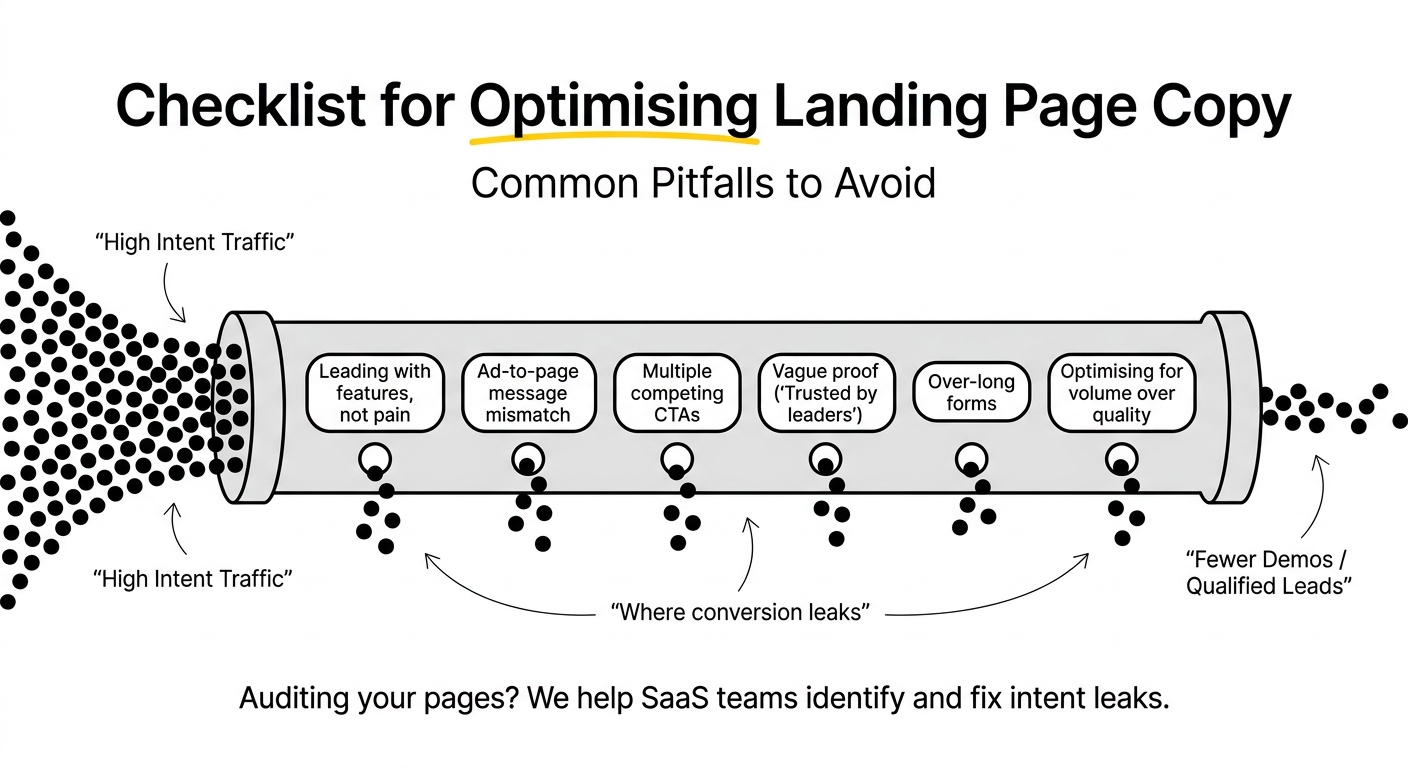
If you are auditing your own pages against this list and want a second set of eyes on where demo intent is leaking, that is the kind of thing we work through with SaaS teams regularly.
Frequently Asked Questions
How can SaaS landing page copy effectively address customer pain points?
Lead with the buyer's problem, not your product. Open by naming a specific ICP pain in the buyer's own words, drawn from sales calls, support tickets, and review sites rather than internal positioning. Match that pain to the ad and keyword that brought the visitor there. Copy that shows you understand the frustration better than the reader can articulate it earns the attention needed to drive demo intent.
What are common mistakes to avoid when writing SaaS landing page copy?
The frequent ones are leading with features instead of pain, mismatching the ad promise and the page content, offering several competing calls to action, using vague proof like “trusted by leaders,” and asking for too many form fields. Each pushes qualified visitors away. Optimising for demo volume rather than qualified demos is a subtler mistake that inflates numbers while starving sales of usable pipeline.
What strategies can B2B marketers use to create urgency in their landing page copy?
Skip countdown timers and fake scarcity, which erode trust on a B2B page. Build urgency from the cost of inaction instead: show what the pain is quietly costing in wasted spend, slow pipeline, or lost hours, and what compounds if nothing changes this quarter. Tying urgency to the buyer's own metrics motivates action without the cheap tactics that damage credibility with a considered audience.
How can A/B testing improve the effectiveness of SaaS landing pages?
A/B testing turns copy opinions into evidence. Test the highest-leverage elements first, the headline, call-to-action copy, and proof placement, changing one meaningful thing at a time. Run each experiment for roughly four to six weeks so it reaches significance, and judge variants by demo requests that become qualified pipeline rather than clicks. A test that lifts engagement but lowers demo quality is a loss disguised as a win.
What role does credible proof play in enhancing demo intent on landing pages?
Proof answers the question that follows every claim: can I trust you to fix this? Specific evidence, named logos, a real outcome with a number, a testimonial from someone in the reader's role, reduces hesitation at the point of decision. Placing proof near the call to action matters, and specificity is everything. “Cut reporting time 60% for a 200-seat team” persuades where “trusted by industry leaders” does not.
How can data-driven messaging optimise SaaS landing pages for PPC campaigns?
Data-driven messaging means letting evidence, not preference, decide what the page says. Use sales-call language and review-site phrasing to name pain, then validate copy through testing against qualified demos. Tightening the match between ad and page also lifts ad quality score, which lowers cost per click. Treated this way, copy becomes a PPC efficiency lever that improves both conversion and the economics of the campaign feeding it.
What are the best practices for writing compelling calls to action on SaaS landing pages?
Use one focused call to action and repeat it, rather than offering competing options. Single-CTA pages convert notably better than multi-CTA ones. Make the demo the only meaningful action, remove the navigation menu and secondary links, and add reassuring microcopy near the button, such as the demo length and that no preparation is needed. Clear, specific, low-friction CTAs turn interest into booked demos.
How can B2B marketers measure the success of their landing page copy?
Track visitor-to-demo conversion against your vertical benchmark, demo-to-SQL rate to protect quality, bounce rate and time on page as intent signals, ad quality score for campaign alignment, and cost per qualified demo to connect copy to CAC. Always attach context, segment, traffic source, and funnel stage, since a blended number hides which channel or page actually has a problem.
What elements should be included in SaaS landing pages to drive demo intent?
A demo-focused page needs a clear, specific headline that passes the five-second test, an opening that names the ICP pain, honest urgency built on the cost of inaction, credible proof near the call to action, a single low-friction CTA, and a short form. Removing the navigation menu and secondary links keeps the visitor focused. Together these form the pain-urgency-proof-next-step spine that converts.
How can understanding the ideal customer profile improve landing page copy?
The sharper your grasp of the ICP, the more precisely you can name the pain that matters to them, in language they recognise. That precision makes copy read as if it were written for one person rather than a broad market, which is what earns trust and demo requests. A clear ICP also explains why different campaign intents need different pages, since each segment arrives with a different problem.