Structuring SaaS PPC Accounts for PLG vs Sales-Led Funnels
A practical blueprint for structuring SaaS PPC accounts for PLG vs sales-led funnels -- campaign splits, conversions, bidding and reporting to match your GTM.

You set up a Google Ads account, build campaigns, drive traffic, and watch conversions roll in. The problem is which conversions. A trial signup from a self-serve user who churns in 30 days looks identical in Google Ads to a demo request from a Series B CFO evaluating a three-year contract. If your account treats them the same, your bidding algorithm will too.
This is the core tension in SaaS PPC account structure. Product-led growth (PLG) and sales-led motions have fundamentally different definitions of a valuable conversion, different keyword intents, different landing pages, and different relationships between a click and closed revenue. When both motions share the same campaign structure and the same conversion actions, neither gets optimised properly.
This article is a practical blueprint for structuring your Google Ads account around your go-to-market motion, whether that's PLG, sales-led, or a hybrid of both.
Why GTM Motion Changes Everything in SaaS PPC Account Structure
Most Google Ads account structuring advice treats structure as a technical question: how many campaigns, what match types, broad vs phrase. In SaaS PPC, structure is a strategic question first. The right architecture depends on how your users buy, not on what makes your account tidy.
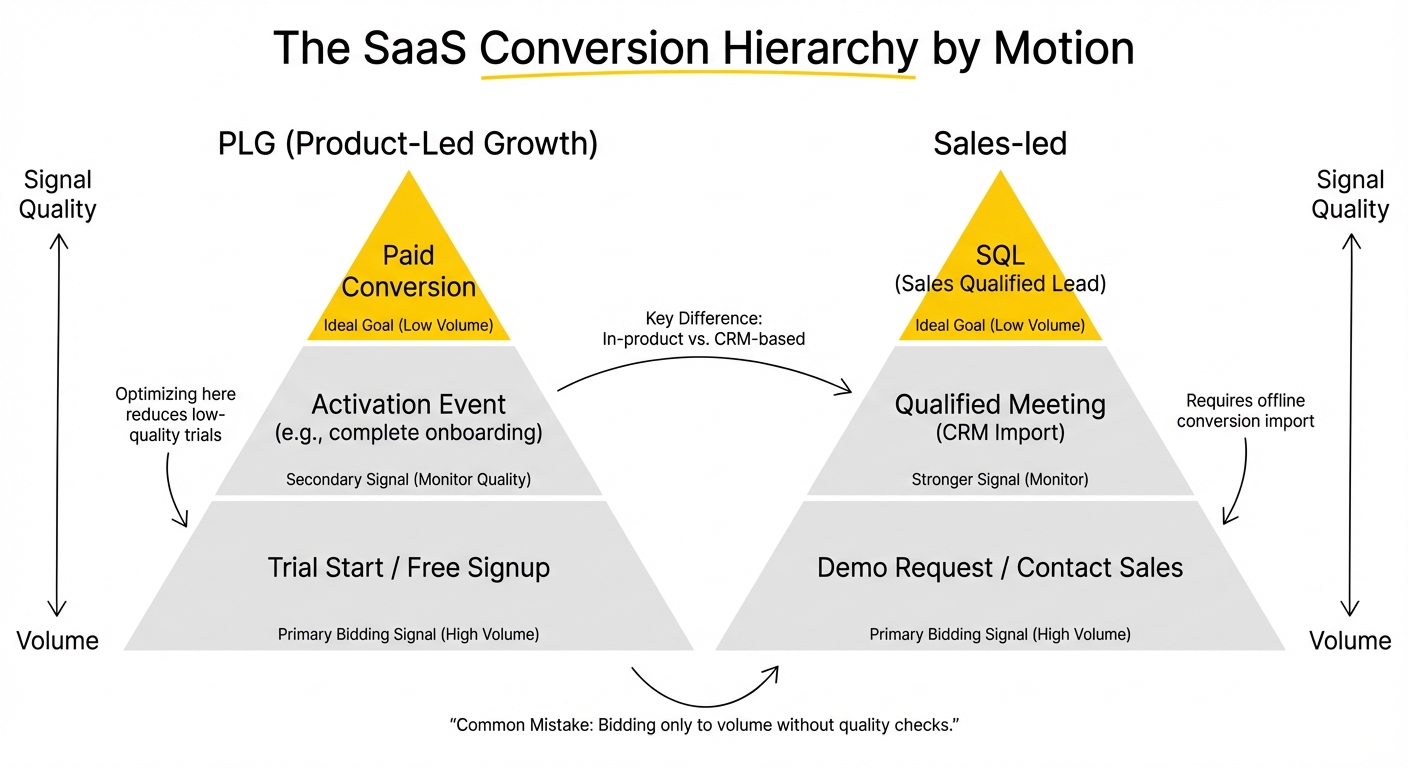
A PLG motion asks users to experience value before they commit. The conversion chain is roughly: click, trial signup or freemium activation, in-product engagement, paid upgrade. Google Ads needs to optimise toward early signals in that chain because downstream revenue events are too infrequent and too delayed to bid to directly. The job of the PPC account is to generate quality signups at volume.
A sales-led motion puts a human being between the click and the contract. The conversion chain is: click, demo request or contact form, sales-qualified meeting, opportunity, close. Google Ads is feeding a sales pipeline, not a self-serve funnel. Volume matters less than quality. Bidding to a raw lead count in a sales-led account is a reliable path to burning budget on prospects your sales team will never close.
Most B2B SaaS companies in 2026 run some version of both, which adds a third scenario: hybrid accounts where PLG self-serve signals and sales-led pipeline signals compete for bidding authority in the same campaigns. That competition is the most common account structure mistake we see.
PLG PPC Strategy: Account Structure Blueprint
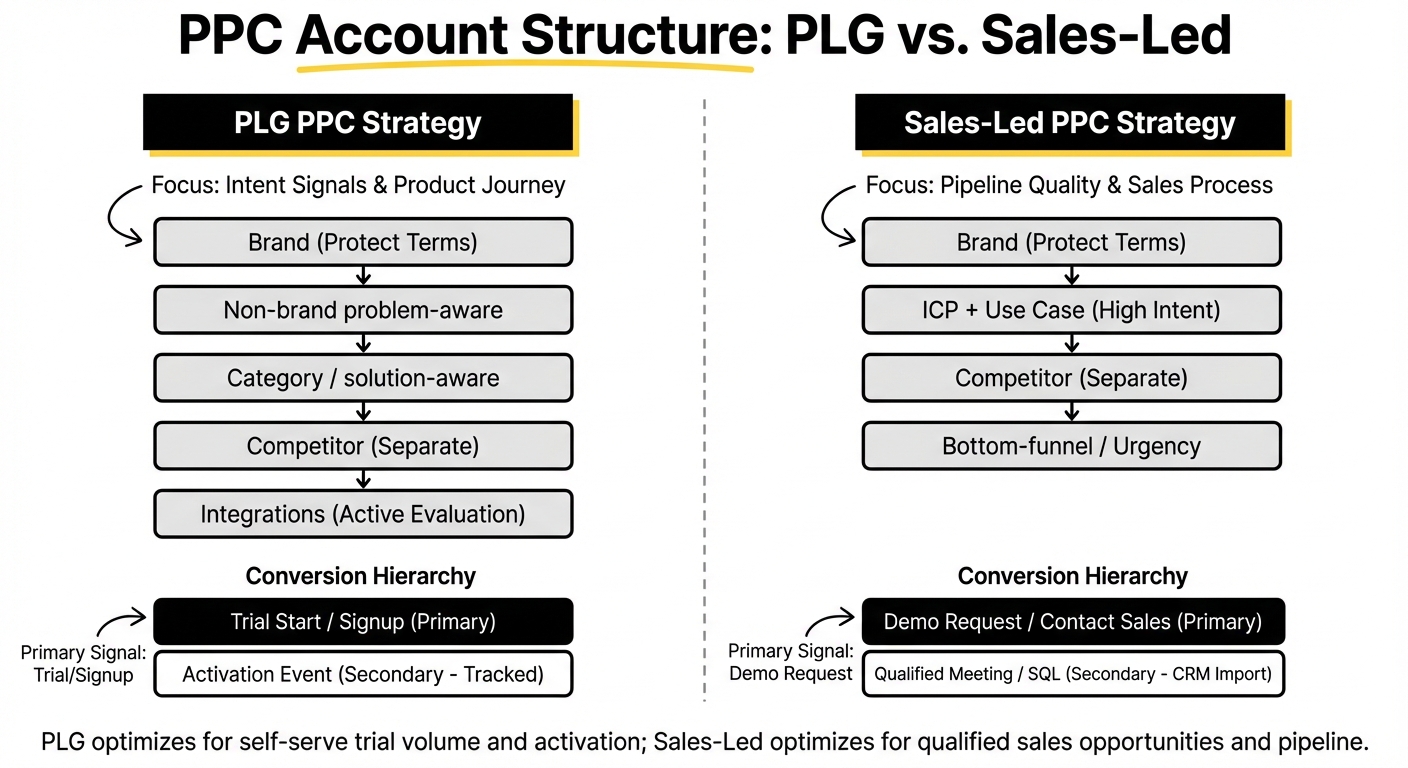
A PLG-optimised account centres on campaign families that align with where a user is in their buying journey. The intent signals they search for are different from sales-led buyers, and the keywords, ads, and landing pages need to reflect that.
Campaign families for PLG
Structure your campaigns by intent type, not by product feature. A practical PLG campaign architecture looks like this:
Conversion hierarchy for PLG
This is where PLG accounts diverge most sharply from generic SaaS PPC advice. The ideal conversion signal is the one closest to revenue that still generates enough volume for smart bidding to function. In practice:
Set your primary bidding conversion as trial start or signup. Add activation as a secondary conversion (tracked but not bid to) so you can monitor signup quality. If and when you have enough paid conversion volume, consider testing optimisation at that level using Google Ads campaign experiments before committing.
Bidding for PLG
PLG accounts typically work well with Maximise Conversions or Target CPA bidding once you have a consistent volume of your primary conversion. Google's current recommendation is at least 30 conversions per month in a campaign before moving to smart bidding. For PLG accounts, this threshold is usually achievable at the trial/signup level even for early-stage companies. The risk is that optimising purely to signup volume without monitoring activation rates can increase trial volume while reducing trial quality. Counter this by reviewing your signup-to-activation rate monthly and adjusting your landing page experience or ad messaging if activation drops relative to signup volume.
Landing experience for PLG
PLG landing pages should make time-to-value visible. Self-serve trial pages, pricing pages with a clear free tier, and pages that answer "what can I do in the first 5 minutes?" all perform better in PLG accounts than generic overview pages. If your non-brand campaigns land on a homepage with a "request a demo" CTA, you're asking PLG intent traffic to convert through a sales-led journey, and conversion rates will reflect that mismatch.
Sales-Led PPC Strategy: Account Structure Blueprint
Sales-led accounts are optimised for pipeline quality, not volume. The structure needs to isolate high-intent, ICP-aligned traffic and feed it efficiently into a sales process.
Campaign families for sales-led
Conversion hierarchy for sales-led
The common mistake in sales-led accounts is bidding to demo request volume alone. A demo request is just a form fill. Google's algorithm will optimise for the traffic most likely to fill in the form, which is not always the traffic most likely to become a qualified opportunity.
A more robust conversion hierarchy for sales-led accounts:
Lead quality controls also belong here. Required fields that filter for ICP signals (company size, industry, job role) are worth testing on high-intent landing pages. The trade-off is always volume against quality. At low spend levels, add friction cautiously. At higher spend, the cost of disqualified demo requests often justifies it.
Landing experience for sales-led
Sales-led landing pages are doing a different job than PLG pages. They need to build credibility quickly and lower the perceived risk of committing to a conversation. Relevant case studies, proof of ROI, security and compliance credentials, and a clear articulation of what the demo actually involves all reduce the friction between click and form fill. A generic "request a demo" page with a hero image and a contact form is leaving conversion rate on the table.
Hybrid GTM PPC Account Structure: Separating Trial, Demo, and Pipeline
Hybrid accounts are the most common and the most frequently broken. When PLG self-serve signups and sales-led demo requests live in the same campaigns with the same conversion priority, you get bidding algorithms optimised to a blended signal that doesn't accurately represent either motion's revenue reality.
When to separate campaigns by motion
If your hybrid account has both trial signups and demo requests, separate them at the campaign level at minimum. This means:
Preventing PLG from polluting sales-led optimisation
If PLG trial signups and sales-led demo requests both appear in your "all conversions" column, your sales-led campaigns will gradually optimise toward trial signup traffic. Trial signups are higher volume and cheaper to generate, so Google's algorithm will chase them. Your demo request volume will drop, your pipeline will thin, and it will look like a keyword or bid problem when it's actually a conversion architecture problem.
The guardrails for a hybrid account:
When NOT to Split: The Minimum Viable Structure Rule
There are scenarios where splitting campaigns by motion creates more problems than it solves. If any of the following apply, start with a minimum viable structure first and evolve from there:
A Practical Restructure Plan
Restructuring an existing account is lower risk than most teams expect, provided you do it incrementally and maintain reporting continuity.
Naming conventions
Establish a naming convention before you start. A clear convention makes reporting, filtering, and budget allocation straightforward. A simple format that works:
[Motion] | [Campaign Family] | [Targeting Type]
For example: PLG | Non-Brand | Problem-Aware or SLG | Competitor | Exact Match. Consistent naming means you can filter your reporting by motion at a glance without needing custom labels or complex segmentation.
Migration checklist
Reporting before and after
The most common restructure failure mode is interpreting normal post-restructure volatility as evidence the new structure is worse. Smart bidding needs a learning period of 5 to 7 days minimum after any significant structural change. CPL or CPA will often look worse in the first two weeks before it stabilises. Set a review window of at least 30 days and compare like-for-like periods (same days of the week, adjusted for seasonal variance) before drawing conclusions.
Frequently Asked Questions
How should you structure a SaaS PPC account differently for PLG vs sales-led?
PLG accounts should centre on high-volume conversion events (trial signup, activation) and campaign families aligned to problem-aware and solution-aware intent. Sales-led accounts should prioritise ICP-aligned keyword targeting, bottom-funnel intent, and conversion hierarchies that feed into offline CRM data wherever possible. The core structural difference is what you optimise for: volume in PLG, pipeline quality in sales-led.
Should PLG and sales-led motions live in the same Google Ads account or be separated?
They can coexist in the same account, but they must be separated at the campaign and conversion action level. Running both motions through the same campaigns with shared conversion actions means your bidding algorithm cannot distinguish between them, and it will optimise toward whichever signal is cheapest and most frequent, typically the PLG motion, at the expense of sales-led pipeline quality.
What conversions should PLG teams optimise for: trial starts, activations, or paid upgrades?
Start with trial starts as your primary bidding conversion. Add activation as a secondary tracked conversion to monitor quality. Optimise to activation if your volume supports it (typically 30 or more per month per campaign). Paid upgrade is rarely viable as a direct bidding signal in most PLG accounts due to volume constraints, but it is worth tracking and reviewing for downstream attribution.
What conversions should sales-led teams optimise for: demo requests, qualified meetings, or SQLs?
Bid to demo requests as your primary conversion, but import qualified meetings from your CRM as a secondary conversion wherever technically feasible. This gives Google's algorithm a quality signal rather than just a volume signal. SQLs are the ideal downstream goal, but most accounts lack the import infrastructure or the volume to bid to them directly.
How do you prevent PLG signups from polluting sales-led optimisation in a hybrid motion?
Use separate conversion actions for each motion and assign them as primary only in the campaigns they are relevant to. Never combine trial signups and demo requests into a single "all conversions" pool for bidding purposes. Separate budgets and separate bid strategies for each motion are the most reliable guardrails against signal contamination.
When is it too early to split campaigns by motion?
If your total conversion volume is under 30 per month, if your conversion tracking is unreliable, or if your ICP definition is still being validated, a minimum viable single-motion structure is more appropriate than a sophisticated split. Structure follows signal quality. Building complex architecture on incomplete data produces complexity without insight.
What is the best way to restructure an existing account without losing learnings?
Run new campaigns in parallel with existing ones for at least four weeks before pausing anything. Export historical data as a baseline before making changes. Document the restructure date in your account for reporting context. Expect a learning period volatility window of 5 to 14 days after structural changes and assess performance over a full 30-day cycle before drawing conclusions.
Getting the Structure Right End-to-End
Account structure is foundational, but it only delivers when conversion tracking, bidding logic, and landing page experience all align with the same GTM motion. A well-structured PLG account feeding a poorly instrumented conversion hierarchy will still produce unreliable results. A well-structured sales-led account landing on a trial-focused page will leak pipeline.
If you want to understand what a properly built SaaS PPC account looks like at the management and optimisation layer, not just the structural level, the ppc for saas overview covers the full scope.
If you're working through a restructure and want a second opinion on your conversion setup or campaign architecture, we're happy to take a look. This is the kind of thing we dig into with SaaS teams regularly.