When and How to Scale SaaS PPC Spend Without Blowing Up CAC
Learn when and how to scale SaaS PPC spend without blowing up CAC, using clear guardrails, budget thresholds, and revenue-focused decision rules.

Most SaaS marketing teams don’t fail at scaling because they lack ambition. They fail because they mistake a good quarter for a green light.
You have two months of solid CPL. Pipeline looks healthy. Someone in the leadership meeting says the obvious thing: “We should be spending more.” And so you do. Six weeks later, CAC is up, SQL rate is down, and finance is asking questions you don’t have clean answers to.
Scaling SaaS PPC spend is not a media-buying decision. It is an operating decision. And making it without checking the right signals first is one of the most common and expensive mistakes growth-stage SaaS teams make.
This article covers exactly when paid search is genuinely ready for more budget, what guardrails to put in place before you increase it, and how to scale in a way that keeps your acquisition economics intact.
Why More Budget Doesn’t Automatically Mean More Efficient Growth
There’s an assumption embedded in most SaaS budget discussions: if the channel is working, more spend will produce more of what’s working. This is often wrong.
B2B SaaS buying journeys are long. The average B2B customer journey now takes over 200 days and requires dozens of touchpoints before purchase. That lag means the impact of a spend increase takes months to show up as closed revenue. What you see immediately is higher spend and more leads. What you don’t see yet is whether those leads are closing at the same rate.
In that window between increased spend and lagging revenue, CAC looks broken because it is. You’ve spent more. The denominator hasn’t caught up. Teams that confuse this timing effect with genuine channel efficiency problems often cut the budget too early, then scale again prematurely, creating a pattern of yo-yo decisions driven by the wrong signals.
The other problem: Google’s Smart Bidding doesn’t care about your SQL rate. It optimises toward the conversion you’ve told it to target. If that conversion is a demo booking, the algorithm will find more demo bookings. Whether those demos are converting to pipeline is a question it cannot answer. Scaling spend before you’ve closed the loop between your PPC conversions and your CRM data amplifies whatever inefficiency already exists.
What “Ready to Scale” Actually Means in SaaS PPC
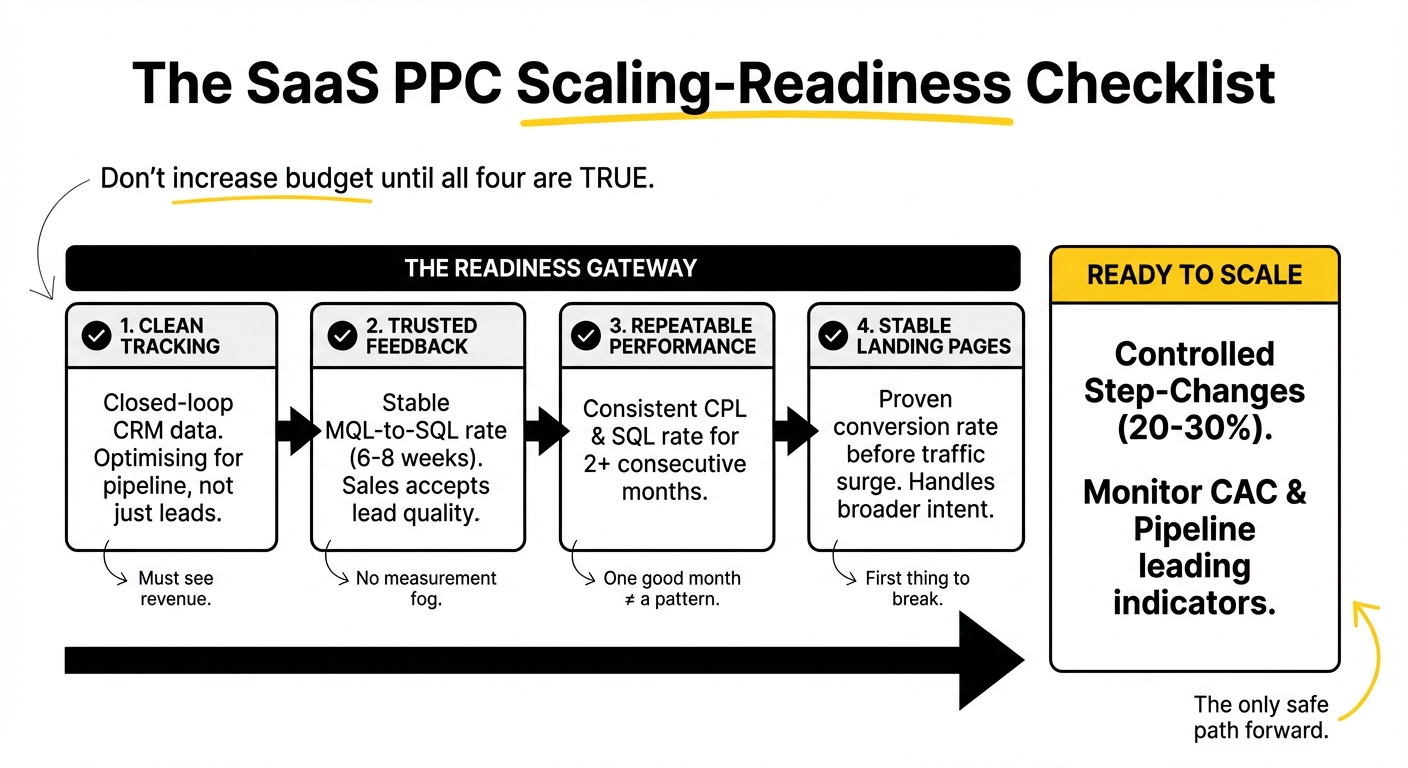
Before increasing total paid search budget, four things need to be true.
Conversion tracking is clean and closed-loop. You need offline conversion imports or CRM-synced conversion data telling Google Ads which clicks became opportunities or closed won. Not just demo completions, but qualified pipeline. If your bidding strategy is optimising toward top-of-funnel form fills with no downstream signal, scaling is premature.
CRM feedback is trustworthy. You know what percentage of PPC leads are being accepted by sales, what the MQL-to-SQL rate looks like for the channel, and whether that rate has been stable for at least six to eight weeks. If lead quality data is inconsistent or your CRM isn’t tagging source correctly, you’re scaling into a measurement fog.
Performance has been repeatable across at least two months. One strong month is not a pattern. Two consecutive months of consistent CPL, SQL rate, and pipeline contribution at similar spend levels is the minimum signal needed. Seasonal variation, a single competitor pausing their campaigns, or a temporarily effective ad creative can all produce a strong month that doesn’t repeat.
Landing page conversion rate is stable. Landing page performance is the first thing to degrade under increased spend. Higher impression share means broader queries, weaker intent signals, and more traffic that wasn’t searching for exactly what you offer. If your landing page is converting at 3% and you scale spend by 50%, don’t assume it stays at 3%.
The Difference Between Earning More Budget and Needing More Budget
This is the distinction that separates well-run PPC programmes from reactive ones.
Scaling because targets increased is a pressure response. Scaling because the channel has demonstrated consistent returns and is impression-share constrained is a channel argument. Only the second one justifies more spend.
The channel argument requires evidence: your target keywords have significant uncaptured impression share (above 20-30% absolute IS lost to budget), search demand is growing in your ICP segments, and performance at current spend levels has been consistent. When all three are true, scaling is a controlled decision to capture more of what’s already working.
When none of those are true, and you’re scaling because the board wants more pipeline, you’re amplifying the cost of every existing weakness in your funnel.
CAC Guardrails: When Expansion Is Acceptable and When It’s a Warning Sign
B2B SaaS paid search CAC has risen significantly in recent years. According to Benchmarkit’s 2025 SaaS Performance Metrics report, the median new customer acquisition cost ratio increased 14% in 2024 to $2.00 for every $1 of new ARR added. The fourth quartile of companies is spending $2.82. These numbers reflect a real structural shift: competition for high-intent keywords is intensifying, and the easy paid search gains are mostly gone.
Against that backdrop, some CAC expansion when scaling is normal and acceptable. What matters is how much, and what’s driving it.
Acceptable CAC expansion when scaling:
- CAC rises by 10-20% as you move into slightly lower-intent keyword territory or geographic expansion, but pipeline volume and close rate remain stable.
- Payback period extends by one to two months but stays within your LTV:CAC ceiling. For most B2B SaaS with ACVs above £20k, a healthy LTV:CAC ratio is 3:1 or above. Under 3:1 for an extended period is a warning sign, not a phase.
- SQL rate holds within 5-10% of your baseline across a four-week window.
Warning signs that CAC expansion is structural:
- CPL holds steady but MQL-to-SQL rate drops. This is the most common pattern when scaling produces weaker intent. More leads at similar cost, fewer of them suitable for sales, CAC rising upstream.
- Pipeline value per closed lead declines. More activity, smaller deals. This suggests the incremental demand you’ve captured through scaling is lower ACV than your proven segment.
- Sales begin raising quality objections. If your SDR team starts pushing back on lead quality or reducing follow-up effort on PPC leads, it’s a downstream signal of upstream drift.
The hardest version of this problem is when CAC rises because of scaling, and sales efficiency drops at the same time. The two compound each other. The answer is not to keep scaling and hope the pipeline catches up.

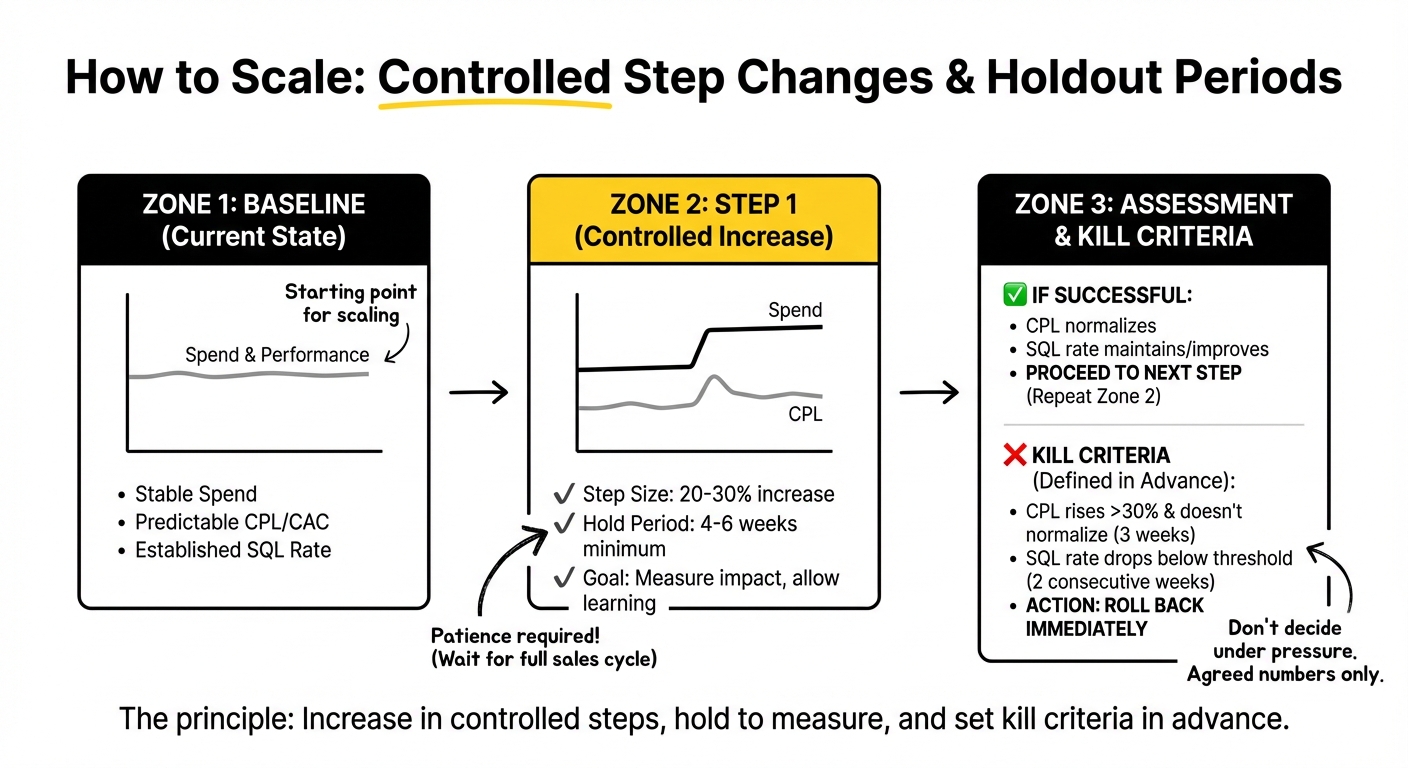
How to Scale: Controlled Step Changes and Holdout Periods
Scaling PPC spend well is an exercise in patience that most leadership teams find uncomfortable.
The principle is simple: increase spend in controlled steps, hold for long enough to measure impact before the next step, and set kill criteria in advance so decisions aren’t made reactively when things don’t go according to plan.
A workable step-change cadence for most B2B SaaS accounts:
- Step size: 20-30% increases per step. Larger jumps (50%+) push Smart Bidding into a new learning phase and make it harder to isolate what changed.
- Hold period: Four to six weeks minimum before judging whether the step worked. For accounts with longer sales cycles (30+ days to demo, 60+ days to SQL), you need a full cycle to see the downstream effects.
- Kill criteria: Define in advance what a failed step looks like. If CPL rises more than 30% and doesn’t normalise within three weeks, or if SQL rate drops below your threshold for two consecutive weeks, you roll back. These should be numbers agreed before the budget goes up, not interpretations made under pressure after it has.
Watching Leading Indicators Before Revenue Catches Up
Revenue lags paid search activity by weeks or months in B2B SaaS. If you wait for closed-won revenue to validate a scaling decision, you’ll always be reacting to data that’s three months old.
The leading indicators that give you earlier signal:
- Demo quality score. If you or your sales team grades demos on ICP fit and intent level, track this weekly after a spend increase. Degrading quality shows up here before it hits pipeline.
- SQL rate trend. MQL to SQL conversion should remain within a defined band. A 20% drop over three weeks is a signal. A one-week dip probably isn’t.
- Pipeline creation rate. New opportunities opened per week, tagged to paid search. Volume going up while quality is steady is a green signal. Volume going up while average deal size or close probability drops is a flag.
- Sales cycle stage progression. Early-stage deals moving through stages at normal velocity tells you that incremental pipeline isn’t stalling. Deals created post-scale that are sitting at stage one longer than usual is a warning sign worth investigating.
None of these replace CAC as the primary metric. But they tell you three to six weeks earlier whether scaling is working.
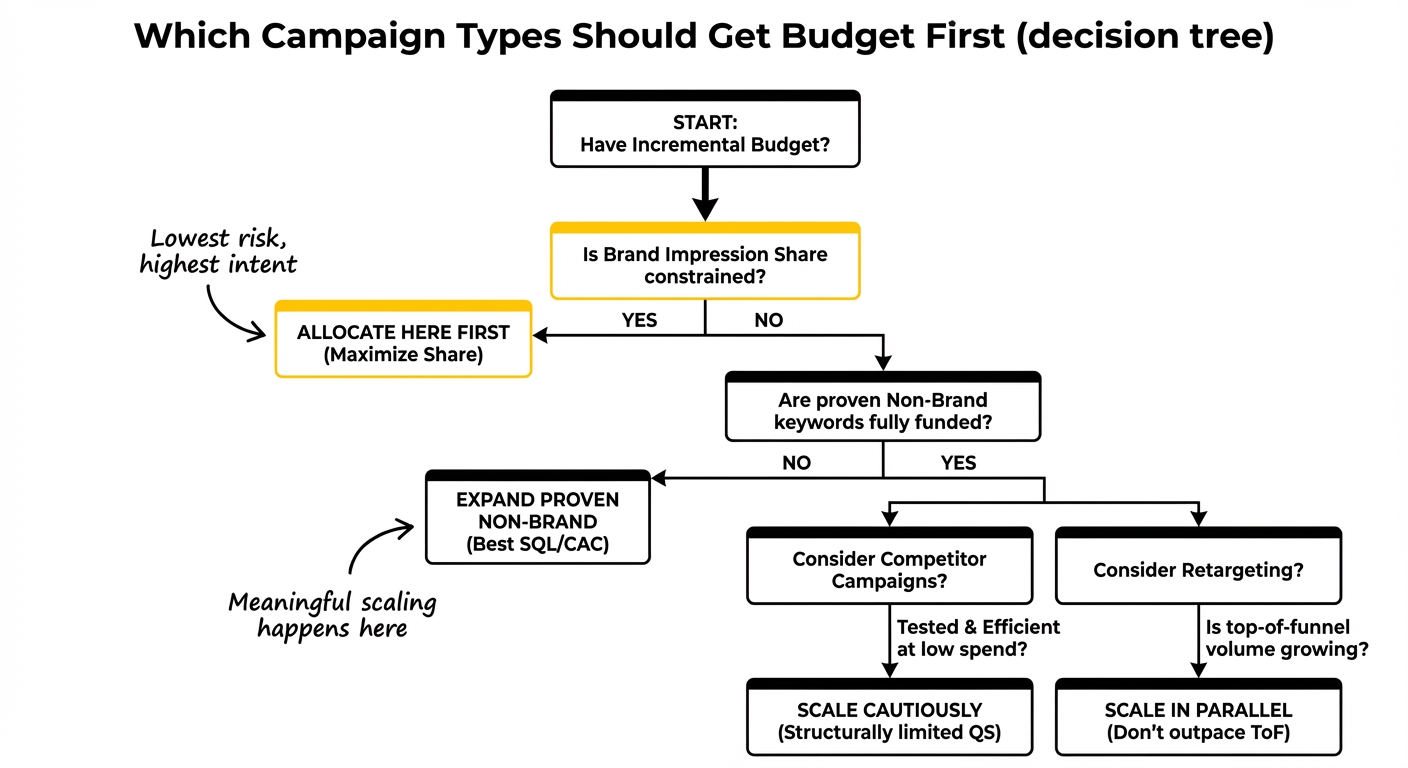
Which Campaign Types Should Get Budget First
Not all campaign types scale the same way. The order in which you allocate incremental budget matters.
Brand campaigns should almost never be impression-share constrained. If they are, this is the first place to add budget. The intent is highest, the CPL and CAC are lowest, and you’re capturing demand that already exists for your product. There is no reason to be losing brand impression share due to budget.
Non-brand demand capture is typically where the meaningful scaling happens. Expand in order of proven performance: keywords and ad groups with the best SQL rate and CAC history get more budget before you open new keyword territory. Going deeper into what already works is lower risk than widening into adjacent queries.
Competitor campaigns can be efficient if you’ve already tested them at lower spend levels. But they tend to have less predictable CPL scaling characteristics because your quality score for competitor-branded terms is structurally limited. Scale these once demand capture is consolidated, not before.
Retargeting often makes sense to scale in parallel with non-brand, because higher top-of-funnel volume creates a larger qualified audience to retarget. But retargeting alone doesn’t create new demand, it recaptures existing intent. Don’t let retargeting budget expand faster than the top-of-funnel that feeds it.
For guidance on how to think about budget allocation across search, social and display once you’ve made the scaling decision, see our dedicated article on channel allocation.
Deeper vs Wider: Where to Put Incremental Budget
Once you’ve confirmed the account is ready to scale, the choice is usually between going deeper into proven segments or wider into new ones. Building a Scale-Ready SaaS PPC Engine After PMF: From Ad-Hoc to Operating System, also on this blog, takes this further.
Deeper means more budget behind keywords, audiences, and geographies where you already have performance data. This is lower risk, faster to validate, and usually more efficient in the near term.
Wider means entering new keyword clusters, new ICP segments, or new markets. This requires a proper testing budget, a separate measurement period, and clearly separate campaign structures so you don’t blend new and proven performance data.
The mistake most teams make is treating these as the same decision. They increase total budget, move it across all campaigns proportionally, and end up with a blurred picture where they can’t tell what’s working and what isn’t.
The cleaner approach: scale proven segments first. Allocate a defined portion of incremental budget (15-25%) to new territory with explicit test parameters. Report on them separately. Only graduate new-territory campaigns to mainstream budget once they’ve hit your SQL and CAC thresholds.
The Finance Discipline: CAC Targets and Payback Expectations
Scaling decisions need a financial frame before they become spending decisions.
Know your target CAC before you scale. This should be based on LTV:CAC ratio targets and payback period expectations, not on what last month’s CAC happened to be. If your ACV is £30k and your average contract length is three years, your maximum tolerable CAC at a 3:1 LTV:CAC ratio is substantially higher than if your ACV is £8k and churn is high. The number is specific to your business.
Know your acceptable variance. A 15% CAC increase during a scaling phase may be within tolerance if you’ve modelled the payback trajectory. A 40% increase is a different conversation. Agreeing these thresholds with your CFO or finance team before you scale removes the need for difficult retrospective conversations when the numbers come in.
Payback period benchmarks for 2026: most B2B SaaS companies are targeting CAC payback under 12 months for capital efficiency. Enterprise-focused businesses with high ACV are often comfortable with 18 to 24 months given the contract economics. If your payback period is already above your target before you scale, that is the problem to fix first.
Addressing the Objection: “We Should Scale Before Competitors Do”
This argument tends to come from urgency rather than evidence, and it usually lands hardest when things are going well and everyone wants to press the advantage.
The counterargument is straightforward. If your tracking isn’t closed-loop, your landing pages haven’t been tested at higher volume, and your sales team is already filtering lead quality questions, premature scaling doesn’t beat competitors. It magnifies the cost of every existing gap. You’ll spend more to get leads your sales team can’t convert, while a more disciplined competitor scales at the right time and captures the same demand more efficiently.
Urgency is sometimes real, especially in a category with consolidating demand or a competitor running an aggressive spend push. But the response to competitive pressure is not to scale faster than your funnel can handle. It is to fix what needs fixing, then scale confidently with guardrails in place.
Frequently Asked Questions
When is a SaaS PPC account actually ready for budget scaling?
When conversion tracking includes offline or CRM-synced pipeline data, when SQL rate has been stable for at least six to eight weeks, when landing page performance is consistent, and when there is evidence of impression share lost to budget rather than rank. Meeting all four conditions is the threshold. Meeting two or three is usually a reason to fix the gaps, not a green light to scale.
How much can you increase SaaS PPC spend at one time without distorting performance?
20 to 30% per step is a reasonable ceiling. Increases above 30-40% push Smart Bidding into a new learning phase, and make it harder to isolate whether performance changes are caused by the budget increase, the algorithm’s re-optimisation, or seasonal effects. Each step should be held for four to six weeks before the next one.
What should you check before scaling non-brand search in B2B SaaS?
SQL rate and close rate for existing non-brand campaigns, landing page conversion rate under current traffic conditions, search term match quality to confirm you’re not already over-expanded, and CRM source tagging to confirm that pipeline from non-brand can be tracked accurately. If any of these are unclear, scaling will make the measurement problem worse.
How do you tell the difference between normal CAC expansion and broken PPC efficiency?
Normal CAC expansion during scaling is usually temporary, proportional to the step size, and accompanied by stable or improving SQL rates. Broken efficiency shows up as SQL rate declining, sales team raising quality objections, average deal size from PPC leads dropping, or pipeline velocity slowing for PPC-sourced deals. The pattern matters more than the absolute number.
Should SaaS teams scale budget based on CPL, CAC, or pipeline contribution?
Pipeline contribution is the most reliable primary metric for scaling decisions in B2B SaaS. CPL is a leading indicator but doesn’t capture sales quality. CAC is the most honest economic measure but lags by weeks or months. Pipeline contribution, tracked weekly and benchmarked against your close rate, gives you the earliest reliable signal of whether scaling is working.
Which campaign types should get extra budget first when SaaS PPC is working?
Brand campaigns first if impression share is being lost to budget. Then proven non-brand demand capture segments, deepening into keyword sets and audiences with the best existing SQL and CAC data. Competitor campaigns and new keyword territory come later, once the core is consolidated, and should be budgeted separately with distinct test parameters.
How long should you hold budget steady before judging whether a spend increase worked?
Four to six weeks minimum for leading indicators (demo quality, SQL rate, pipeline creation). Six to ten weeks before drawing conclusions from CAC and revenue data, given B2B SaaS cycle lengths. If your average deal takes 60 days from first click to closed, a four-week hold period won’t tell you anything meaningful about downstream economics.
What are the warning signs that SaaS PPC spend is rising faster than revenue quality?
CPL holding while MQL-to-SQL rate falls. Average deal size from PPC leads declining. Sales team filtering or deprioritising PPC leads without flagging it formally. Pipeline creation volume rising while pipeline-to-close rate drops. Any one of these warrants a pause and investigation. Two or more happening simultaneously is a clear signal to hold spend and fix the funnel before continuing.
Scaling SaaS PPC is one of those decisions that looks easy from the outside and requires real discipline to do well. The teams that get it right treat it as an operating decision with financial guardrails, not a channel action taken in response to targets.
If you’re working through whether your account is genuinely ready to scale, or you want a second opinion on the signals before you increase spend, that’s a conversation we have regularly with SaaS marketing teams. We’re a SaaS performance marketing agency that works exclusively with B2B SaaS, and we’re happy to take a look.