12-Month Roadmap to a Scalable Demand Generation Engine for Series A SaaS
A 12-month roadmap for Series A SaaS marketing directors to move from opportunistic campaigns to a scalable, multi-channel demand generation engine.

You close your Series A. The pressure lands immediately. Investors want to see pipeline grow on a quarterly schedule. Leadership wants predictable results from marketing spend. And you’re running campaigns that work sometimes, on channels that made sense six months ago, with metrics that nobody upstairs fully trusts.
That’s not a resource problem. It’s a structural one. What got you to Series A was a mix of founder hustle, early product-market fit, and opportunistic demand generation: a conference here, a Google Ads campaign there, referrals from the founding team’s network. What gets you through Series A and into Series B is something different. It’s a repeatable demand generation engine, one that creates qualified pipeline consistently regardless of who’s running individual campaigns.
This roadmap covers how to build that engine across 12 months. It’s designed for Series A SaaS marketing directors in the UK and EU who are moving from ad hoc to structured, and who need results that hold up in board meetings, not just on a marketing dashboard.

What Demand Generation Actually Means at Series A
Before getting into the roadmap, it’s worth being precise about what demand generation is and what it isn’t. Demand generation is not the same as lead generation. Lead generation captures existing demand: people already searching for a solution like yours. Demand generation creates new demand: it gets the right buyers to become aware of the problem your product solves, and positions your company as the credible answer before they start comparing options.
Most Series A SaaS companies over-invest in lead capture and under-invest in demand creation. The Gartner CMO Spend Survey (2025) found that 74% of B2B marketing budgets go toward demand capture activities, leaving just 26% for demand creation. That’s nearly the inverse of what actually builds a durable pipeline. A company running on lead capture alone can only grow by spending more on paid acquisition. Cut the budget, and pipeline disappears.
The goal of this 12-month plan is to build both engines simultaneously: capturing intent in the short term through paid search and conversion-optimised landing pages, while systematically creating new demand through content, brand, and multi-channel nurture.
Q1 (Months 1-3): Foundations Before Scale
The single biggest mistake Series A teams make is scaling spend before the foundation is in place. Month one is for diagnosis, not acceleration.
Audit what you already have. Before adding channels or increasing budget, map what’s actually working. Pull your existing Google Ads and paid social data and ask three questions: which campaigns are producing sales-qualified pipeline (not just MQLs), what is your cost-per-opportunity by channel, and how long does it take from first paid touch to closed-won? If you can’t answer those questions with your current data, that’s the first problem to fix.
Get your tracking right. CRM and marketing analytics need to be connected before you spend another pound at scale. This means configuring HubSpot or Salesforce to capture first-touch and multi-touch attribution, importing offline conversion data into Google Ads, and setting up consistent UTM structures across every channel. Without this, every budget decision you make in months four through twelve is guesswork.
Establish a paid search baseline. Google Ads is the right place to start for most Series A B2B SaaS companies because it captures existing intent. People searching for solutions like yours right now. Build tightly themed campaign structures around your core use cases, set up exact match and phrase match campaigns for high-intent terms, and establish your cost-per-SQL target from the outset. If you don’t know your target CAC payback period yet, Bessemer Venture Partners’ 2025 SaaS benchmarks suggest under 12 months is the threshold investors typically use at this stage. Cost Per Acquisition (CPA) - The Most Critical PPC Metric, also on this blog, takes this further.
Define your ICP with precision. Not a broad persona document. A specific, operational targeting profile: company size ranges, industry verticals, tech stack signals, and the job titles involved in the buying decision. This ICP definition feeds every channel and campaign decision you make from Q2 onwards.
Q2 (Months 4-6): Expanding the Channel Mix
With foundations in place, Q2 is where multi-channel demand generation begins in earnest. The goal is not to be everywhere. It’s to show up consistently in the places your ICP actually spends time.
Add LinkedIn as a demand creation channel. Google Ads captures buyers who are already searching. LinkedIn reaches buyers who aren’t searching yet but who match your ICP. These are different jobs. LinkedIn’s 2024 B2B Marketing Benchmark Report recommends a 60/40 split between demand creation and demand capture investment for growth-stage B2B companies. At Series A, you’re probably closer to 80/20 in favour of capture. Q2 is when you start rebalancing.
For LinkedIn, focus on thought leadership and problem-aware content rather than product-forward ads. Reaching a head of operations at a 200-person fintech with an ad about “why spreadsheet-based processes break at scale” will outperform “Book a demo for [Product Name]” at this stage of the funnel.
Build a repeatable content programme. Content for demand generation is not blog posts for SEO. It’s material that educates your ICP on the problem your product solves: webinars, ungated guides, short-form video, case studies with real numbers. The rule is simple: if you’re gating it, ask whether the form is actually filtering for quality or just adding friction for existing intent. Most gated content at Series A collects email addresses from people who will never respond to a nurture sequence.
Start retargeting across channels. Anyone who visits your website without converting is a warm signal. Build retargeting audiences in Google and LinkedIn based on page-level intent: people who visited your pricing page should see different messaging to people who read a top-of-funnel blog post.
Q3 (Months 7-9): Optimising for Pipeline Quality
By month seven, you have enough data to make meaningful optimisation decisions. This is also the point where many Series A teams make the mistake of chasing volume rather than quality.
Move your optimisation target downstream. If you started Q1 optimising for MQL volume, Q3 is when you shift to optimising toward sales-qualified opportunities. Only 13% of MQLs convert to SQLs at the average B2B SaaS company, according to Gartner’s 2026 B2B Marketing Benchmarks. That means 87% of the pipeline volume you’re reporting to your board never reaches a sales conversation. The number that matters is cost-per-SQL, not cost-per-lead.
Tighten your paid search targeting. Review your search term reports and negative keyword lists. At Series A, budget is constrained, so every click needs to be defensible. Identify your highest-intent search terms: competitor comparisons, use-case-specific queries, and “best [category]” terms where purchase intent is highest. These typically have higher CPCs but better SQL rates. A SaaS PPC specialist who understands your sales cycle will prioritise cost-per-opportunity over cost-per-click. If your paid search setup is structured purely around keyword volume and CPC, that’s a signal the campaign architecture needs rebuilding.
Measure pipeline ROAS at 90 and 180 days. Short sales cycles look different from long ones. A 3x pipeline ROAS at 90 days may become a 6x or 8x ROAS at 180 days once longer-cycle deals close. Understanding this shape helps you make more accurate budget arguments to your board and invest with more confidence. Working with a b2b saas growth marketing agency that has handled similar sales cycles can help you benchmark what healthy ratios look like for your ACV range.
Review your CRM data for attribution patterns. Look at every closed-won deal from the last six months. What was the first marketing touch? What was the last before the sales conversation? Which content pieces appear repeatedly in deal timelines? These patterns are more valuable for channel investment decisions than any attribution model.
Q4 (Months 10-12): Systematising for Repeatability
The goal of month twelve is not to have run a great year of campaigns. It’s to have built a system that produces predictable pipeline regardless of personnel changes, budget fluctuations, or platform shifts.
Document your channel playbooks. Every channel you’re running should have a written playbook: campaign structure, targeting parameters, creative testing framework, and optimisation cadence. This is what turns individual campaign knowledge into institutional knowledge.
Build a pipeline forecasting model. By Q4, you have three quarters of data. You should be able to model with reasonable confidence: how many SQLs a given marketing budget will produce in the next quarter, the expected conversion rate at each pipeline stage, and the revenue influence of each channel. This is the language your investors speak and it’s also the tool that gets you more budget.
Review unit economics against benchmarks. According to SaaS Capital’s 2025 Spending Benchmarks, the median SaaS company spends £2 to acquire £1 of new ARR. If your CAC payback period is creeping toward 18 or 24 months, the answer is not always to spend less. Sometimes it’s to improve the quality of what you’re capturing, reduce churn in the first six months, or raise ACV. Marketing doesn’t own all of those levers, but it needs to understand them.
Plan your Series B narrative. Series B investors will want to see that demand generation is working as a system. That means showing channel diversification, declining CAC over time as brand compounds, and a documented path from marketing touch to closed revenue. Start building that narrative in Q4 of your first year, not when the fundraise starts.

Key Metrics to Track Across the 12 Months
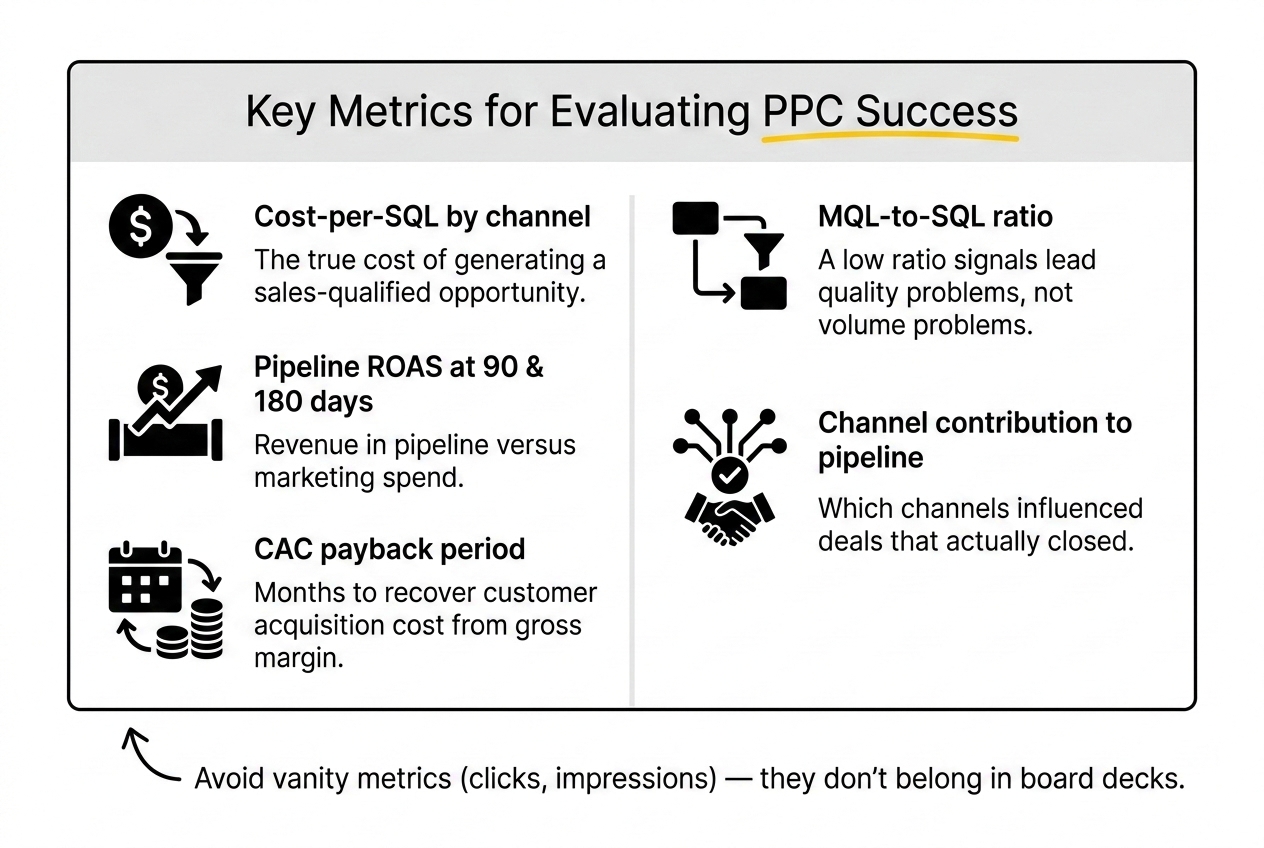
Avoid reporting on impressions, clicks, and CTR. These don’t show up in board decks. These do:
- Cost-per-SQL by channel: the true cost of generating a sales-qualified opportunity
- Pipeline ROAS at 90 days and 180 days: revenue in pipeline versus marketing spend
- CAC payback period: months to recover customer acquisition cost from gross margin
- MQL-to-SQL ratio: a low ratio signals lead quality problems, not volume problems
- Channel contribution to pipeline: which channels influenced deals that actually closed
What Most Teams Get Wrong About Paid Search
Paid search is the most important demand capture channel for most Series A SaaS companies, and also the most commonly mismanaged. The typical failure pattern is a set of broad-match campaigns optimised for click volume, generating traffic from tangentially related search terms, producing MQLs that sales won’t touch.
The fix is not better copy or a higher budget. It’s campaign structure. Precise keyword grouping by use case, tight match types, and a negative keyword list that reflects your ICP will reduce wasted spend by more than any bid strategy adjustment. Combining paid search with CRM data to feed offline conversion tracking into Google’s Smart Bidding is the setup that makes PPC campaigns genuinely reliable rather than directionally useful.
Reliability is the word Series A teams need to chase. Investors and leadership don’t expect marketing to be perfect. They need it to be predictable.
The Common Pitfall: Building Too Fast
The pressure to show results quickly at Series A is real, but scaling spend before the conversion infrastructure is in place accelerates waste rather than growth. A landing page that converts at 2% costs twice as much per lead as the same page converting at 4%, across every channel you run. Fixing conversion rate before scaling traffic is always the better sequence.
The same logic applies to sales alignment. Demand generation only works if sales can close what marketing produces. If there’s no agreed definition of a qualified opportunity, no SLA on lead follow-up, and no feedback loop on lead quality, the best-structured demand gen engine in your category will still produce inconsistent results.
Frequently Asked Questions
What are the key components of a successful demand generation strategy for Series A SaaS companies?
A successful Series A demand generation strategy combines short-term demand capture (primarily paid search) with longer-term demand creation (content, LinkedIn, and brand). The foundation is clean tracking that connects marketing spend to sales-qualified pipeline in your CRM. Without that, optimisation decisions are based on incomplete data. Alongside channel execution, ICP precision and a shared definition of qualified opportunity with your sales team are the components most likely to determine whether the strategy scales or stalls.
How can Series A SaaS marketing directors implement a 12-month demand generation roadmap?
Start with diagnosis before acceleration. Months one to three should focus on auditing existing channels, fixing tracking, and establishing baseline paid search performance. Months four to six expand the channel mix with LinkedIn and content. Months seven to nine shift optimisation targets from MQL volume to SQL quality. Months ten to twelve build the documentation and forecasting models that turn campaign activity into a repeatable system.
What role does data-driven decision-making play in building a repeatable demand generation machine?
Specific, clean data is what separates repeatable demand generation from opportunistic campaigns. The shift from reporting on impressions and clicks to reporting on cost-per-SQL, pipeline ROAS, and CAC payback creates a different decision-making environment. It forces budget allocation toward what produces qualified pipeline, and surfaces problems like a low MQL-to-SQL ratio before they compound into a missed quarterly target.
What are the best practices for maintaining healthy unit economics while scaling growth?
Track CAC payback period, not just cost-per-lead, and benchmark it against your ACV. A payback period under 12 months is the threshold most Series A investors use. As you scale, watch for rising CPC on branded terms (a sign that brand investment is compounding positively) and declining conversion rates on paid channels (a sign that you’re pushing beyond your core ICP). Scaling spend before conversion infrastructure is optimised is the most common route to poor unit economics.
How can paid search strategies be optimised for reliability in demand generation?
Reliability in paid search comes from precise campaign structure, not bid optimisation alone. Tightly themed ad groups, exact and phrase match over broad, a maintained negative keyword list, and offline conversion data fed back into the platform are the building blocks. Optimising toward SQL or opportunity value rather than form fills or MQLs changes the bidding environment fundamentally and produces better pipeline quality over time.
What unique challenges do growth-focused marketing leaders face when under investor scrutiny?
The core tension is time horizon. Investors want quarterly results. Sustainable demand generation compounds over 12 to 18 months. The answer is to run both in parallel: a short-term paid search engine that delivers near-term pipeline, and a demand creation programme that builds brand and organic pipeline over time. Reporting on pipeline ROAS at both 90 and 180 days helps frame the longer-term investment case in a language the board understands.
How can partnering with specialised SaaS PPC experts improve demand generation outcomes?
A PPC specialist with B2B SaaS experience brings two things a generalist agency doesn’t: familiarity with long sales cycles and buying committees, and campaign structure that reflects how SaaS deals actually close. That means optimising for qualified pipeline rather than form fills, understanding which search terms indicate genuine purchase intent versus research behaviour, and knowing how to feed CRM data back into platform algorithms. The difference in cost-per-SQL between a well-structured and a poorly structured paid search account is typically 30 to 50%.
What metrics should Series A SaaS companies track to measure demand generation success?
Track cost-per-SQL, pipeline ROAS at 90 and 180 days, CAC payback period, and channel contribution to closed-won revenue. MQL-to-SQL ratio is a useful diagnostic: if it’s below 15 to 20%, the problem is lead quality, not volume. Avoid reporting on impressions, CTR, and raw lead counts as primary metrics. These numbers look good in marketing dashboards and mean very little to investors and revenue leadership.
How can a multi-channel approach enhance demand generation for SaaS companies?
Single-channel demand generation creates fragility. If Google Ads costs rise, or a platform changes its algorithm, pipeline disappears. A multi-channel approach distributes risk and creates compounding effects: LinkedIn brand exposure raises the conversion rate on paid search, retargeting keeps warm audiences engaged through a long sales cycle, and content builds organic pipeline that reduces CAC over time. The goal isn’t to be on every channel. It’s to combine demand creation and demand capture across the channels where your ICP actually spends time.
What are common pitfalls when transitioning from opportunistic to structured demand generation?
The most common pitfall is scaling spend before fixing conversion. A landing page converting at 2% costs twice as much per lead as one converting at 4%, across every channel. The second is misalignment with sales on what qualifies as a lead worth following up. If there’s no agreed SQL definition and no lead follow-up SLA, even well-structured demand generation produces inconsistent pipeline. The third is reporting on MQL volume rather than SQL quality, which creates pressure to optimise for form fills rather than revenue.
If you’re at Series A and working through the transition from opportunistic campaigns to a structured demand generation system, this is the kind of problem we work on regularly with SaaS marketing teams. Worth a conversation if you’re at that point.