Evaluating Your SaaS PPC Agency: When to Replace or Fix
Key warning signs and a decision framework for revenue-accountable VPs deciding whether to fix or replace their SaaS PPC agency.

Your pipeline numbers are soft. The board is asking questions. Your agency sends a deck with click-through rates and impression share, and you’re left trying to translate that into something the CFO will accept. If that sounds familiar, you’re not alone, and the frustration is justified.
The decision to replace a SaaS PPC agency is not one to take lightly. Switching carries real risk: lost campaign history, a learning curve for a new team, and a period of underperformance while the handover settles. But staying with an agency that isn’t delivering costs you more in the long run, particularly when you’re under pressure to scale paid search predictably and show a clear line from spend to closed-won revenue.
This article gives you a structured way to evaluate whether your current b2b saas ppc agency relationship is fixable, or whether you’re past that point.
Performance Signals That Should Concern You
The first category of warning signs is the one most VPs notice: the numbers aren’t working.
The challenge is that “not working” is easy to feel but harder to document. Agencies are skilled at reframing performance, and platform metrics (impressions, clicks, quality score) can look healthy while pipeline stays flat. So rather than looking at platform dashboards, anchor your evaluation on outcomes that hold up in board meetings.
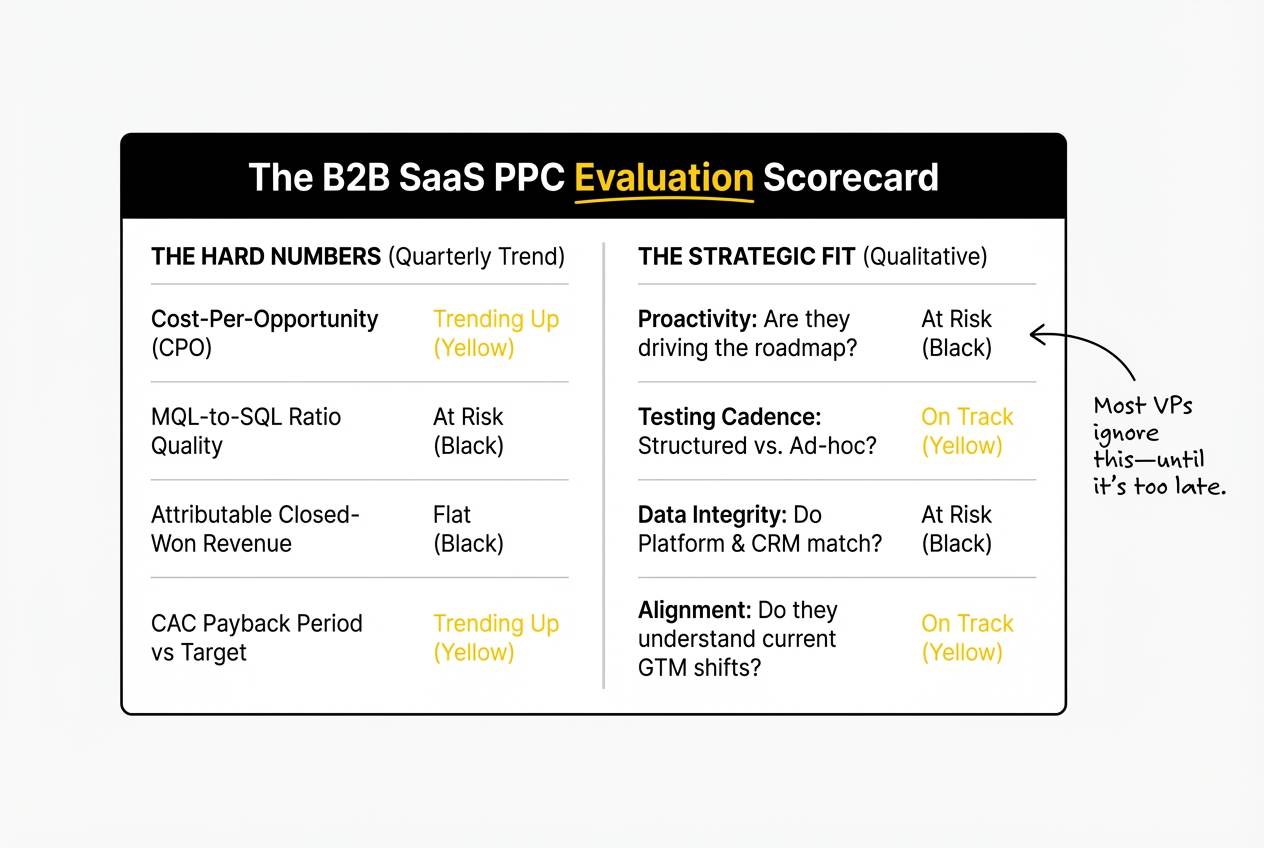
The metrics that matter:
- Cost-per-opportunity, not cost-per-click or cost-per-lead
- MQL-to-SQL ratio over time, not MQL volume in isolation
- Closed-won revenue attributable to paid search, even directionally
- CAC payback period compared to your ACV and sales cycle length
If your agency cannot report on at least two of these, that is itself a signal. Agencies that specialise in SaaS PPC should be building reporting infrastructure around pipeline outcomes from the first 90 days. If you’re 12 months in and still looking at a dashboard built around platform vanity metrics, the agency either doesn’t have access to the downstream data or isn’t using it.
A second performance signal is inconsistency. Paid search should become more predictable over time, not less. If your cost-per-opportunity is volatile quarter to quarter without a corresponding change in ICP, targeting, or market conditions, that volatility suggests the account is being managed reactively rather than strategically.
Process Red Flags in PPC Agency Management
Performance signals tell you something is wrong. Process red flags tell you why it won’t get better.
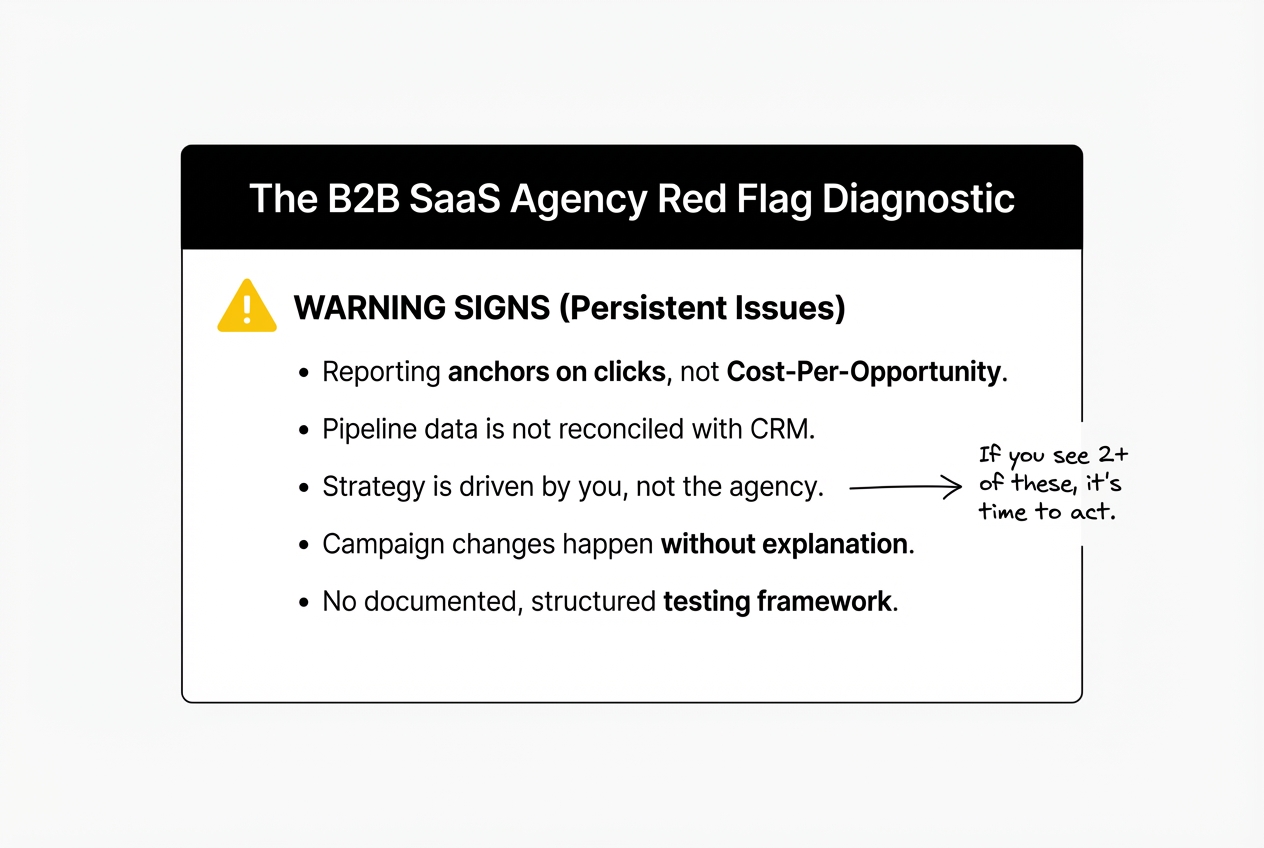
Your account is managed by someone junior without strategic oversight. This is more common than it should be. You were sold by a senior team and handed to an account manager 18 months out of a digital marketing degree. This isn’t always fatal if the strategic layer is genuinely present and involved. But if the person you speak to weekly can’t explain the rationale behind recent budget shifts, or defers every strategic question to someone who never appears on calls, the oversight isn’t there.
There’s no documented testing framework. Good SaaS PPC management runs structured experiments: ad copy tests, landing page variants, bidding strategy changes, audience segment tests. These should appear in your reporting as a regular feature, with hypotheses, results, and implications. If testing is happening ad hoc or not at all, the account is being managed by gut feel. That approach doesn’t scale. Building a Scale-Ready SaaS PPC Engine After PMF: From Ad-Hoc to Operating System, also on this blog, takes this further.
You’re driving the roadmap. A capable agency should be proactive. If your monthly call is mostly you raising concerns and asking what’s being done about them, rather than the agency presenting what they’ve identified and what they’re doing next, the relationship has inverted. You’re doing the strategic work and paying them for execution.
Campaign changes happen without explanation. Every material change to budget allocation, bidding strategy, or targeting should come with a rationale, documented in a change log. If you’re reviewing your account and finding changes you weren’t told about, or changes that can’t be explained on request, that’s a process failure with real risk attached.
Reporting Gaps That Indicate Deeper Problems
Reporting quality is a useful diagnostic because it reflects how an agency thinks about accountability. Agencies that build their reporting around pipeline outcomes do so because they want to be measured against pipeline outcomes. Agencies that build around platform metrics often do so because that’s where the numbers look better.
The most common reporting gap in SaaS PPC is the disconnect between ad platform data and CRM data. Your Google Ads account shows 47 conversions last month. Your CRM shows 12 demo requests from paid search. No one has reconciled the difference, and no one has explained it. This gap is not just a reporting problem. It means your bidding algorithm is optimising toward events that don’t map to pipeline, which distorts every decision downstream.
A second gap is attribution transparency. Multi-touch attribution across a 60-to-90-day B2B sales cycle is genuinely difficult, and any honest agency will tell you that. But “difficult” doesn’t mean “impossible to discuss.” If your agency can’t give you a clear view of how they’re attributing pipeline to paid search, even with caveats about model limitations, that’s a problem. You need a directional narrative for the board. An agency that can’t help you build one isn’t doing the job. PPC Agency Contract Red Flags for SaaS, also on this blog, takes this further.
A third gap is competitive context. Paid search doesn’t operate in a vacuum. If CPCs have risen 25% year-over-year in your category, your agency should be surfacing that context proactively. If you only find out about market-level changes when you ask, that’s a signal about how engaged they are with your category.
How to Evaluate Your SaaS PPC Agency Performance: The Fix vs Replace Framework
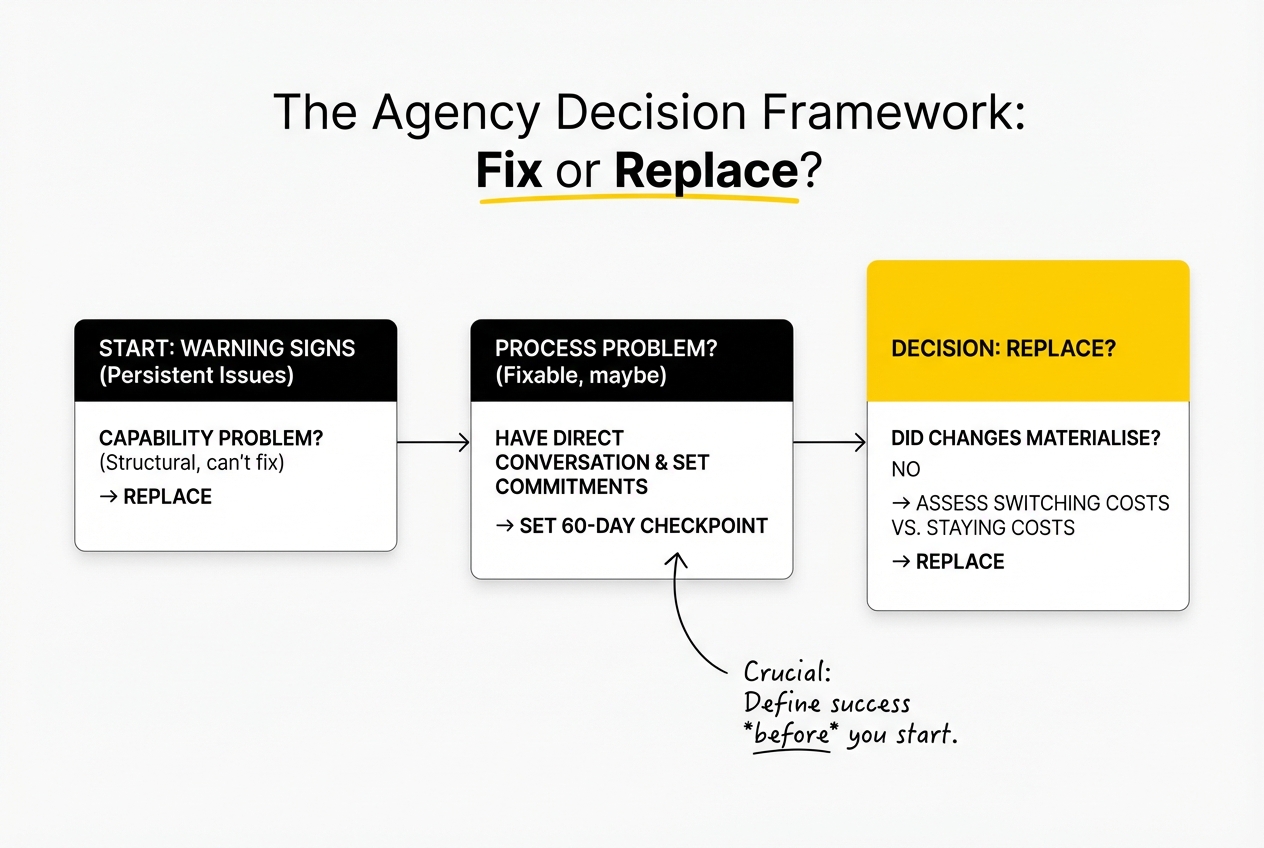
Once you’ve identified the warning signs, the question is what to do about them. Before defaulting to replacement, run through this structured assessment.
Step 1: Separate symptoms from root causes
List every problem you’ve identified. For each one, ask: is this a capability problem or a process problem?
Capability problems (wrong skill set for SaaS, no CRM integration experience, can’t do multi-touch attribution) are structural. They don’t get fixed with better communication or a new account manager. Process problems (poor reporting, reactive account management, no testing cadence) can sometimes be corrected if the will is there and you’re early enough in the relationship.
Step 2: Have the direct conversation
If you haven’t raised these issues explicitly, do that before making any decision. Document what you raise and what the agency commits to, with a timeline. This is important for two reasons: it may surface a path to resolution you hadn’t considered, and it creates the paper trail you need if you do decide to move.
Step 3: Set a 60-day checkpoint
If the agency commits to changes, give them 60 days to demonstrate them. Define in advance what “demonstrating them” looks like. If the changes materialise, you have a more functional relationship. If they don’t, you have a clear decision.
Step 4: Assess the switching cost honestly
Replacing a SaaS PPC agency involves real costs: the time required to brief a new agency, a probable dip in performance during the transition, and the risk that the new agency also disappoints. Against that, weigh the cost of staying, including the opportunity cost of underperformance and the energy your team is spending managing a difficult relationship.
One useful calibration: if your current agency’s output were submitted by a new agency in a pitch, would you hire them? If the honest answer is no, you have your answer.
Step 5: If you decide to switch, plan the handover
The biggest risk in switching isn’t the new agency. It’s losing institutional knowledge from the current account. Before you give notice, request a full account audit: campaign structure documentation, historical performance data, change logs, audience lists, and conversion tracking configuration. Handing this information to your incoming agency substantially reduces the transition risk.
The Alignment Question Most Teams Skip
There’s a category of agency failure that doesn’t show up in performance metrics or process audits. It’s a misalignment of strategic direction.
Your business may be moving upmarket, shifting ICP, launching a new product line, or pivoting GTM motion from sales-led to product-led. Any of these changes the nature of your PPC strategy. An agency that was well-suited to your Series A targeting may not be right for your Series B expansion. If the agency isn’t evolving with your strategy, or isn’t engaged enough with your business to anticipate what you’ll need next, that’s a slow-moving problem that compounds over time.
The question to ask is: does your agency understand your business well enough to push back on your brief? An agency that executes everything you ask without challenge is either too deferential or not paying attention. The best agencies will occasionally tell you that the brief is wrong, or that there’s a better way to structure the campaign. If your agency has never done that, that’s worth noting.
Frequently Asked Questions
What are the warning signs that it’s time to replace your PPC agency?
The clearest warning signs are: persistent underperformance on pipeline metrics (not platform metrics), an inability to report from spend to closed-won revenue, a reactive rather than proactive account management style, no structured testing framework, and changes being made to your account without documented rationale. Any one of these is worth raising. Multiple together are a stronger signal to evaluate your options formally.
How can you evaluate the performance of your current PPC agency?
Start with the metrics that matter in board conversations: cost-per-opportunity, MQL-to-SQL ratio, and attributable pipeline from paid search. Then audit the process: is there a testing roadmap, a change log, and a consistent reporting framework tied to downstream outcomes? Finally, assess the relationship itself. Are you being managed proactively, or are you the one driving the agenda?
What key performance metrics should VPs of Marketing use to assess a PPC agency?
Cost-per-opportunity and CAC payback are the primary ones. Beyond those, watch MQL-to-SQL conversion rate (to assess lead quality, not just volume), the ratio of CRM-recorded conversions to platform-reported conversions (to assess tracking integrity), and quarter-over-quarter pipeline stability. Volatility in that last metric, absent a clear explanation, is often a sign of reactive management.
What process red flags should you look for when working with a PPC agency?
The most significant: no documented change log, no structured testing cadence, strategic questions deferred to someone who isn’t present on calls, and reporting that lives entirely in the ad platform without CRM reconciliation. Also watch for proposals that look like they were templated from a previous client, or account reviews where the agency is clearly working from the report rather than from knowledge of the account.
How do reporting gaps affect your decision to keep or replace a PPC agency?
Reporting gaps are both a symptom and a cause. They’re a symptom of an agency that isn’t building accountability infrastructure. They’re also a cause of bad decisions: if your attribution model is broken, your bidding algorithm optimises toward the wrong events, your budget allocation follows the wrong signals, and your board narrative is built on shaky foundations. Agencies that build strong reporting pipelines early do it because they want to be held accountable. That tells you something.
How can you determine whether it’s better to fix issues with your current agency or replace them?
Run the capability-versus-process diagnostic. Capability problems are structural and don’t resolve with better communication. Process problems can sometimes be fixed, but only if the agency commits to specific changes with a timeline and delivers on them. If you’ve had the direct conversation, given a reasonable window, and the problems persist, you have your answer. The switching cost is real but finite. The cost of continued underperformance compounds.
What factors should be considered when assessing the ROI of your PPC campaigns?
In B2B SaaS, ROI should be calculated against closed-won revenue, not leads or demos. The complication is the sales cycle: deals that close in Q3 may have originated from Q1 campaigns. A credible ROI model needs to account for that lag and use cohort-based attribution rather than same-period matching. Any agency that claims to show you PPC ROI without addressing the sales cycle lag is either simplifying to the point of misleading, or not thinking about it carefully enough.
How can you ensure your PPC agency aligns with your company’s strategic goals?
Brief them regularly on business context, not just campaign briefs. If you’re moving upmarket, they should know that. If your ICP is shifting, they should be involved in that conversation. The test of alignment is whether the agency can articulate your strategic direction in their own words, and whether their campaign recommendations reflect it. Agencies that operate purely in the ad platforms, without visibility into your broader GTM motion, will drift out of alignment regardless of tactical performance.
What steps can you take to maintain momentum during the transition to a new PPC agency?
The most important is the handover data request: full campaign documentation, historical performance exports, change logs, audience lists, and conversion tracking setup. Before you give notice, ensure you have admin access to every platform asset. Structure the handover so there’s a defined period where both agencies have visibility if possible, or build in a minimum two-week overlap between outgoing handover and new agency launch. Momentum dips are almost always caused by missing information, not by the transition itself.
If you’re working through this evaluation and want a second opinion on what you’re seeing in your account, we’re happy to take a look. This is the kind of conversation we have regularly with SaaS marketing teams, and sometimes an outside view helps clarify what’s a genuine problem versus what’s noise.