Essential Elements of Effective Monthly SaaS PPC Recommendations
What strong monthly SaaS PPC recommendations should include beyond dashboards: a clear decision, the rationale behind it, the risk of being wrong, and a measurable next action, for Series A Marketing Directors accountable to quarterly growth targets.

The dashboard is full. CTR is up, CPC is down, and there's a chart for everything. And yet, at the end of the call, nobody can answer the one question that actually matters: what should we do differently next month?
That gap is the difference between a report and a recommendation. For a growth-focused Series A Marketing Director, time-poor and accountable for quarterly targets, a monthly SaaS PPC strategy recommendation that stops at metrics isn't useful, it's just more homework. What should strong monthly SaaS PPC recommendations cover instead is decisions, the reasoning behind them, the risk of being wrong, and a next action specific enough to actually execute.
Why a Dashboard Isn't a Recommendation
Mark Meyerson, writing in Search Engine Land, points to analytics expert Avinash Kaushik's term for what most monthly reports actually deliver: data puke, an overwhelming volume of numbers with no clear signal about what to do next. A dashboard shows what happened. It doesn't tell you what to do about it, and the difference matters more in SaaS than almost anywhere else, because the sales cycle is long enough that this month's numbers rarely tell the full story on their own.
Best practices for SaaS PPC campaigns start from treating the monthly review as a decision-making moment, not a data dump. If a marketing director leaves that conversation with more charts and no clearer sense of what changes next, the recommendation has failed regardless of how much data supported it.
The Four Things Every Strong Monthly SaaS PPC Recommendation Needs
A clear decision
Every strong recommendation states, explicitly, what should change. Not “performance was mixed this month,” but “shift 15% of budget from Channel A to Channel B.” Vague observations put the burden of deciding back on the marketing director, which defeats the purpose of paying for expertise in the first place.
The rationale behind it
A decision without reasoning is a guess dressed up as expertise. Key components of effective monthly SaaS PPC advice always include why: which data point triggered the recommendation, what pattern it fits, and why this response makes sense given the sales cycle and growth targets specifically, not as a generic best practice.
The risk of being wrong
Strong recommendations name their own downside. If the recommended shift doesn't work, what's the expected cost, and how quickly will that become clear? A partner willing to state the risk plainly is a partner confident enough in the reasoning to be transparent about where it could fail.
A measurable next action
The recommendation ends with something specific enough to check next month: a target metric, a threshold, a date. “We'll monitor lead quality” is not measurable. “We'll review SQL conversion from this segment in four weeks, and revert the change if it falls below 8%” is.
Effective PPC Metrics for SaaS Growth: What to Prioritise Beyond Vanity Numbers
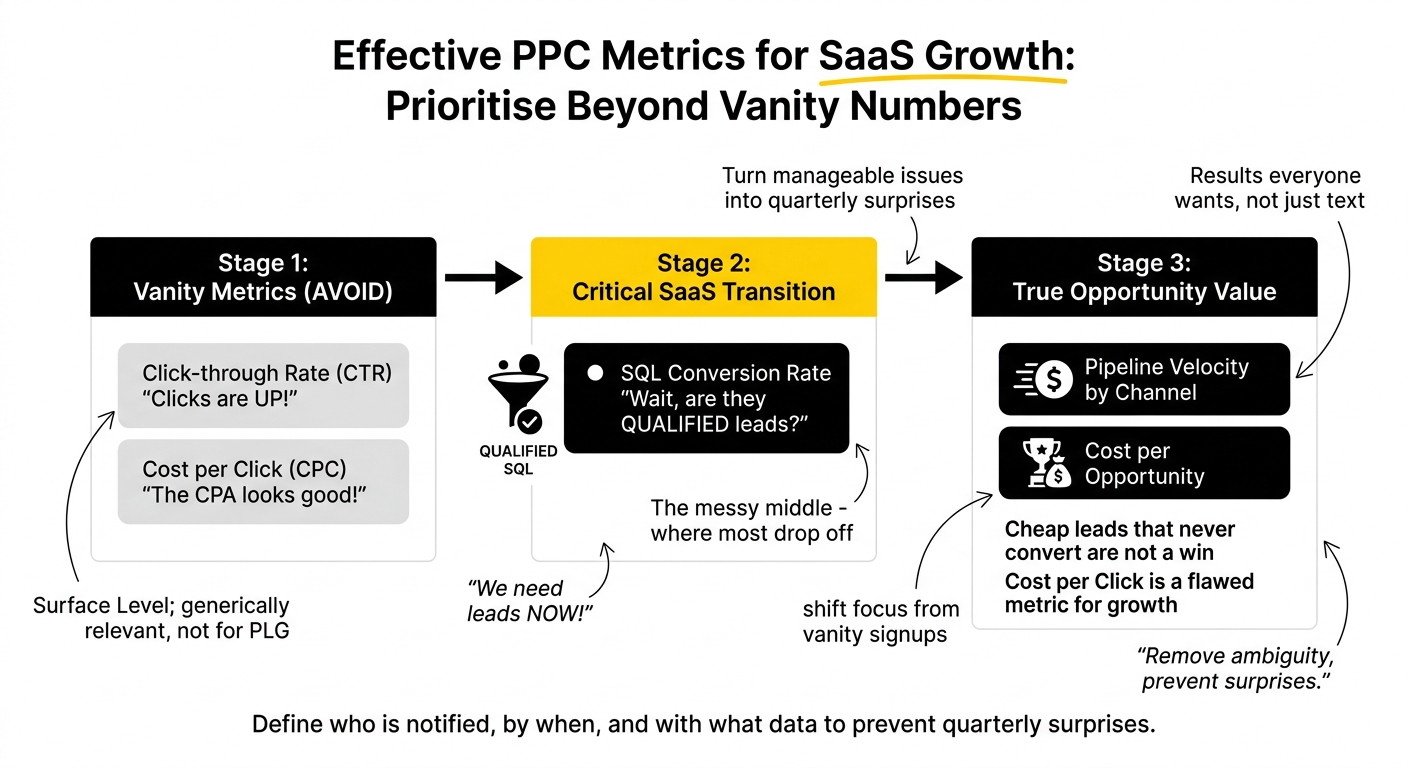
Qualified leads in digital marketing matter more than volume, and this is where SaaS PPC recommendations diverge sharply from generic PPC advice. Click-through rate and cost per click describe the top of the funnel. They say almost nothing about whether the leads a campaign generates actually progress through a B2B sales cycle that can run for months.
Effective PPC metrics for SaaS growth prioritise SQL conversion rate, pipeline velocity by channel, and cost per opportunity over cost per click or raw lead volume. A campaign generating cheap leads that never convert to sales-qualified is not a win, no matter how good the cost-per-click number looks on a monthly marketing report.
How SaaS PPC Recommendations Differ From Traditional PPC Advice
Ppc strategy for Series A startups needs a different lens than most traditional PPC guidance, because the buying decision is rarely made by one person in one session. Traditional e-commerce PPC advice optimises toward a single, fast conversion event. Saas growth marketing has to account for a multi-touch, multi-stakeholder journey where this month's spend produces a signal that won't fully resolve into revenue for months.
This is why recommendations focused purely on immediate conversion volume mislead growth-focused SaaS marketing directors. A strong recommendation explains how a change connects to what happens further down the pipeline, not just what happened at the click.
A Worked Example: A Recommendation That Actually Works
Take a hypothetical Series A HR tech SaaS reviewing a month where LinkedIn spend produced a strong click-through rate but a soft SQL conversion rate against the trailing average. A status update would say: LinkedIn CTR improved 12%, SQL conversion dipped slightly. A strong recommendation says something different: shift 20% of LinkedIn budget toward a narrower job-title filter, because the current audience is generating clicks from a title band that has historically converted below the account's SQL threshold, and if SQL conversion from that segment hasn't recovered above 8% in four weeks, revert the change and revisit targeting entirely.
The difference isn't the data underneath it, both versions could be built from the same platform export. The difference is that one hands the marketing director a decision, a reason, a stated risk, and a specific date to check back. The other hands them a summary and expects them to work out what to do with it.
.jpg)
Common Pitfalls That Turn Recommendations Into Just Reporting
A few patterns turn what should be a recommendation into a status update:
- Leading with metrics and burying the actual recommendation, if there is one, at the end
- Describing what happened without stating what should change as a result
- Recommending a change with no stated risk, which tends to mean the risk wasn't actually considered
- Setting no specific follow-up point, so nobody checks whether the recommendation worked
PPC dashboard best practices help here, but only as a supporting layer. A well-designed dashboard makes the data easier to trust. It doesn't replace the judgment call a strong recommendation requires.
Evaluating Whether Your Agency's Recommendations Are Actually Strong
Monthly marketing report insights are only as good as the test they're held to. Before the next review, check whether last month's recommendation named a decision, gave a reason tied to your specific growth targets, stated a risk, and set a measurable follow-up. If two or more of these were missing, what arrived was a report, not a recommendation, regardless of how it was framed.
Ppc campaign performance metrics should support the recommendation, not substitute for it. If a monthly update reads well but you can't point to the specific decision it's asking you to make, that's worth raising directly with whoever is providing it.
A Checklist for Reviewing Monthly SaaS PPC Recommendations
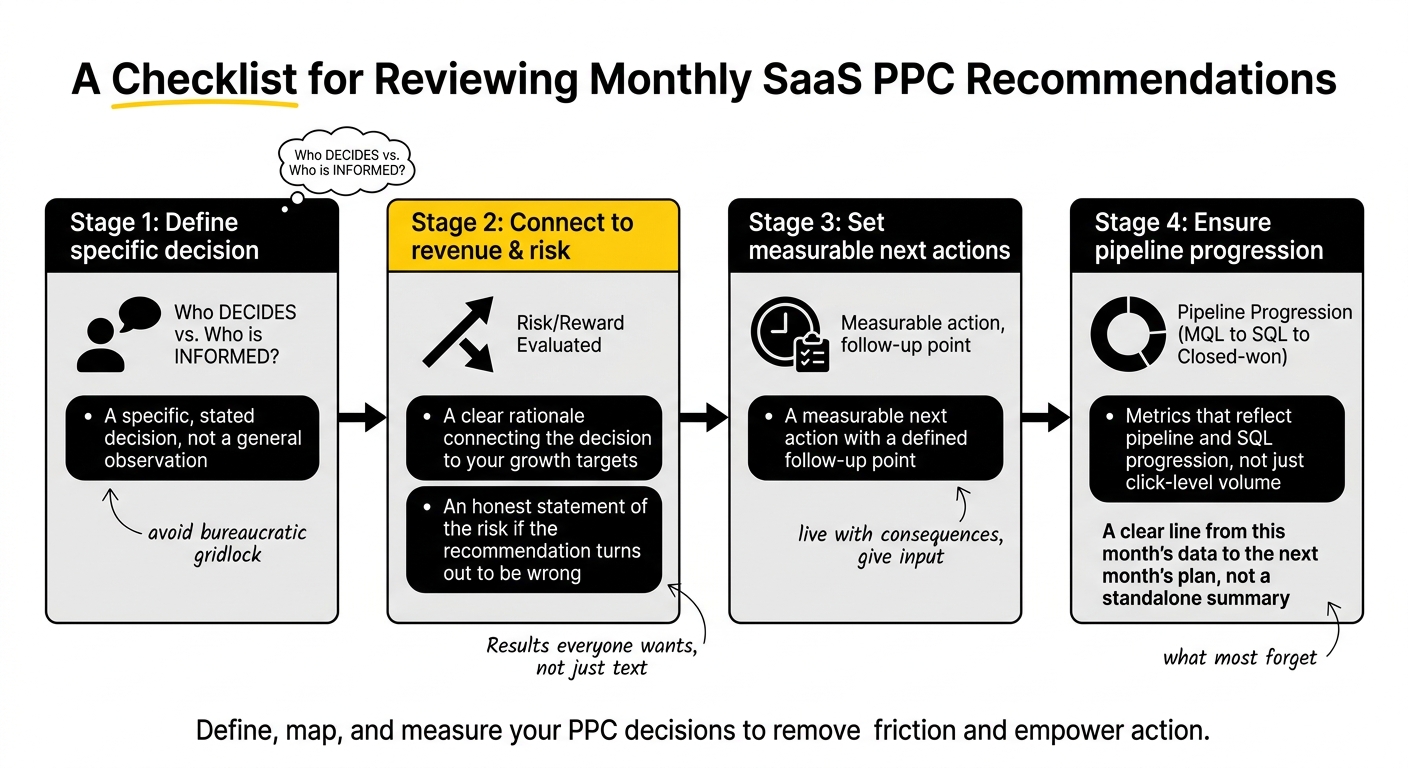
Before your next review, check that the recommendation includes:
- A specific, stated decision, not a general observation about performance
- A clear rationale connecting the decision to your growth targets and sales cycle
- An honest statement of the risk if the recommendation turns out to be wrong
- A measurable next action with a defined follow-up point
- Metrics that reflect pipeline and SQL progression, not just click-level volume
- A clear line from this month's data to the next month's plan, not a standalone summary
Frequently Asked Questions
What are the key components of a successful SaaS PPC campaign?
A campaign built around metrics that track pipeline progression, not just clicks, paired with monthly recommendations that state a decision, the rationale behind it, the risk involved, and a measurable next action.
How does a SaaS PPC strategy differ from traditional PPC strategies?
Traditional PPC often optimises toward a single fast conversion. SaaS PPC has to account for a longer, multi-stakeholder sales cycle, which means this month's data is a signal about future pipeline, not a complete verdict on performance.
What metrics should be prioritised in SaaS PPC recommendations?
SQL conversion rate, pipeline velocity by channel, and cost per opportunity, rather than cost per click or lead volume alone, since those don't reflect whether leads actually progress toward revenue.
What actionable insights should be included in monthly SaaS PPC reports?
A specific decision, the reasoning behind it tied to your growth targets, the risk if it's wrong, and a measurable next action with a defined check-in point. Anything short of all four is closer to a status update.
How can marketing directors evaluate the effectiveness of their SaaS PPC campaigns?
Check whether last month's recommendation led to a specific decision that was actually implemented, and whether the follow-up metric named at the time showed the expected result. If there was no measurable follow-up, effectiveness is difficult to assess at all.
What common pitfalls should be avoided in SaaS PPC management?
Recommendations that describe performance without stating what should change, no stated risk attached to a suggested change, and no specific follow-up point to check whether the change worked.
What role does audience targeting play in SaaS PPC success?
Audience targeting determines lead quality more than almost any other lever, which is why a recommendation to adjust targeting needs to state its rationale in terms of pipeline impact, not just click volume or reach.
How can SaaS companies align their PPC strategies with quarterly growth targets?
By ensuring monthly recommendations explicitly connect each decision to the specific growth target it's meant to move, rather than reporting generic performance improvements disconnected from the number the business is actually accountable for.
What are the risks associated with SaaS PPC campaigns and how can they be mitigated?
The main risk is optimising toward metrics that look good short-term but don't reflect pipeline quality. Mitigate this by requiring every recommendation to state its risk explicitly and set a specific point to check whether it worked.
What measurable next actions should follow a monthly SaaS PPC review?
A specific metric, threshold, and date, for example reviewing SQL conversion from a given segment in four weeks, with a defined response if it falls short. Vague commitments to “monitor” something aren't measurable next actions.
If your monthly updates read more like a report than a recommendation, that's worth raising directly. This is the standard we hold ourselves to as a SaaS PPC agency. Worth checking before your next review, not after another quarter of data without decisions.