Unlocking Upper-Funnel Demand Generation for SaaS Success
Discover effective upper-funnel demand generation strategies for SaaS that enhance lead quality and connect education to pipeline outcomes.

Your campaigns generate MQLs. Your sales team works them. Most go nowhere. Three months later, someone asks why pipeline looks thin despite healthy impression counts and cost-per-lead hitting target.
The problem usually isn’t the bottom of the funnel. It’s that upper-funnel demand generation for SaaS is being treated as a nice-to-have rather than a structured, measurable programme. And when it gets attention at all, it’s often conflated with awareness metrics that no one in a revenue conversation actually cares about.
This article is a practical playbook for demand generation leaders who want to build upper-funnel programmes that genuinely move the needle on pipeline, without abandoning the discipline that makes paid media defensible in a board meeting.
What Upper-Funnel Demand Generation Actually Means in B2B SaaS
Demand generation in B2B SaaS splits into two distinct jobs: demand creation and demand capture. Most teams understand the difference in theory. Fewer act on it in practice.
Demand capture is the work of reaching buyers who are already in-market. Paid search, category review site listings, branded retargeting, competitor conquesting. These channels are efficient, measurable, and finite. You can only capture the demand that already exists.
Demand creation is everything that happens before a prospect opens a search tab. Content that shifts how someone understands their problem. Paid social that builds category awareness. Thought leadership that earns a brand presence in the spaces where buying committees form opinions. This is what upper-funnel demand generation for SaaS is actually about.
The strategic issue is allocation. According to the Forrester B2B Marketing Survey (2025), 74% of B2B marketing budgets go toward demand capture activities, leaving 26% for creation. That ratio is almost exactly the inverse of what research suggests is optimal for companies looking to build sustainable pipeline. Capture channels will always perform well in the short term, but they ceiling out. When you have harvested your addressable search volume and retargeted your existing audience enough times, spending more delivers diminishing returns.
The companies that compound their pipeline growth over time do both. They capture existing demand and create new demand simultaneously, through channels and content that engage buyers well before anyone is ready to convert. Our work as a b2b saas marketing agency consistently shows that this balance is the primary driver of sustainable pipeline.
The B2B SaaS Buyer Has Already Moved On
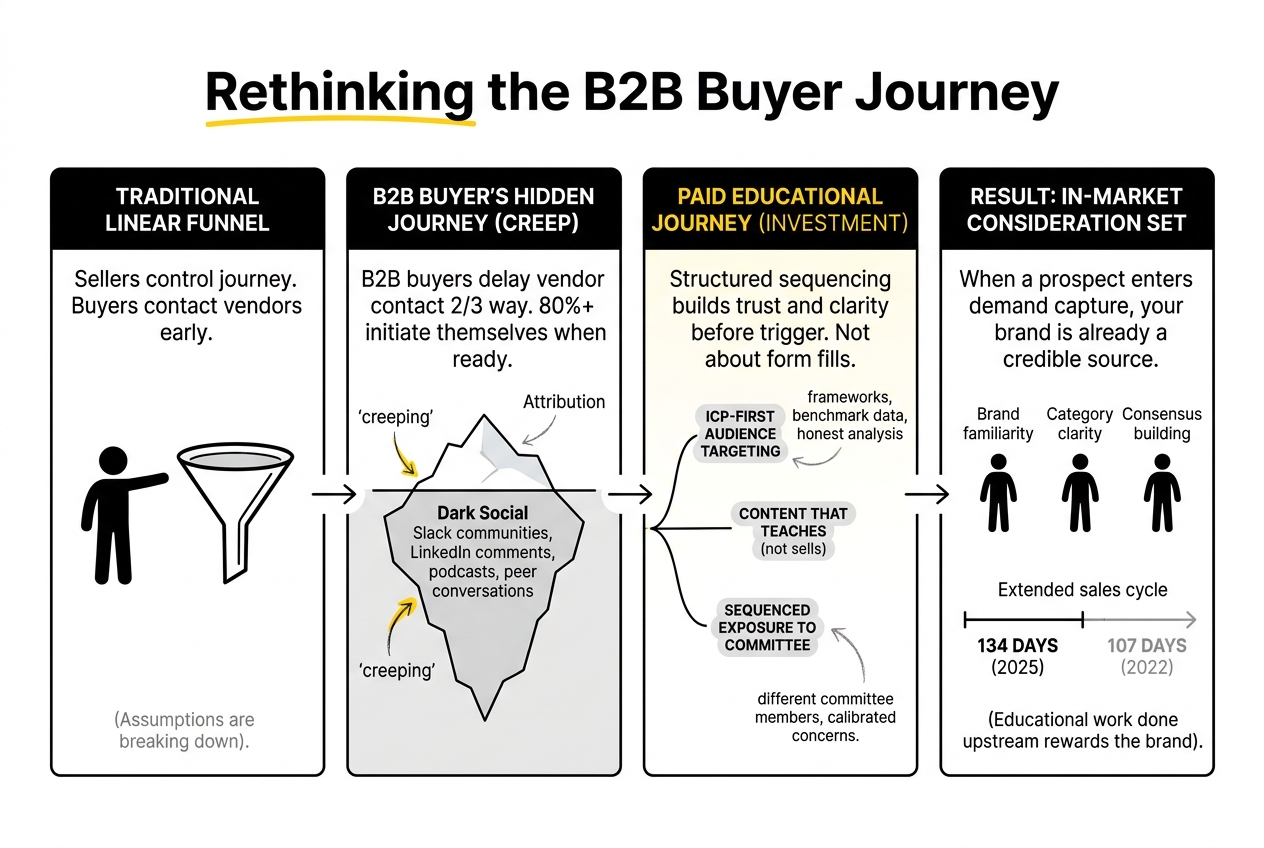
The traditional linear funnel assumes sellers control a significant portion of the buying journey. That assumption has not held up.
According to the 6sense 2025 Buyer Experience Report, B2B buyers delay direct vendor contact until approximately two-thirds of their way through the journey, and over 80% initiate that contact themselves when they are ready. The research, the problem framing, the shortlist formation: most of this happens in spaces your attribution tools cannot see. Slack communities, LinkedIn comments, podcasts, peer conversations at industry events.
This matters for upper-funnel strategy because it shifts where the value of educational content actually sits. A webinar that reaches your ICP six months before they have budget is not a wasted impression. It is an investment in the moment when that buyer, now finally in-market, already thinks of your brand as a credible source on the problem they are trying to solve.
The average B2B SaaS sales cycle extended to 134 days in 2025, up from 107 days in 2022. Buying committees now average 11 stakeholders, each requiring different information at different points in the evaluation. These are not conditions that reward a pure capture-and-convert approach. They reward brands that have done the educational work upstream.
Building Paid Educational Journeys That Create Pipeline
Paid educational journeys are structured sequences of content-led campaigns designed to move potential buyers through problem awareness before they reach a buying trigger. The goal is not to generate form fills on the first touch. The goal is to build familiarity, trust, and category clarity so that when a prospect eventually enters demand capture territory, your brand is already in the consideration set.
There are three components that make paid educational journeys work for B2B SaaS.
1. ICP-first audience targeting
Educational content fails when it is broadcast to broad audiences. On LinkedIn, this means targeting by job function, seniority, company size, and vertical rather than relying on interest-based audiences. A Series B analytics platform targeting Heads of Revenue Operations at 100-500 person SaaS companies in EMEA is a paid educational programme. A campaign targeting “people interested in data analytics” is not.
Use SparkToro to identify where your ICP actually spends time reading and listening. The channels your buyers engage with before they form vendor opinions are the channels worth investing in for educational outreach.
2. Content that teaches, not content that sells
The most common failure mode in upper-funnel paid content is promotional framing dressed up as education. A piece of content that explains your product’s features while pretending to explain a problem category is not educational. It is a product brochure.
Educational content for upper-funnel demand generation should be genuinely useful to someone who has no intention of buying from you. Frameworks for thinking about a problem. Benchmark data that helps a Head of Demand Gen understand whether their MQL-to-SQL ratio is worth addressing. Honest trade-off analysis between approaches. This kind of content earns attention because it provides value before asking for anything.
Distribution through paid channels, primarily LinkedIn Sponsored Content for B2B SaaS, allows you to reach the right accounts even before organic content gains traction. The paid component is not amplifying a sales message. It is funding the reach of content that earns trust.
3. Sequenced exposure across the buying committee
In B2B SaaS, a single piece of content rarely reaches every stakeholder who will influence the eventual purchase decision. A Head of Demand Gen might engage with a framework article while a CFO later encounters a cost-of-inaction piece, and a VP of Marketing sees a benchmark report.
Structured paid sequences, built around the stages from problem awareness to solution exploration, allow you to reach different committee members with content calibrated to their concerns. This is not the same as retargeting. It is deliberate, forward-looking exposure designed to build consensus within a target account over time, not to close a prospect who has already shown buying intent.
The Education vs. Capture Balance
Most demand generation teams run educational and capture efforts simultaneously but in silos. The educational programmes report on engagement metrics that do not show up in pipeline reports. The capture campaigns take credit for everything that converts. This is how upper-funnel investment gets cut: it never appears to contribute to revenue, because the attribution model was not built to show it.
The balance itself is not the main problem. The problem is that the two zones are not connected in the data or the reporting.
A useful starting framework for thinking about allocation is the 60/40 split that Refine Labs has long advocated: approximately 60% of budget toward demand creation and education, 40% toward capture and conversion. For most Series A and B SaaS companies, this represents a significant rebalancing from their current state. The 60% toward creation does not mean abandoning leads as a metric; it means extending the measurement window and using pipeline influence as the signal rather than immediate form completion.
The key structural principle is that educational content should feed into capture campaigns through remarketing. Someone who watched 75% of a LinkedIn video explaining the cost of poor lead quality is a materially better audience for a demo-request campaign than a cold lookalike audience. The upper and lower funnel are not separate programmes. They are sequential stages in the same buyer journey.
Attribution Frameworks That Connect Education to Pipeline
Attribution is the hardest part of upper-funnel demand generation. It is also the thing that determines whether your programme survives its second budget cycle.
Last-touch attribution systematically undercounts the contribution of educational content. A prospect who engaged with three pieces of LinkedIn content, attended a webinar, and then converted via a branded search six weeks later will be attributed entirely to brand search in a last-touch model. The educational touchpoints that built purchase intent are invisible.
Multi-touch attribution models distribute credit across the journey. One B2B SaaS company that shifted to multi-touch found their webinar programme was initiating 40% of successful customer journeys, while paid social appeared in 65% of winning conversion paths, and case study content was present in 72% of enterprise deals. None of this was visible in their last-touch reporting.
For demand generation leaders presenting to stakeholders, the right attribution framework is not necessarily the most mathematically precise one. It is the one that is consistent, directional, and defensible in a conversation about budget. A few practical approaches:
- First-touch for creation, last-touch for capture: Assign first-touch credit to the educational channel that initiated the relationship, and last-touch credit to the capture channel that closed the loop. Run both reports and present them alongside each other.
- Influence reporting: Track pipeline influenced by a channel or content asset within a rolling 90-day window, regardless of whether it received attribution credit. This measures the footprint of upper-funnel activity in actual opportunities.
- Self-reported attribution: Add an open text field (“How did you hear about us?”) to high-intent forms. The patterns in this data, podcast mentions, Slack groups, specific content pieces, are often more actionable than anything your tracking stack captures automatically.
Attribution will never be perfect. The goal is consistent, directional data that gives you enough signal to allocate budget with confidence and defend those decisions with evidence.
Metrics That Matter for Upper-Funnel Demand Generation
Upper-funnel demand generation for SaaS is measured differently from capture-zone campaigns. Cost-per-lead and MQL volume are the wrong primary metrics for educational programmes. Chasing them turns upper-funnel campaigns into underpowered lead gen campaigns.
The metrics that actually tell you whether your upper-funnel investment is working:
- Brand search volume growth: Month-on-month growth in branded search queries is one of the clearest signals that awareness programmes are reaching the right audiences. If your educational campaigns are working, more people should be looking for you by name.
- Target account engagement rate: Percentage of your ICP account list showing measurable engagement (page visits, content downloads, ad interactions) within a given period. This is pipeline signal before pipeline exists.
- MQL-to-SQL conversion rate from influenced leads: Leads that had prior upper-funnel exposure before entering a capture flow should convert at a higher rate than cold leads. Industry median MQL-to-SQL sits between 15-21%; teams with strong alignment and quality education programmes reach around 40%. Track conversion rates by cohort to see whether education-influenced leads outperform.
- Time to opportunity: Does upper-funnel engagement compress the time between a prospect’s first capture interaction and the creation of a qualified opportunity? Shorter cycles in this group indicate that educational content is doing its job upstream.
- Pipeline influenced: Total value of open and closed-won pipeline where the account had a documented upper-funnel touchpoint. Report this monthly alongside direct-attributed pipeline.
The goal is a reporting structure that connects the awareness and education work to eventual commercial outcomes, even when that connection spans weeks or months and multiple attribution touchpoints.
Sales Alignment: The Variable Most Demand Gen Teams Underestimate
Upper-funnel programmes fail inside organisations before they fail on the market. A demand generation team running educational campaigns while the sales team is optimised for fast MQL-to-call conversion creates a structural contradiction. Sales velocity incentives push against the patient, education-first approach that upper-funnel programmes require.
The alignment conversation needs to happen at the level of how a qualified opportunity is defined, not just what volume of leads is expected. If a sales team considers an MQL qualified purely on the basis of a form fill, educational engagement will never show up in their funnel. If a qualified opportunity is defined partly by prior account engagement with educational content, the two programmes start reinforcing each other.
Practical alignment steps:
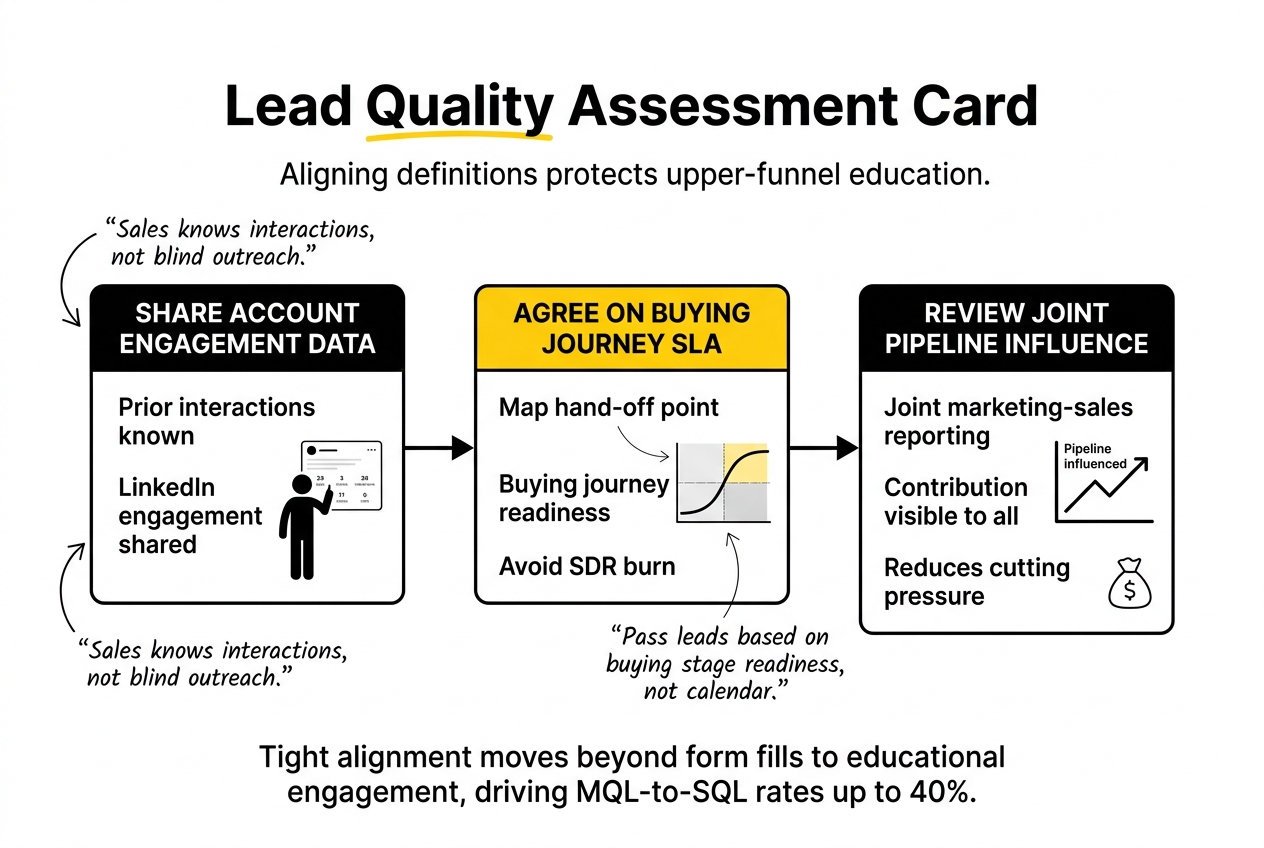
- Share account engagement data with sales. A sales rep who knows that a prospect from a target account has engaged with three pieces of LinkedIn content before the first outreach call is in a different position than one going in blind.
- Agree on a handoff SLA that reflects the actual sales cycle. Passing an education-stage lead to a close-focused SDR sequence will burn it. Map the handoff point to the buying journey, not the calendar.
- Review pipeline influenced in joint marketing-sales reporting. This makes upper-funnel contribution visible to both teams and reduces the political pressure to cut educational programmes during periods when immediate pipeline is the only thing being tracked.
Enterprise B2B SaaS companies with tight sales and marketing alignment achieve MQL-to-SQL conversion rates around 40%, against an industry median of 15-21%. The gap between those figures is alignment, not campaign quality.
Structured Testing for Upper-Funnel Programmes
Upper-funnel demand generation requires a different testing cadence than bottom-funnel campaigns. Conversion rate optimisation in capture campaigns can run on a two-week cycle. Educational content takes months to show impact in pipeline metrics.
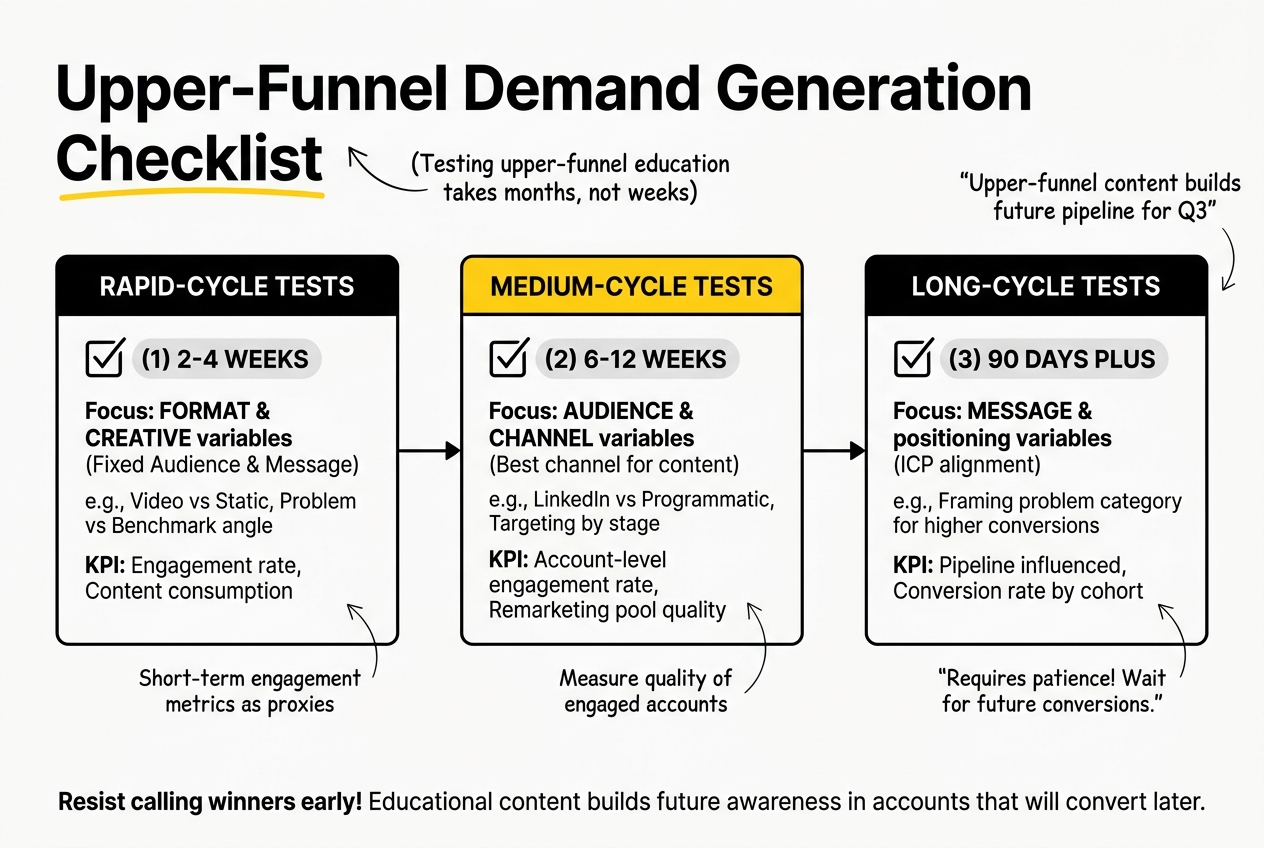
The testing structure that works is a tiered approach:
Rapid-cycle tests (2-4 weeks): Format and creative variables within a fixed audience and message. Does video outperform static? Does a problem-framing angle outperform a benchmark angle? These tests run quickly because they use engagement rate and content consumption as proxies, not pipeline.
Medium-cycle tests (6-12 weeks): Audience and channel variables. Does this content perform better on LinkedIn or through programmatic content syndication? Does targeting by company stage change engagement quality? Measure by account-level engagement rate and remarketing pool quality.
Long-cycle tests (90 days plus): Message and ICP positioning variables. Does a particular framing of the problem category attract accounts that subsequently convert at higher rates? These tests require patience and cannot be evaluated against short-term metrics. Use pipeline influenced and conversion rate by cohort as the signal.
The discipline here is resisting the urge to call a winner before the attribution window has closed. Upper-funnel content that “didn’t work” in a four-week evaluation may be doing exactly what it is supposed to do: building awareness in accounts that will convert in Q3.
Frequently Asked Questions
What are effective upper-funnel demand generation strategies for B2B SaaS?
Effective upper-funnel demand generation strategies for B2B SaaS focus on creating genuine educational value for your ICP before they enter a buying cycle. This includes paid social campaigns distributing problem-framing content, webinars and video content targeted at specific job titles and company profiles, content syndication to reach accounts outside your organic traffic, and podcast sponsorship where your buyers are already listening. The unifying principle is content that earns attention by being useful, not by selling. Distribution should be paid, targeted, and measured at the account level rather than by individual lead volume.
How can SaaS companies balance education and lead capture in their demand generation efforts?
The most practical starting point is to treat education and capture as sequential rather than simultaneous. Not every audience member is at the same stage. Segment your paid programme by intent signal: broad educational content for cold ICP audiences, solution-exploration content for accounts that have shown engagement, and direct capture campaigns for accounts demonstrating active buying behaviour. Budget allocation should reflect the size of each audience segment, with a higher weighting toward creation for companies whose category awareness is still developing.
What metrics should be used to measure the success of upper-funnel demand generation?
The right metrics are brand search volume growth, target account engagement rate, pipeline influenced, and MQL-to-SQL conversion rate from education-influenced cohorts. Cost-per-lead is the wrong primary metric for educational programmes because it incentivises volume over quality. The goal is a reporting structure that connects educational touchpoints to eventual pipeline outcomes, even across a 90-day attribution window.
How can demand generation leaders improve lead quality in the upper funnel?
Lead quality in the upper funnel improves when the content used to attract leads is genuinely useful to the specific buyers you want to reach. Broad, undifferentiated content attracts broad, undifferentiated audiences. An ICP-first targeting approach, content built around the specific problems of senior decision-makers at your ideal account profile, and a clear handoff process with sales will produce leads that are worth the cost-per-opportunity.
What role does paid educational content play in upper-funnel demand generation?
Paid educational content funds the reach of material that builds purchase intent before buyers are ready to engage with sales. The paid component solves a distribution problem: organic content reaches the audience that already knows you. Paid educational distribution reaches target accounts that do not yet. When done well, it seeds familiarity and credibility in accounts that will eventually enter a buying cycle, making every downstream capture activity more efficient.
How can demand generation teams establish clear attribution frameworks for upper-funnel activities?
The most practical attribution approach for upper-funnel programmes combines three inputs: multi-touch attribution to track touchpoint contribution across the buyer journey, pipeline influence reporting to capture the footprint of educational content in actual opportunities, and self-reported attribution from open-text form fields that surface dark funnel influences. No single model captures the full picture. Running two or three approaches in parallel and acting on their convergence is more useful than optimising for precision in one.
What are common challenges in upper-funnel demand generation for SaaS companies?
The most common challenges are attribution visibility (upper-funnel activity does not show up in last-touch models), internal pressure to convert educational audiences too quickly, misalignment with sales teams who measure success by lead volume rather than account quality, and the patience required to evaluate results over a 90-day or longer window. Budget is rarely the primary constraint. The constraint is the measurement framework, which either validates or undermines upper-funnel investment depending on how it is structured.
How can demand generation professionals collaborate effectively with sales teams?
Share account engagement data with sales before outreach. Agree on a handoff criteria that reflects buying stage, not form-fill behaviour. Review pipeline influenced in joint marketing-sales reporting rather than treating it as a marketing-only metric. The most important alignment step is agreeing on how a qualified opportunity is defined, and ensuring that prior educational engagement counts as a signal within that definition.
What actionable insights can optimise upper-funnel demand generation strategies?
Audit your current budget allocation between creation and capture. If capture represents more than 70% of spend, you are likely at or approaching a ceiling. Build a structured remarketing audience from educational content engagement. Run the first test on whether education-influenced leads convert at a higher MQL-to-SQL rate than cold leads. If they do, you have an internal business case for expanding the programme.
How can structured testing methodologies enhance upper-funnel demand generation efforts?
Structured testing for upper-funnel programmes requires a tiered approach calibrated to the length of the attribution window. Short-cycle tests (two to four weeks) optimise creative and format variables using engagement as a proxy. Medium-cycle tests (six to twelve weeks) evaluate audience and channel variables. Long-cycle tests (90 days and beyond) evaluate whether different positioning angles attract accounts that convert at different rates downstream. The critical discipline is matching the evaluation period to the buying cycle rather than the quarterly reporting calendar.
If you are building or restructuring an upper-funnel programme and want a second opinion on how it connects to pipeline, this is the kind of work we do regularly with SaaS demand generation teams. Worth a conversation if you are at that point.

.png)