Your Essential Week-One PPC Account Audit Plan for B2B SaaS
Kickstart your B2B SaaS PPC campaigns with a week-one audit plan focusing on structure, tracking, landing pages, budgets, and reporting.

The agency kickoff call ends. Access gets granted. Campaigns launch. And then, for most B2B SaaS marketing managers, week one becomes a waiting game: watching a dashboard, hoping the numbers trend the right way, with no real way to tell whether what they are seeing reflects a sound account or a lucky week.
A week one SaaS PPC account audit sprint replaces that guesswork with a structured check. It is not a strategy overhaul and it is not a deep technical migration. It is a focused, first-week assessment of the five things that determine whether everything built after week one stands on solid ground: campaign structure, tracking, landing pages, budget allocation, and reporting alignment. The benefits of PPC as a channel only show up when these five things are actually true, not just assumed to be.
Why the First Week Sets the Tone for Everything After
PPC account audit best practices for SaaS treat the first week differently from every audit that follows. A quarterly audit or a Series A scale-readiness review assumes the foundation is already sound and is looking for optimisation opportunities. A first week SaaS PPC account assessment sprint assumes nothing. Its job is to confirm the foundation exists at all before anyone starts trusting the performance data sitting on top of it.
Performance-obsessed marketing managers tend to feel this tension acutely. The instinct after a slow, opaque previous agency relationship is to demand results immediately. But a campaign optimising against broken tracking or a misaligned structure produces results that look real and are not. The week-one sprint exists to prevent that specific failure: mistaking activity for progress.
This is a baseline health check, not a diagnosis of an underperforming account and not a comprehensive review before scaling spend. Those are different exercises for different moments in the relationship. Week one is about confirming the starting line is where everyone agrees it is.
Campaign Structure: Does It Match the Business, Not Just the Platform Defaults
Campaign structure is the first thing to review, because everything else, budget, targeting, reporting, inherits whatever structure is already in place.
What to check in the first pass:
- Campaigns are separated by funnel stage or intent (branded, competitor, category, and pain-point terms should not share a budget pool)
- Enterprise and SMB or self-serve motions run as distinct campaigns, not blended into one generic structure
- Ad groups map to specific themes rather than broad keyword dumps
- Geographic and language targeting matches the actual addressable market, not a default “all English-speaking countries” setting
- Negative keyword lists exist and are not empty
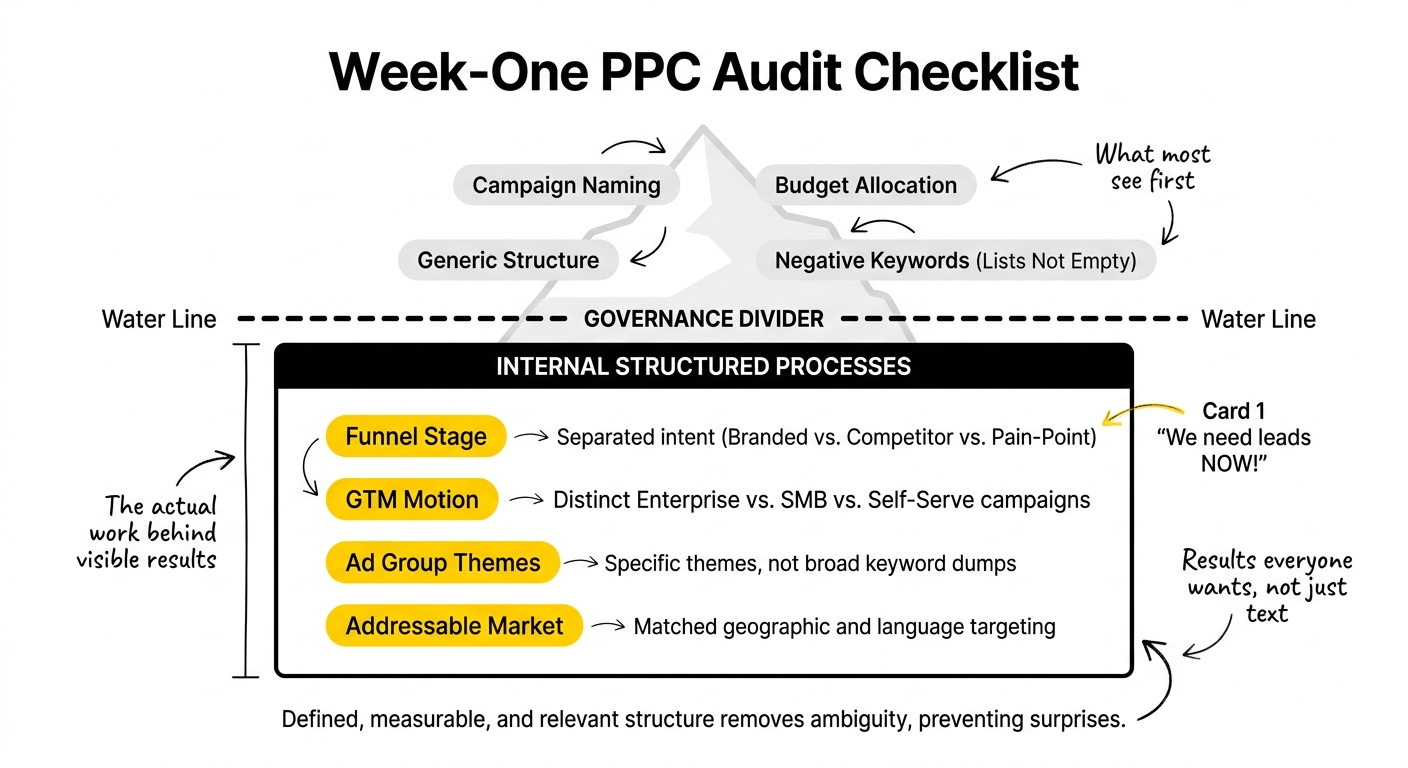
A generic campaign structure inherited from a template is one of the most common pitfalls in a first week SaaS PPC account assessment sprint. It looks organised. It runs. But if branded, competitor, and cold-audience terms are all fighting for the same budget, the account is making decisions about where money goes based on whichever campaign happens to have room left in the day, not based on which segment actually deserves the spend.
Tracking: Confirm It Before Trusting Anything Downstream
Tracking and reporting alignment only works if the underlying tracking is accurate, and accuracy has to be verified directly rather than assumed because a dashboard is populated.
The check here is straightforward in principle and easy to skip in practice: pull a sample of platform-reported conversions from the past few weeks and trace each one against the CRM. Do the counts match. Do the values match. If a demo request shows up as a conversion in Google Ads but never appears as a lead in HubSpot or Salesforce, that gap needs an explanation before anyone builds a budget decision on top of the numbers either side of it.
Tracking checks for the week-one sprint:
- Conversion actions map to real business outcomes (demo requests, trial signups, qualified form fills), not proxy events like page scrolls or time-on-page
- Offline conversion import from the CRM is active, so closed-won and qualified-lead status feeds back into the ad platform rather than stopping at raw form fills
- The attribution window reflects the actual sales cycle length, not a shorter platform default
- Duplicate tracking does not exist between GA4 native tags and Google Tag Manager
An account that relies solely on raw form submissions as its success signal, without qualified-lead or closed-won data feeding back, ends up optimising for volume. Spend increases, form fills go up, and lead quality quietly deteriorates, because the bidding algorithm has no way to tell a real buyer from a curious visitor. Where marketing automation platforms sit between the ad account and the CRM, this is also the moment to confirm lead status syncs correctly rather than stalling in a queue nobody checks.
Landing Pages: Message Match Before Design Polish
Landing page effectiveness gets evaluated for the wrong thing more often than not. Design polish matters less in week one than message match: does the page the ad sends someone to actually answer the question the ad's headline implied it would.
According to Unbounce's 2026 Conversion Benchmark Report, the median dedicated landing page now converts at 4.02%, with the top quartile exceeding 11.45%. B2B SaaS free-trial pages often clear 7 to 8% when message match and form length are handled correctly. A page converting well below its category median in week one is not a design problem to solve later. It is a signal to check immediately, because every point of conversion rate below benchmark means paying more to generate the same lead volume.
What the week-one review should confirm:
- Each major campaign theme has its own landing page rather than routing to one generic page
- The headline and hero section echo the ad copy that brought the visitor there
- The form asks for the minimum information needed to qualify a lead, not the maximum information sales would like to have
- Page load speed is fast enough that it is not silently suppressing the conversion rate before anyone reads the headline
Budgets: Where the Money Is Actually Going
Budget allocation review in week one is less about whether the total spend is right and more about whether the split across campaigns matches priority. It is common to find a legacy campaign still absorbing a disproportionate share of budget simply because nobody has revisited the split since it was first set up.
Cross-check impression share lost to budget on the campaigns that matter most. A high-performing campaign type that is losing half its impression share to budget constraints is often the fastest fix available in week one: reallocating spend from an underperforming campaign rather than requesting more total budget.
Reporting Alignment: Transparency From Day One
Reporting alignment sets the tone for the entire agency relationship. Performance-obsessed marketing managers cite a lack of transparency in reporting as one of the most common frustrations with PPC agencies, and week one is the moment to establish whether that pattern will repeat or not.
The reporting review should confirm that the metrics both sides will track are agreed in writing: cost-per-opportunity and pipeline contribution, not just clicks and impressions. It should also confirm the reporting cadence and the format, so nobody discovers in week four that “weekly reporting” meant something different to the agency than it meant to the client.
Metrics That Actually Matter in Week One
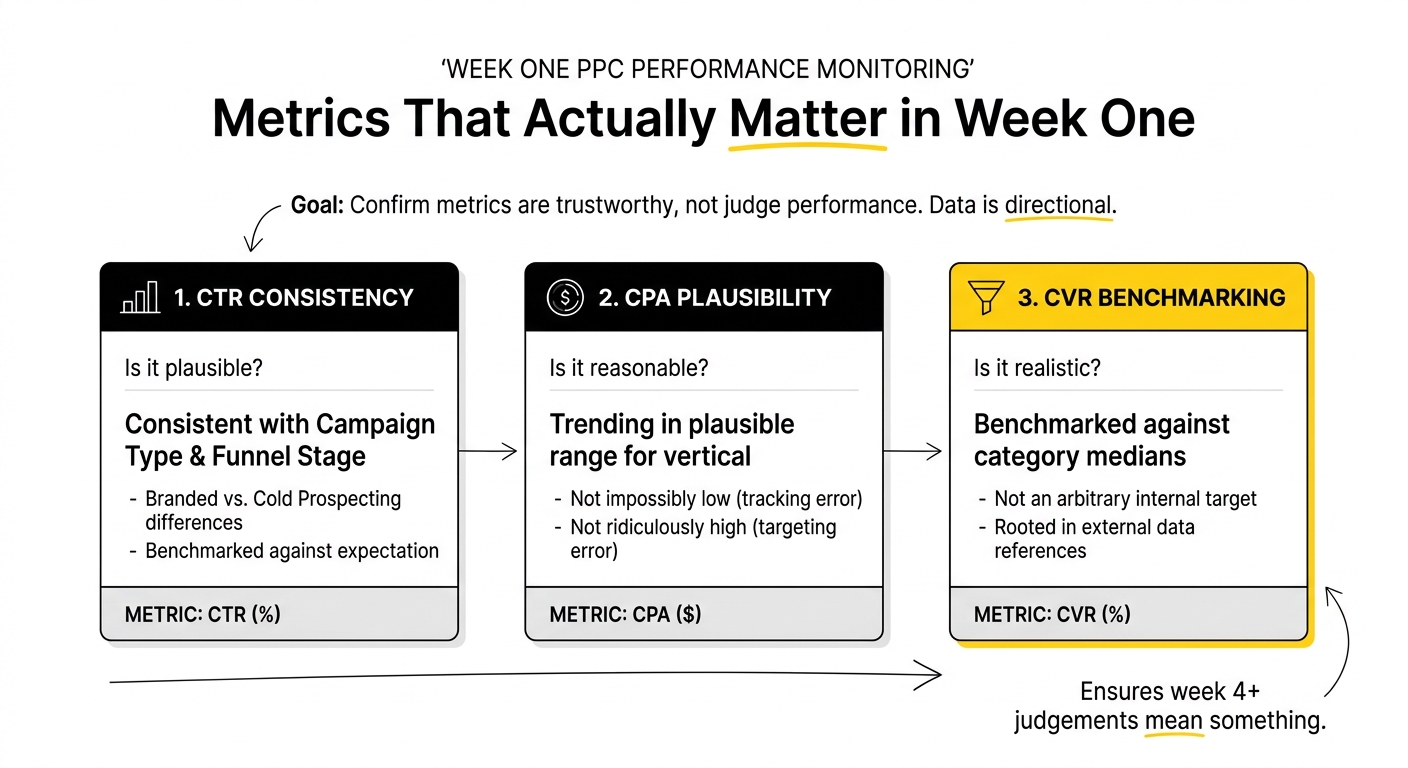
CTR, CPA, and conversion rate all get reviewed in the week-one sprint, but with the understanding that a single week of data is directional, not conclusive. The goal is not to judge performance in week one. The goal is to confirm the metrics themselves are trustworthy, so that judging performance in week four or week eight means something.
SaaS marketing performance metrics review at this stage should look for:
- CTR consistent with the campaign type and funnel stage (a branded campaign should see a materially higher CTR than a cold prospecting campaign)
- CPA trending in a plausible range for the vertical, not so low it suggests tracking is under-counting spend or so high it suggests targeting is off
- Conversion rate on landing pages benchmarked against category medians, not against an arbitrary internal target with no external reference point
Common Pitfalls in the Week-One Sprint
A few patterns show up repeatedly:
- Reviewing performance before verifying tracking. Performance numbers built on broken tracking are not performance numbers. They are noise with a dollar sign attached.
- Treating the audit as a one-time event. Week one establishes a baseline. It is not a substitute for the deeper audits that follow at later stages of the relationship.
- Skipping the CRM reconciliation. Platform-reported conversions that never get checked against CRM data can look perfectly healthy while missing the sales quality problem entirely.
- Confusing activity with alignment. A busy first week of calls and reports means nothing if campaign structure, tracking, and budget allocation have not actually been verified.
- Assuming the previous agency's account structure was sound. Inherited structure should be assessed on its own merits, not assumed correct because it existed before.
Turning the Audit Into a Working Plan
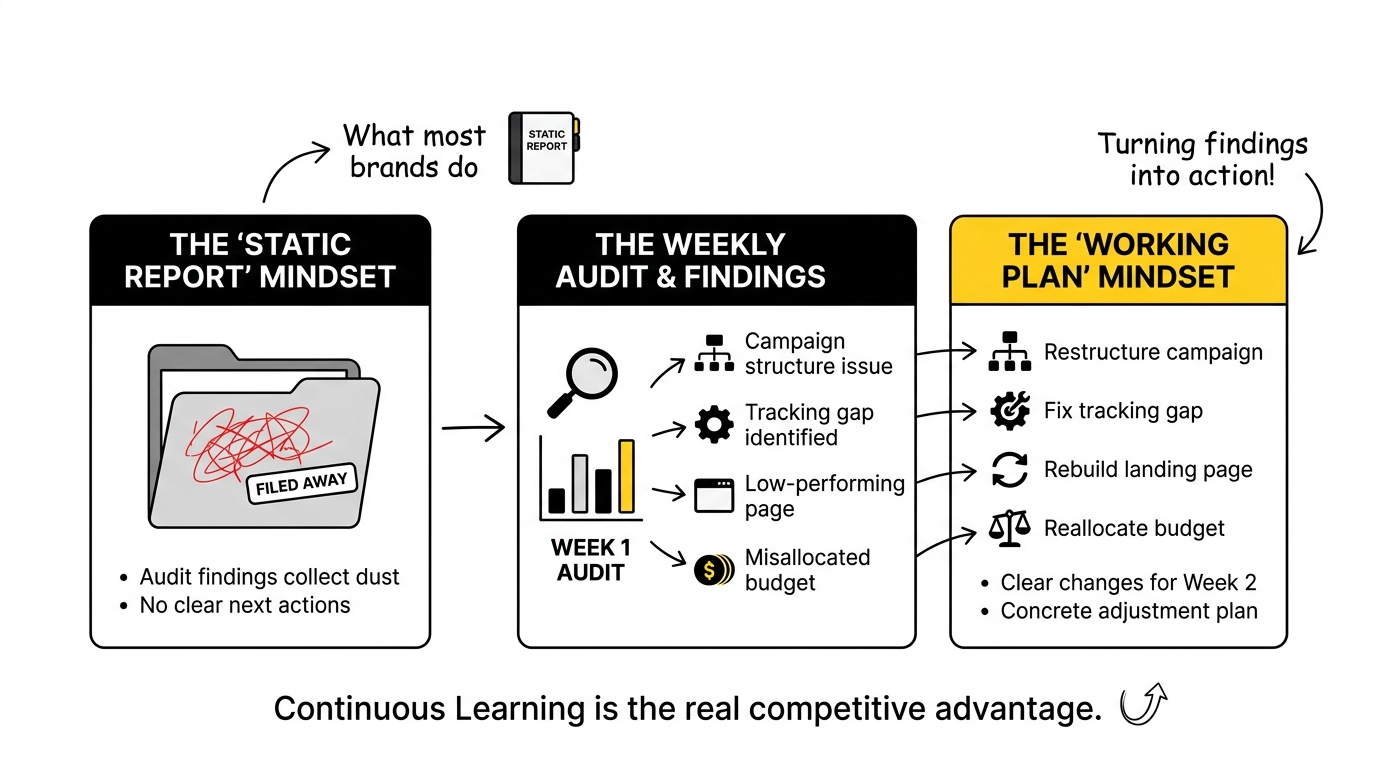
The audit itself is only useful if its findings turn into a concrete adjustment plan, not a static report that gets filed away. Each finding from the week-one sprint should map to a specific next action: restructure this campaign, fix this tracking gap, rebuild this landing page, reallocate this budget line. A marketing manager reviewing the output should be able to see exactly what changes in week two as a direct result of what was found in week one.
This is where continuous learning matters more than a single clean audit. PPC optimization techniques evolve as consent requirements shift, as platforms change how they handle automated bidding, and as the account itself accumulates more data. The week-one sprint is the starting point for that ongoing cycle, not a box to tick once and forget.
Where the Week-One Sprint Fits
A week one SaaS PPC account audit sprint is deliberately narrow. It does not replace the deeper access and tracking QA work that should happen even earlier, in the first 48 hours of onboarding, an Access & Tracking QA Checklist for New SaaS PPC Agencies covers that ground in detail, and it is not the same exercise as a comprehensive review before scaling spend into six or seven figures a month. Each of those serves a different moment in the relationship. Confusing them, running a light week-one check when a deep turnaround review is what is actually needed, or running a heavyweight scale-readiness audit when all that is required is a baseline health check, wastes time on both sides.
If your team is bringing on a new PPC partner, the sequence that tends to work best is a focused saas paid media audit on access and tracking in the first 48 hours, followed by this week-one structural sprint, with deeper audits reserved for the moments that actually call for them. A PPC strategy built on a validated week-one foundation holds up better under scrutiny than one built on assumption, and it sits more comfortably alongside whatever other digital marketing strategies and performance marketing channels the business already runs.
A well-run onboarding also depends on what the client hands over before the sprint starts. A SaaS PPC Onboarding Pack covering brand assets, prior campaign data, and CRM field mapping gives the agency what it needs to run this sprint without chasing down basic inputs mid-week.
Frequently Asked Questions
What is the PPC audit approach for B2B SaaS campaigns?
The week-one approach for B2B SaaS focuses on confirming five things exist and function correctly: campaign structure, tracking, landing pages, budget allocation, and reporting alignment. It is a baseline health check, not a deep performance diagnosis.
How to conduct a PPC audit for SaaS companies?
Start by tracing a sample of platform-reported conversions against CRM records to confirm tracking is accurate, then review campaign structure against funnel stage and audience segment, check landing page message match against ad copy, and confirm the reporting metrics both sides will use are agreed in writing.
What critical elements should be included in a PPC audit?
A week-one PPC audit should include campaign structure review, tracking verification against CRM data, landing page message-match evaluation, budget allocation across campaign priority, and confirmation of reporting cadence and metrics.
How can tracking be effectively audited in a PPC campaign?
Pull a sample of platform-reported conversions and trace each one against CRM records to confirm the counts and values match. Confirm offline conversion import is active so qualified-lead and closed-won status feeds back into the ad platform, not just raw form fills.
What role do landing pages play in a PPC account audit?
Landing pages determine whether ad spend converts into leads at a rate consistent with category benchmarks. A week-one audit checks message match between ad copy and landing page headline, form length, and whether each major campaign theme has its own dedicated page rather than a shared generic one.
How to assess budget allocation during a PPC audit?
Compare the current budget split across campaigns against actual priority, and check impression share lost to budget on the campaigns that matter most. Reallocating from an underperforming campaign is often a faster fix than requesting additional total spend.
What metrics should be analyzed in a PPC audit report?
CTR, CPA, and landing page conversion rate should all be reviewed, benchmarked against category medians rather than arbitrary internal targets. In week one, the goal is confirming these metrics are trustworthy, not judging performance from a single week of data.
How can transparency improve PPC campaign performance?
Agreeing on reporting metrics and cadence in writing during week one prevents the most common source of agency friction: discovering weeks later that “reporting” meant something different to each side. Transparency early reduces disputes about performance later.
What are the common pitfalls to avoid during a PPC audit?
The most common pitfalls are reviewing performance before verifying tracking, skipping CRM reconciliation, treating the audit as a one-time event, and assuming an inherited campaign structure is sound simply because it already existed.
How to align PPC reporting with business goals?
Anchor reporting to cost-per-opportunity and pipeline contribution rather than clicks and impressions alone, and confirm both sides agree on the reporting format and cadence in writing during the first week, not after the first report is delivered.
If your team wants a second set of eyes on a week-one audit, or wants help building the plan that turns findings into action, we are happy to walk through it together.