What Makes a Great B2B SaaS Digital Advertising Agency in the UK
Choosing the right B2B SaaS digital advertising agency is one of the highest-impact decisions a scaling company can make. It affects pipeline quality, spend efficiency, and how credible paid media looks to your revenue team. Yet most demand generation leaders approach it like buying a commodity service, when the difference between an exceptional agency and an average one is often measured in millions of pounds of revenue impact over a year.

Key Characteristics of Exceptional B2B SaaS Digital Advertising Agencies
You launch campaigns with what you think are the best B2B SaaS digital advertising agencies in the UK. Demos come in. Platform metrics look healthy. Three months later, the board asks where the pipeline is.
This is the gap most demand generation leaders inherit when they start working with a new digital advertising agency. The agency can run ads. It can generate leads. But the leads don't convert, the cost-per-opportunity spirals, and the revenue team doesn't trust the names coming through. You're left wondering whether the problem is your product, your sales process, or the agency's ability to find actual buyers.
Choosing the right B2B SaaS digital advertising agency is one of the highest-impact decisions a scaling company can make. It affects pipeline quality, spend efficiency, and how credible paid media looks to your revenue team. Yet most demand generation leaders approach it like buying a commodity service, when the difference between an exceptional agency and an average one is often measured in millions of pounds of revenue impact over a year.
This article breaks down what actually defines a great B2B SaaS digital advertising agency in the UK, what to look for beyond the pitch deck, and how to build an evaluation framework that protects your budget and your credibility. For more context on the broader B2B SaaS PPC landscape, visit our B2B SaaS PPC agency resource.
What Makes a B2B SaaS Digital Advertising Agency Truly Different
Most digital advertising agencies are generalists. They run campaigns across industries, platforms, and business models. They optimise for click volume, conversion rate, and ROAS. All useful metrics. None of them directly connect to whether your board sees pipeline and revenue.
An exceptional B2B SaaS digital advertising agency is built on a different foundation. It understands that SaaS buying is different. It recognises that a Series B company evaluating an analytics platform is not the same buyer as a mid-market enterprise looking at process automation software. It knows that MQL volume and deal pipeline move in opposite directions more often than marketers admit.
The agencies that stand out do three things exceptionally well:
They specialise in B2B SaaS, not just dabble in it. They've built repeatable processes specifically for long sales cycles, buying committees, and revenue-connected measurement. And they prove their impact through client outcomes, not benchmark data or platform metrics.
Specialisation in B2B SaaS Advertising
Generalist agencies can run competent campaigns for any vertical. They optimise for click-through rates, conversion volume, and cost-per-lead. For a B2B SaaS company, this creates a hidden problem: the agency optimises for what it can measure easily, not what matters to your revenue team.
In SaaS, the real work starts after a lead lands. An exceptional agency understands this. It builds campaigns not just to generate leads, but to find buyers who fit your ICP. It understands that a single ideal customer profile (ICP) encompasses multiple personas making different decisions. It knows that a CFO's hesitation about cost-per-user carries more weight than a procurement manager's check box concern. It treats educational touchpoints and demand capture as connected activities, not separate campaigns.
A specialist B2B SaaS agency has spent years learning what this looks like. It has worked with companies at multiple scales (Series A, B, C, established). It has watched what campaigns work when the sales cycle is 12 weeks, not 12 days. It has seen how buying committee composition changes the messaging, the channels, and the right time to engage.
This expertise is the first proof point. Ask any potential agency about their ICP discovery process, how they segment audiences within the SaaS segment, and what percentage of their client base is B2B SaaS. The answer separates specialists from those who handle SaaS as one vertical among many.
Campaign Execution and Discovery Depth
An exceptional agency doesn't start with a media plan. It starts with discovery. Real discovery.
What does real discovery look like? The agency interviews your sales team about the deals that win and the ones that don't. It asks your product team which features differentiate you from competitors. It digs into your CRM to understand where deals stall, which leads never convert, and which sales conversations move fast. It runs a competitive positioning exercise to understand how your buyer perceives you against alternatives. It builds an audience map that captures not just job titles, but pain points, decision triggers, and buying stage signals.
Only after this discovery does it build a campaign strategy. The strategy aligns lead quality to sales cycles. It splits educational touch (demand generation) from intent capture (demand generation). It identifies which message works at which stage of the buying journey. It maps message-to-channel-to-audience with specificity.
Too many agencies skip discovery and jump straight to media plan. They assume standard SaaS messages work for your specific product. They build one audience for the entire sales cycle. They measure success by lead volume. An exceptional agency treats your company's specificity as the entire foundation of the work.
Proof Points That Indicate Real Effectiveness
Claims are cheap. Proof is specific.
When evaluating a potential agency, ask for case studies that include actual numbers. Not "improved performance" or "drove consistent pipeline." Specific numbers: the cost-per-opportunity, the MQL-to-SQL conversion rate, the volume of sales-qualified leads per month, the revenue attributable to the campaigns over a 12-month period.
Many agencies will hesitate. They'll cite confidentiality. Some will say they've changed account structures so old numbers don't apply anymore. Others will show you top-level metrics without context. These are flags.
A truly exceptional agency will have case studies that show:
Even better: ask them to speak with a reference client in a similar space (same ACV range, same sales cycle, same company stage). Ask that reference what would have happened if they'd chosen a different agency. Specific references trump generic case studies every time.
Processes That Separate Exceptional Agencies from the Middle
The way an agency manages your account tells you almost everything about its quality.
Discovery and Strategy
An exceptional agency runs a discovery process that takes weeks, not days. It's collaborative, not prescriptive. It interviews your go-to-market team, your sales team, and ideally, your product and executive leadership. It doesn't assume it knows your market. It builds the strategy on what it learns, not what it learned at the last SaaS client.
The output is a documented strategy. This document (ideally 10-20 pages) covers the audience segmentation, the messaging pillars, the channel strategy, the campaign cadence, and success metrics. It's something both you and the agency can point back to. It's also changeable. Real discovery surfaces unknowns. The strategy should evolve as you learn.
Rapid Iteration and Learning
Campaigns don't work perfectly on day one. But exceptional agencies build iteration into their process from the start. They run smaller test campaigns first. They isolate variables (one message, one audience, one channel). They measure what works and what doesn't. They move budget to what's working faster than average agencies do.
This speed matters. A competitor's campaign might work for six months and then plateau. An exceptional agency will notice the plateau in week 5, not week 16. It will have already identified a new angle and begun testing it. The team is not waiting for monthly reviews to adjust. It's weekly, sometimes daily, depending on the data.
Revenue Connection
An exceptional agency insists on proper CRM integration and sales tracking. It wants to know not just how many leads its campaigns create, but how many of those leads reach SQL, move through the sales cycle, and close as customers. It measures backwards from revenue.
This requires discipline. Your sales team needs to log activities in the CRM. Your system needs to capture what source and channel a lead came from. The agency needs access to that data. Many companies and agencies treat this as too much friction. Exceptional agencies treat it as non-negotiable. They know that without it, they can't actually prove the impact and they're optimising for the wrong things.
How Agencies Connect Capture and Educational Activities to Revenue
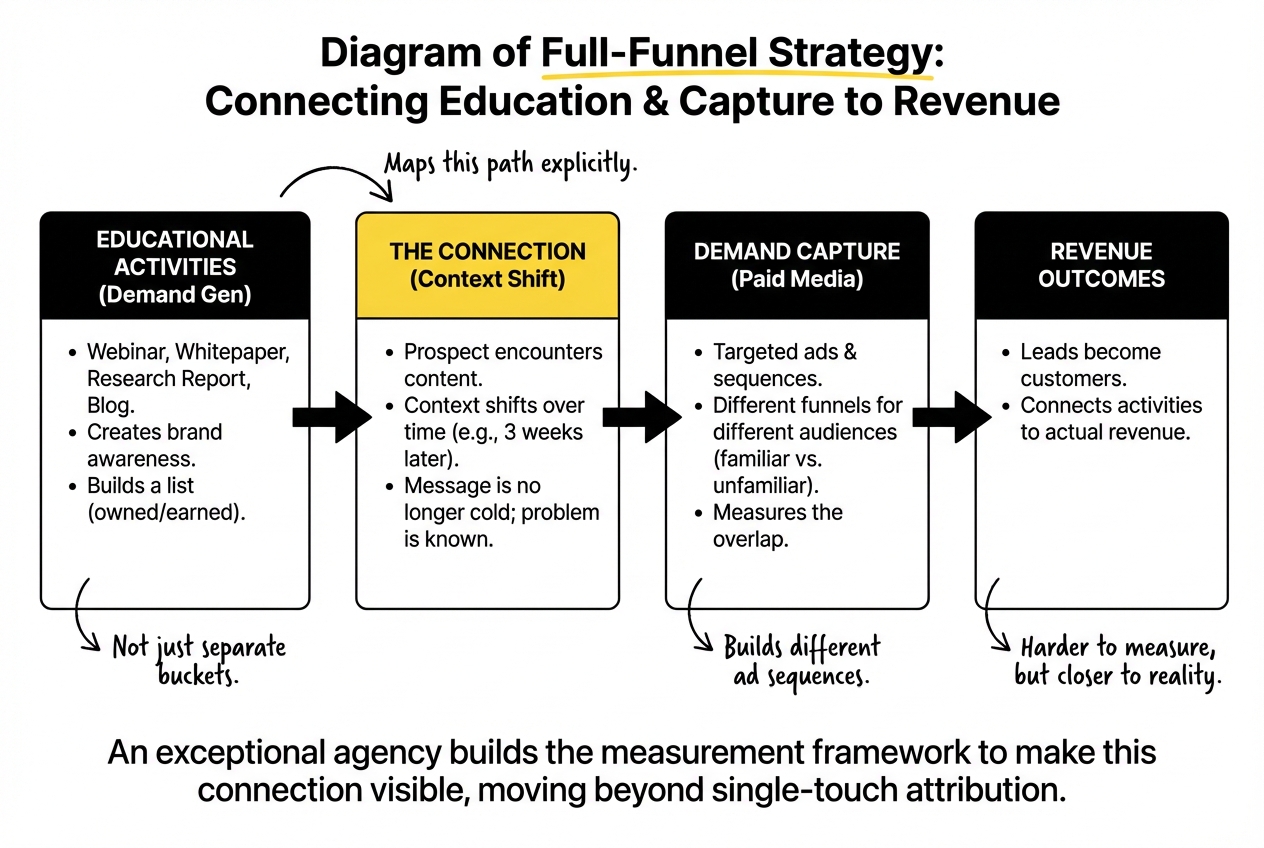
Most B2B SaaS companies treat demand generation and demand capture as separate campaign buckets. Demand gen creates brand awareness and builds a list. Demand capture turns that list into leads.
An exceptional agency understands that these aren't separate. They're connected. A prospect who encounters your educational content (webinar, whitepaper, research report) is more likely to respond positively to your demand capture ad three weeks later because the context has shifted. The message is no longer cold. The person already knows the problem exists and is considering solutions.
An exceptional agency maps this path explicitly. It shows how educational content (owned and earned) and paid demand capture work together. It measures the overlap. It understands the timing. A prospect who hasn't seen your educational content requires a different ad sequence than one who already reads your blog. The agency builds different funnels for different audiences based on their level of familiarity with your brand.
This is harder to measure than single-touch attribution. But it's closer to reality. And an exceptional agency builds the measurement framework to make it visible.
The Lead Quality Problem
One of the most consistent problems demand generation leaders report is this: leads are up, but pipeline is flat.
When this happens, the instinct is often to blame sales: they're not following up, they don't see the value in the leads. But the real problem is usually upstream. The agency has optimised for lead volume at the expense of quality. It's found a cheap way to generate leads that don't match your ICP. It's targeting too broad. It's using message that attracts curious browsers, not buyers.
An exceptional agency actively resists this problem. It measures lead quality not by the volume of MQLs, but by the percentage of those MQLs that become SQLs. It measures not how many leads the campaigns create, but how many of those leads result in deals. It gets uncomfortable if lead volume is up but SQL conversion is down, because that's a clear sign the criteria for what counts as a lead is drifting.
The way an agency handles this tension is revealing. Does it push back on raw lead volume targets? Does it have a conversation with you about what "quality" means in your business? Does it build audience selection criteria that are tight, not loose? These are signs of an exceptional agency.
Metrics That Matter for Evaluating a B2B SaaS Agency
When you're assessing a potential agency partnership, most conversations start with "What's your average ROAS" or "What's your typical cost-per-lead in our space."
These questions are traps. ROAS varies wildly depending on your product, your market, your sales cycle, and your brand familiarity. A cost-per-lead benchmark is almost meaningless without understanding the quality of those leads and the cost-per-opportunity down the funnel.
An exceptional agency will push back on these questions. It will ask you: what does a good customer actually cost to acquire for you. It will ask about your sales cycle. It will ask about your average contract value. Then it will give you a framework, not a benchmark.
The metrics that actually matter:
Cost-per-opportunity, Not cost-per-lead or cost-per-click. The cost of each qualified opportunity that reaches your sales team. This connects to revenue. Everything else is vanity.
MQL-to-SQL conversion rate, What percentage of leads the agency generates actually become qualified opportunities your sales team wants to pursue. Agencies that generate low-quality leads will have weak conversion rates here.
Pipeline velocity, How quickly opportunities the agency sourced move through your sales cycle compared to other sources. Paid media should typically be faster than inbound, but slower than direct outbound.
Cost-to-close, If you can measure it, the full cost (all-in, including creative, media, and management) to close a customer through paid media. This is the true north metric for revenue teams.
Learning velocity, How quickly the agency moves budget from underperforming campaigns to winning campaigns. This is harder to measure but crucial. Agencies with slow iteration cycles waste budget on things that don't work for longer than necessary.
An exceptional agency will commit to measuring these. Not all at once, but progressively as the relationship matures. It will reject vanity metrics and focus your entire team on what actually matters.

Building Your Evaluation Framework
When you're assessing potential agencies, use this framework to cut through the pitch.
Stage One: Specialisation Check
Ask the agency: What percentage of your client base is B2B SaaS? Ask them to name three B2B SaaS clients in the UK (confidentiality is fine, but you want to know they have current local experience). Ask them to walk through their last three onboarding processes for SaaS clients. What did they ask about. What surprised them. How did the strategy differ from what they expected based on the client's initial brief.
A specialist agency will have specific answers rooted in actual client experience. A generalist agency will give you framework-level answers that could apply to any vertical.
Stage Two: Discovery Process
Ask the agency to show you their discovery process. Get them to walk through what they'd do in your first 30 days. What would they want to learn. Who would they interview. What data would they need access to.
The specificity of the answer matters. If they say they'll build an audience plan and run a competitive analysis, that's good but generic. If they say "We'll interview your top 10 customers to understand the specific events that triggered their buying decision, and we'll audit your CRM to find the earliest touchpoint where leads that became customers first appeared," that's specific and signals depth.
Stage Three: Proof and Reference Calls
Ask for three case studies with numbers. Ask for references in the same ACV band and with a similar sales cycle to yours. When you call those references, ask about the first three months (Were there surprises? Did the agency have to pivot the strategy?) and the outcome after 12 months. Also ask: what would you have done differently if you were hiring this agency again.
Stage Four: Measurement and Integration
Ask the agency how it measures success. The answer should include your CRM, not just its own dashboard. It should include questions about lead quality, not just lead volume. It should include a framework for attribution that acknowledges what it can and can't measure.
If the agency says "We'll measure ROAS from Google Ads" and stops there, it's missing the full picture. An exceptional agency will have a plan to connect its work to your revenue outcomes, even if some attribution is ambiguous.
Stage Five: The Collaboration Signal
Pay attention to how the agency approaches the sales conversation. Does it ask more questions than it makes claims. Does it seem interested in learning your business, or is it trying to fit you into a template it's already running. Does it push back on anything you've said (a good sign that it's thinking, not just nodding along).
A great agency won't be the easiest to work with in the sales cycle. It will ask hard questions and have opinions. This is a signal of specialisation.
.jpeg)
Common Challenges When Selecting a B2B SaaS Agency
The Generalist vs. Specialist Tension
The biggest challenge is that generalist agencies can look and feel professional. They have good process documentation. They have testimonials. But they lack the muscle memory of SaaS-specific problems. When your lead quality drops, a generalist agency will look for platform fixes (bid adjustments, audience exclusions). An exceptional agency will question whether the ICP definition has drifted and recommend messaging changes.
Specialist agencies are smaller and sometimes feel less established. Resist the urge to choose the bigger, more polished option. The cost of choosing wrong is much higher than the comfort of choosing the familiar.
The Proof Problem
Many exceptional agencies have clients who are under NDA or too competitive to speak publicly about their results. This is legitimate. But you should still be able to see case studies with specific numbers. If an agency has zero case studies with specific outcomes, that's a problem. It either doesn't have strong results or it's not comfortable sharing them. Either way, it's a flag.
The Transition Cost
If you're moving from another agency, there will be a transition period where your account structure is rebuilt, audiences are mapped from scratch, and new campaigns are set up. This transition can cost 4-8 weeks in time and sometimes in campaign performance. An exceptional agency will budget this explicitly and be honest about the timeline. It won't promise to hit targets in week two of the engagement. Structuring SaaS PPC Accounts for PLG vs Sales-Led Funnels, also on this blog, takes this further.
Measurement Resistance
Some agencies will resist connecting campaigns to your revenue outcomes. They'll say attribution is too complicated or your CRM isn't set up well enough. This is often an excuse. Real measurement discipline is a sign of strength. If an agency is pushing back on accountability, that's a red flag.
The Upraw Perspective
At Upraw, we've seen both sides of this. We've worked with teams that came to us after frustrating experiences with agencies that prioritised lead volume over lead quality. We've also built campaigns with teams that knew exactly what a good prospect looked like and had the discipline to measure backwards from revenue.
The difference is always in the clarity of definition and the willingness to be uncomfortable with metrics that don't look impressive on a vanity dashboard. The teams we've worked with most successfully are the ones willing to say "We don't care about MQL volume. We care about SQL pipeline and closed deals." Agencies that share this view are rare. Most want to hide behind lead volume.
Frequently Asked Questions
What makes a B2B SaaS digital advertising agency stand out in the UK?
Specialisation is the first signal. An exceptional agency has worked with multiple B2B SaaS companies at different scales and knows how SaaS buying cycles, pricing models, and revenue measurement differ from other verticals. It builds campaigns not for lead volume, but for lead quality and revenue connection. It also has repeatable discovery and measurement processes, case studies with specific numbers, and the discipline to connect paid media outcomes to pipeline and closed deals.
What key characteristics should you look for in a B2B SaaS digital advertising agency?
Three core characteristics matter most. First, deep specialisation in B2B SaaS (not just digital marketing generalism). Second, a proven process for discovery, strategy, campaign execution, and measurement that's specific to long sales cycles and revenue-connected outcomes. Third, the ability to prove its impact through case studies with specific numbers and reference clients you can speak to honestly about their experience.
How can a B2B SaaS agency enhance lead quality for scaling companies?
Lead quality is enhanced through tight ICP definition, audience segmentation that captures multiple personas within a target account, messaging that speaks to buyer pain points rather than product features, and measurement that tracks not lead volume but the percentage of those leads that convert to SQL and eventually close. An exceptional agency actively resists pressure to optimise for volume at the expense of quality.
What processes do successful B2B SaaS digital advertising agencies use to execute campaigns?
Great agencies use a structured process that starts with discovery (interviewing your team, auditing your CRM, understanding your buyer journey), moves to strategy documentation (audience segments, messaging pillars, channel strategy), then to campaign execution with rapid iteration. They measure weekly and adjust budget allocation based on what's working. They integrate tightly with your CRM to measure backwards from revenue, not just platform metrics.
What proof points indicate the effectiveness of a B2B SaaS digital advertising agency?
The strongest proof points are case studies that include specific numbers (cost-per-opportunity, MQL-to-SQL conversion rate, revenue closed), client references you can speak to about their actual experience, and a framework for measurement that connects campaigns to your revenue outcomes. Be wary of benchmarks or generic success stories. Ask to see the baseline before the agency started, the changes it made, and the measurable outcome after 12 months.
How do B2B SaaS agencies connect capture and educational activities to revenue?
Exceptional agencies map the relationship between demand generation (educational content, brand awareness) and demand capture (intent-based campaigns) explicitly. They recognise that a prospect who has engaged with your educational content is in a different buying mindset than a cold prospect. They build different ad sequences and messaging for prospects at different stages of familiarity with your brand. They measure the overlap and contribution of both types of activity to pipeline outcomes.
What are the common challenges faced by B2B SaaS companies when selecting an advertising agency?
The biggest challenge is distinguishing between generalist agencies that look professional but lack SaaS-specific expertise and specialist agencies that have deep muscle memory in this vertical. Other challenges include evaluating proof claims (many agencies don't have specific case studies), understanding transition costs when moving from another agency, and pushing back on agencies that resist revenue-connected measurement and accountability.
How can demand generation leaders evaluate potential B2B SaaS agencies?
Use a five-stage framework. First, check specialisation by asking what percentage of their client base is B2B SaaS and request evidence of UK experience. Second, examine their discovery process in detail. Third, request specific case studies and ask for reference calls. Fourth, ask how they measure success and whether their measurement includes your CRM. Fifth, observe whether they ask thoughtful questions and push back on assumptions in the sales process itself.
What role does specialisation play in the success of a B2B SaaS digital advertising agency?
Specialisation is foundational. A generalist agency can run competent campaigns but often optimises for the wrong metrics (lead volume instead of lead quality). A specialist agency knows that SaaS buying is different. It understands buying committees, long sales cycles, multiple decision-makers, and revenue measurement. It knows which messaging works at which stage of the journey. This allows it to build campaigns that produce qualified pipeline, not just leads.
What metrics should be used to assess the performance of a B2B SaaS digital advertising agency?
Focus on cost-per-opportunity (the cost of each qualified opportunity that reaches your sales team), MQL-to-SQL conversion rate (what percentage of leads become opportunities your sales team pursues), and pipeline velocity (how quickly opportunities move through your sales cycle). Secondary metrics include cost-to-close (all-in cost per customer acquired through paid media) and learning velocity (how fast the agency moves budget to winning campaigns). Avoid vanity metrics like ROAS or cost-per-lead without context about quality.
Key Takeaways
An exceptional B2B SaaS digital advertising agency specialises in your vertical, not just dabbles in it. It runs deep discovery before writing any campaign briefs. It measures backwards from revenue, not forwards from impressions. It builds repeatable processes for B2B SaaS buying, not just platform mechanics.
When you're evaluating potential partners, look for agencies that ask hard questions before they make promises. Look for proof in the form of specific numbers, not benchmark data. Look for references you can actually speak to. And look for the willingness to be uncomfortable with metrics that feel good but don't connect to your business.
The right agency is one that understands that your success is measured in revenue and pipeline, and that every decision it makes is designed to influence those outcomes. Everything else is optimisation.
If you're working through this evaluation, we're happy to take a look at your current setup and share what we're seeing in the B2B SaaS PPC space right now. This is the kind of thing we dig into with SaaS teams regularly. Worth a conversation if you're at that point.