Agency vs In-House: When to Bring in a SaaS Paid Media Specialist
Decide between agency vs in-house SaaS paid media with a clear framework for budget, complexity, bandwidth and risk, plus the best hybrid model.

The question is rarely “agency or in-house.” It’s “what’s the cost of getting this wrong?”
A bad hire in a paid media role can burn six months of budget and 12 months of runway. A bad agency can do the same in three. And a hybrid setup done without clarity on who owns what usually produces the worst outcome of all: two parties, shared confusion, no accountability.
This article is not a pros and cons list. It’s a decision framework built specifically for B2B SaaS teams, with guidance based on where you actually are, not where you’d like to be. If you already work with a SaaS PPC agency and want to evaluate whether the setup is right, the same framework applies.
What You’re Really Deciding
Most “agency vs in-house” articles frame this as a trade-off between cost and quality. That’s the wrong lens. The real trade-off is:
Control and context (in-house) versus specialist depth and speed (agency) versus risk-managed execution (hybrid).
An in-house hire gives you someone who lives inside the business. They understand the product, the sales team’s objections, the deals that never close. That contextual knowledge matters. The problem is it takes time to build, and during that ramp-up period, money is spent.
A specialist SaaS PPC agency gives you immediate depth. They’ve run campaigns across dozens of SaaS companies, know what campaign structures work in your category, and can build and test faster than a single in-house hire. The limitation is they’re not in the building. Briefing, context transfer, and alignment require deliberate effort on your side.
The hybrid model, which is the most common setup among growth-stage SaaS teams, puts a strategist in-house and hands execution depth to an agency. Done well, it combines the best of both. Done badly, it creates a situation where the in-house person questions everything the agency does, and the agency receives insufficient context to make decisions.
Understanding which model fits your situation starts with being honest about six factors.
The SaaS Paid Media Decision Scorecard
Score each factor honestly. The results will point you toward a starting position.
1. Runway and burn tolerance
If you have under 12 months of runway, a bad hire or a mis-set agency relationship isn’t just an inconvenience. It accelerates the existential problem. Short runway favours an agency pilot: defined scope, faster ramp, easier to exit if it’s not working. In-house hiring takes longer to produce value and longer to reverse.
2. Monthly paid media spend
Below £5,000 per month, the economics of a specialist agency retainer rarely make sense unless you’re in a build phase with plans to scale quickly. Between £5,000 and £25,000 per month, an agency delivers more execution capacity than a single hire at the same all-in cost. Above £25,000 per month across multiple channels and markets, a hybrid model starts to make structural sense.
3. Channel complexity
Running one campaign on Google Search is straightforward. Running multi-channel demand gen across Google Search, LinkedIn, and paid social, split across UK and EU markets, with different ICPs and conversion paths, is a different problem. Complexity multiplies the value of specialist depth. A single in-house hire, no matter how good, is covering a lot of ground.
4. Measurement maturity
If your CRM attribution is broken, your pipeline reporting is unreliable, or you can’t connect ad spend to closed revenue, adding headcount doesn’t fix the problem. It hides it. An agency with experience diagnosing attribution problems will identify what’s broken faster. If you’re building measurement from scratch, getting external help to set the foundation is a better use of the first 90 days than hiring someone to manage campaigns on top of uncertain data.
5. Creative velocity
B2B SaaS paid media in 2025 requires continuous creative testing, particularly on LinkedIn and YouTube. Demand gen channels live and die on fresh creative. If your internal team doesn’t have the bandwidth to produce ad creative on a two-to-three week cycle, an agency with design capacity helps close that gap.
6. Internal leadership bandwidth
An agency without a strong internal point of contact will drift. Someone needs to own the relationship: brief the agency on product changes, share sales feedback, approve decisions, and hold the agency to account. If the most logical internal person for this role is already at capacity, the agency relationship will underperform. If leadership bandwidth is genuinely thin, that changes the calculus on what kind of engagement structure makes sense.
.jpeg)
Stage-Based Guidance
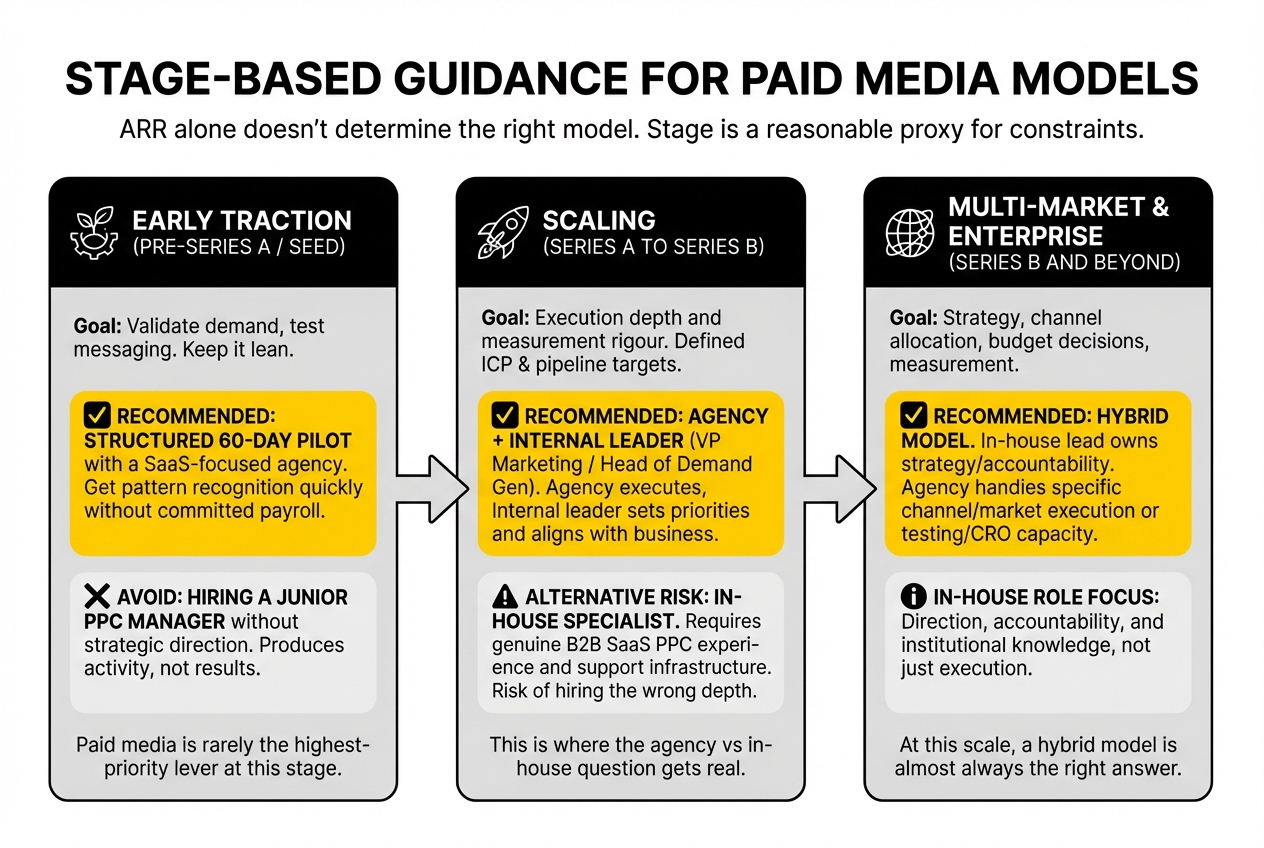
ARR alone doesn’t determine the right model. But stage is a reasonable proxy for the constraints that do.
Early traction (pre-Series A / Seed)
Paid media is rarely the highest-priority lever at this stage. If you’re experimenting with paid to validate demand or test messaging, keep it lean. A structured 60-day pilot with a SaaS-focused agency is more useful than a hire. You get pattern recognition quickly, without a committed salary on the payroll.
What to avoid: hiring a junior PPC manager to “own it” when there’s no strategic direction for them to execute against. That setup produces activity, not results.
Scaling (Series A to Series B)
This is where the agency vs in-house question gets real. You have a meaningful budget, a defined ICP, and pipeline targets that marketing owns. You need execution depth and measurement rigour at the same time.
The most reliable setup here is an external SaaS PPC agency paired with a VP of Marketing or Head of Demand Gen who owns the relationship internally. The agency executes. The internal leader sets priorities, manages the commercial relationship, and keeps the agency aligned with what’s changing in the business.
Hiring an in-house paid media specialist at this stage works if you can find someone with genuine B2B SaaS PPC experience (not just Google-certified generalists), and if the rest of your marketing infrastructure is in place to support them. The risk: the person you can afford is not the person with the depth you need, and the gap becomes clear after three to four months.
Multi-market and enterprise (Series B and beyond)
At this scale, a hybrid model is almost always the right answer. An in-house paid media lead or Head of Performance Marketing owns strategy, channel allocation, budget decisions, and measurement. A specialist b2b saas ppc agency handles execution in specific channels or markets, or provides capacity for testing and landing page CRO that internal teams rarely have bandwidth to run.
The in-house role at this stage isn’t execution. It’s direction, accountability, and institutional knowledge.
Objection: We’ll Lose Learning If We Outsource
This is the most common objection, and it’s legitimate. Knowledge built inside a paid media programme has real value. If it only lives in an agency’s account notes, you’re exposed if you switch.
The solution is structural, not contractual. Require the following from the start:
- Weekly account notes documenting what was changed, why, and what the expected outcome is. Not a reporting dashboard. A human account of decisions.
- Attribution to be owned internally. CRM pipeline data, UTM structure, and conversion tracking should sit with you, not the agency. The agency queries your data. It doesn’t own it.
- Monthly strategy reviews where the agency explains reasoning, not just results. If the agency can’t articulate why a campaign structure was built a specific way, that knowledge isn’t transferring to you.
- Full account access at all times. No exceptions. If an agency hesitates on this, walk away.
A well-run agency engagement increases your internal knowledge over time, because the team managing the relationship learns what good looks like. That’s an asset if you ever do transition to in-house.
Objection: Agencies Don’t Care the Way Employees Do
This objection is also legitimate. The incentive structure is different. An employee’s reputation inside the company is tied to the outcome. An agency’s reputation is tied to retention and referrals, which depends on the relationship, not just the numbers.
The gap doesn’t close through hope. It closes through the structure of the engagement. Before signing:
- Ask who will be working on your account day-to-day. Not just the sales lead. The actual person. Seniority of execution matters.
- Ask for a QA process. What gets checked before campaigns go live? Who checks it?
- Ask how change requests are handled. What’s the expected turnaround? Is there a written SLA?
- Ask for a change log. Every structural change to campaigns should be documented with rationale. If there isn’t one, create the expectation immediately.
The agencies that push back on these questions are not agencies with strong processes. They’re agencies with weak ones that don’t want the accountability.
The Real Cost Comparison
Before deciding, get the numbers in the same frame.
In-house specialist (UK/EU market, 2025)
A mid-level in-house paid media manager with genuine B2B SaaS experience costs between £45,000 and £65,000 base salary. Add employer NI, pension contributions, holiday cover, equipment, and tools, and the total cost is typically £60,000 to £85,000 per year. Ramp-up to full productivity is three to four months minimum. If the hire is wrong, the time cost of exiting and restarting adds another two to three months and the opportunity cost of budget spent during that period.
Agency retainer
A specialist SaaS PPC agency retainer for the same budget level runs £3,000 to £8,000 per month depending on scope, channels, and the agency model. That’s £36,000 to £96,000 per year. Unlike a salary, the retainer is variable. It can be reduced if business conditions change. It can be scoped up when you’re ready to scale. The ramp-up period is shorter, and exit is faster.
The real comparison isn’t just cost. It’s the combination of cost, time-to-value, and reversibility.
An agency pilot delivers results (or evidence of problems) in 60 to 90 days. An in-house hire delivers results in six to nine months, if the hire is right. For a SaaS team managing CAC payback carefully, that difference matters.
When to Hire In-House First
There are specific situations where leading with an in-house hire makes sense.
You’re at a stage where you have strong paid media infrastructure already running and need someone to own, scale, and direct it. You’re bringing multiple channels in-house from an agency and need a single point of operational ownership. You’re building a performance marketing function that will grow to a team of three or more, and need a lead hire. Building a Scale-Ready SaaS PPC Engine After PMF: From Ad-Hoc to Operating System, also on this blog, takes this further.
If you’re hiring in-house, the skills that matter most are: Google Ads account management at scale (not just campaign creation), attribution and analytics literacy (UTMs, CRM integration, interpreting pipeline data), structured experimentation (how to run and read a test), and communication upward (translating performance data into commercial context for the board).
What not to expect from one person: strategic direction setting, creative production, landing page development, and full-stack analytics. A single hire is not a team.
The Hybrid Model Blueprint
For most growth-stage SaaS teams, the hybrid model is the most resilient setup. Here’s how to divide responsibilities cleanly.
In-house owns:
- Positioning and messaging (what the ads say, what the landing pages promise)
- Approval of creative and copy
- CRM and attribution infrastructure
- Relationship management with the agency
- Commercial decisions: budget allocation, new channels, channel exits
Agency owns:
- Campaign structure and account architecture
- Keyword and audience strategy
- Bid management and optimisation
- Testing cadence (ad copy, landing page variants, audience splits)
- Reporting against pipeline metrics, not just ad platform metrics
The place where this breaks down most often: both parties end up with unclear ownership of strategy. The in-house person thinks the agency should be setting direction. The agency thinks the in-house person should be. The result is no strategic direction at all. Solve this at the start by agreeing in writing who sets the quarterly channel strategy, and who executes against it.
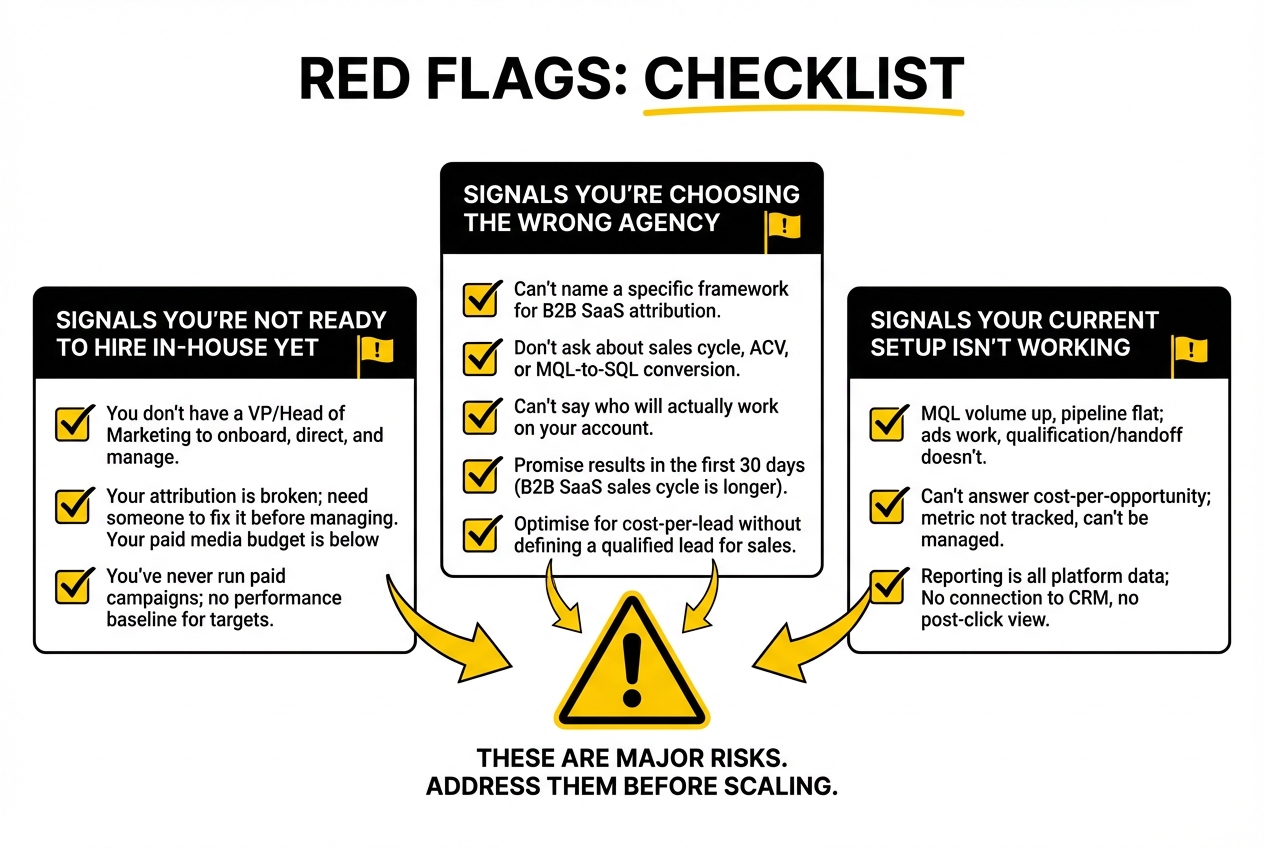
Red Flags: Signals You’re Making the Wrong Choice
Signals you’re not ready to hire in-house yet:
- You don’t have a VP or Head of Marketing who can onboard, direct, and manage the hire
- Your attribution is broken and you need someone to fix it before managing campaigns
- Your paid media budget is below £5,000 per month
- You’ve never run paid campaigns before and don’t have a performance baseline to set targets from
Signals you’re choosing the wrong agency:
- They can’t name a specific framework for B2B SaaS attribution
- They don’t ask about your sales cycle, ACV, or what MQL-to-SQL conversion looks like
- They can’t say who will actually work on your account
- They promise results in the first 30 days (a B2B SaaS sales cycle doesn’t close in 30 days)
- They optimise for cost-per-lead without asking what a qualified lead looks like to your sales team
Signals your current setup isn’t working, regardless of model:
- MQL volume is up but pipeline is flat. The ads are working; the qualification criteria or the handoff isn’t.
- You can’t answer what your cost-per-opportunity is. If the metric isn’t tracked, it can’t be managed.
- Reporting is all platform data. No connection to CRM, no view of what happened after the click.
The 90-Day Pilot Approach
If you’re starting a new agency relationship or hiring in-house for the first time, structure the first 90 days explicitly.
Days 1 to 30: Audit and foundation. Campaign structure audit, attribution review, baseline metrics established. No major campaign changes until the foundation is understood. Any agency that wants to restructure everything in week one is moving fast for the wrong reasons.
Days 31 to 60: Controlled build. Core campaigns live with defined success metrics. First creative tests running. Reporting cadence established and working. At this point you should have directional data, not conclusions.
Days 61 to 90: First evaluation point. Not a results review. A structural review. Are the right campaigns running? Is attribution working? Is the reporting useful? Have decisions been documented? If the foundation is solid, the results will follow. If it isn’t, fix it now.
Meaningful pipeline impact typically takes 90 to 120 days minimum. Anyone, in-house or agency, promising otherwise doesn’t understand the B2B SaaS sales cycle.
Frequently Asked Questions
Should a SaaS company hire an in-house PPC manager or use a SaaS PPC agency?
It depends on where you are. Pre-Series A, an agency almost always makes more sense. You get specialist depth without a committed salary, and the engagement is easier to scale or exit. Series A and beyond, the right answer is usually a hybrid, where an internal marketing lead owns the strategy and relationship, and a specialist b2b saas ppc agency owns execution. Hiring fully in-house makes sense when you’re scaling a team, not building from zero.
When is it the right time to bring in a paid media specialist for SaaS?
When you have a defined ICP, a product with proven market demand, and a monthly paid media budget of at least £3,000 to £5,000. Running paid campaigns before any of those conditions are met wastes budget testing things that aren’t ready to scale. A saas paid media specialist is most valuable when there’s something to optimise and a baseline to beat.
What’s the best hybrid model for SaaS paid media?
In-house owns strategy, messaging, budget decisions, and CRM/attribution infrastructure. The agency owns account architecture, keyword and audience strategy, bid management, and testing. The critical requirement is clarity on who sets direction. If this isn’t agreed at the start, both parties end up waiting for the other to lead.
How much internal time do you actually need to manage an agency well?
More than most teams expect. Realistically, four to six hours per week for a meaningful engagement: reviewing performance data, attending a weekly sync, providing product and sales context, and approving test ideas. If no one internally has that bandwidth, the agency will drift. A hybrid model only works if someone in-house is genuinely owning the relationship.
What should you ask a SaaS PPC agency before signing?
Five things. Who will actually work on my account, and what’s their B2B SaaS experience? How do you connect campaign data to pipeline and revenue? What does your QA process look like before campaigns go live? Can I see a change log from a current client account? What does good look like after 30 days, 60 days, and 90 days, and why?
What are the common signs you’re not ready to hire paid media in-house yet?
If attribution is broken, if there’s no internal leadership capacity to manage the hire, if your budget is too low to justify a full-time salary, or if you’ve never run paid campaigns before and don’t have a baseline to set expectations from. A bad hire is more expensive than waiting.
How do you measure success in the first 60 to 90 days without over-indexing on vanity metrics?
In the first 90 days, measure the quality of the foundation, not just the numbers. Is attribution tracking correctly from ad click to CRM? Are the right campaigns live? Are tests structured properly? The commercial metrics that matter, cost-per-opportunity, pipeline contribution, CAC payback, need three to six months of data to be meaningful. Decisions made on 30 days of data are usually wrong.
When you’re working through this decision, we’re happy to take a look at your setup and tell you honestly what we’d recommend. How growth consultants can partner with specialist paid media agencies covers how to structure those external relationships well, particularly if you’re working with a fractional or consulting arrangement alongside paid media.