Enhancing SaaS Lead Quality by Aligning CRM Scoring with Paid Media
Discover how to integrate CRM scoring with paid media to boost SaaS lead quality and target high-quality ICP leads.

Every B2B SaaS company has the same problem: your paid media team is optimizing for conversions while your sales team is chasing deals. Your analytics team is measuring engagement. But nobody's connecting these dots. You're spending thousands on paid campaigns to generate leads, then watching those leads sit in your CRM because they don't match your sales team's definition of "qualified." The gap between what your paid media considers a conversion and what your sales team considers a qualified lead is costing you thousands in wasted budget and missed revenue. You're not measuring lead quality, you're measuring volume. And volume without quality is just expensive noise.
This misalignment happens because most companies treat paid media and lead qualification as separate systems. Your paid ads target based on demographics and behaviour. Your CRM scores leads based on engagement patterns, company fit, and buying signals. These two systems rarely talk to each other. But what if they did? What if your CRM scoring model, the actual criteria your sales team uses to decide if a lead is worth pursuing, directly informed your paid media targeting and optimization? Suddenly your paid campaigns would drive not just any leads, but the specific leads your sales team is most likely to convert. You'd eliminate the waste, improve conversion rates, and create a direct line from ad spend to qualified pipeline. Implementing this requires robust infrastructure to track and connect these data points, which is why B2B SaaS Analytics Solutions are foundational to this strategy. And critically, this approach aligns with the broader framework of designing paid media that supports the entire SaaS lifecycle, not just acquisition, but the quality and fit that drives long-term customer value.
The Problem: Data Silos and Attribution Gaps
Understanding helps complete your operational framework.
Most SaaS companies have the pieces in place. They have a CRM. They run paid media campaigns. They measure lead volume. But the pieces don't communicate.
Here's the typical scenario: a prospect clicks a paid ad for your analytics platform. They land on a form. They fill it out. The lead enters your CRM as a lead, assigned to a sales rep, and scored based on their profile and behaviour. Meanwhile, the paid platform recorded a conversion. But there's no link between them. The CRM doesn't know which campaign drove this lead. The paid platform doesn't know if this lead qualifies or converts. You can't report backwards from CRM scoring to paid performance because there's no data bridge.
This creates several operational nightmares.
First, you can't optimize paid campaigns for lead quality. You optimize for conversions, which in this case means form fills. But not all form fills are equal. A form fill from a decision-maker at a 50-person SaaS company is worth ten times more than a form fill from a student trying out your free tier. Without knowing which campaigns drive higher-quality leads, you allocate budget inefficiently.
Second, you can't trust your attribution. If a lead qualifies in the CRM, you want to know which campaign deserves credit. But without a data connection, you have to guess. Last-click attribution might say the final email campaign drove the conversion. Multi-touch attribution might split credit across channels. But neither tells you the truth: which campaign attracted prospects who actually became customers.
Third, your reporting is a manual nightmare. You pull data from the CRM, export campaign performance from Google Ads, build a spreadsheet, manually match leads to campaigns, and try to find patterns. By the time you've finished, the data is weeks old and the insights are stale.
Fourth, you can't align your CRM scoring with your paid targeting. If you score high-intent leads by certain criteria, you should be targeting those same criteria in your ads. But if you don't know which of your leads came from which campaigns, you can't feed that feedback back into your paid strategy. Your scoring model lives independently from your targeting.
The cost of these silos is real. Marketing ops teams spend hours manually reconciling data. Sales gets frustrated by unqualified leads. Marketing overspends on low-quality traffic. And leadership makes budget decisions based on incomplete information.
Why CRM Scoring and Paid Media Must Align
CRM scoring is about measuring lead quality. Paid media is about targeting quality prospects. These should be the same thing.
A lead scoring model typically combines explicit signals (company size, industry, budget authority) and implicit signals (website behaviour, email engagement, content downloads). The goal is to predict which leads are most likely to become sales-qualified leads (SQLs) and eventually customers.
Paid media targeting uses similar signals. You target by job title, company size, industry, and intent (keywords, audience interests). The goal is to attract people who match your ICP.
In theory, these should map perfectly. Your CRM scoring criteria should match your paid media targeting criteria. Leads who meet your targeting criteria should score high. Leads who score high should have come from your paid channels, disproportionately.
But in practice, they're misaligned. Here's why: paid media targeting is often built on assumptions. You guess at which titles, company sizes, and industries will be ICP. You bid on keywords you think prospects use. You create lookalike audiences from your best customers. But you don't validate these assumptions against your CRM data. You don't ask: "When we target decision-makers at 20-person SaaS companies, what percentage actually qualify in the CRM?" You just keep bidding.
Similarly, CRM scoring is often built on what's easy to measure. If your CRM integrates with HubSpot, you might score based on email opens and page visits. If it integrates with Salesforce, you might score based on sales activity. But you rarely look back at paid media to ask: "Do leads from high-intent keywords score differently than leads from brand awareness campaigns?" Because the data isn't connected, you don't know.
The alignment problem is bidirectional. You can't feed CRM insights back into paid media. And you can't validate paid assumptions in your CRM.
When you fix this, everything improves. You target better because you know which signals actually predict qualification. You score more accurately because you understand which sources produce better leads. You allocate budget more efficiently because you know the unit economics of each channel. You report reliably because the data is connected.
Building the Data Bridge: From Paid Platform to CRM
The first step is technical: connecting your paid platforms to your CRM so that every lead has a campaign attribution trail.
Most paid platforms (Google Ads, LinkedIn, Facebook) can pass UTM parameters and source information to your CRM. But this only works if you've set it up correctly, and most companies haven't.
Here's what needs to happen:
Set up UTM parameters consistently. Every paid ad should include UTM parameters that identify the source, medium, and campaign. Example: utm_source=google_ads&utm_medium=cpc&utm_campaign=analytics_dashboard_intent. These parameters should follow a naming convention so they're consistent across all your campaigns.
Map UTM parameters to CRM lead source fields. When a lead converts, their UTM parameters should automatically populate a field in your CRM. Most CRMs have a "Lead Source" field. You should also create a "Campaign Name" field that captures the campaign-level UTM parameter. This allows you to segment leads by source and campaign.
Create lead source segments in your CRM. Organise your leads by paid channel: Google Search, LinkedIn, Facebook, Display, Referral, Organic, Direct. Then subdivide by campaign. This segmentation is your foundation for later analysis.
Ensure this data flows automatically. Don't manually enter UTM data. Use integrations (Zapier, native CRM integrations, custom APIs) to automatically capture UTM parameters when leads convert. The moment a lead fills out a form, their campaign attribution should populate their CRM record.
Validate the connection. Pull 100 recent leads from your CRM. Check their Lead Source field. Spot-check against your paid platform. Are leads marked as "Google Ads" in the CRM actually coming from Google Ads? If there are gaps, troubleshoot the integration. This is critical.
Once this data bridge is in place, you have attribution. You can now segment your leads by source and see which campaigns drive which types of leads.

Defining Lead Quality Criteria: The Scoring Model
Now that you're capturing campaign source, the next step is defining what "quality" means.
Most CRM scoring models are too vague. "High engagement" or "strong fit" is subjective. You need explicit criteria.
A good lead scoring model combines company-level and contact-level criteria:
Company criteria: Company size (by headcount or ARR), industry vertical, geography, growth stage, use of competitors' products. For example: "Series A to Series C SaaS companies, 20-500 employees, US/EU, not using Mixpanel."
Contact criteria: Job title, seniority, buying committee role, engagement level, previous product interaction. For example: "VP of Product or Product Manager, demonstrated product usage, attended two or more product webinars."
Explicit scoring: Assign point values to each criterion. Company in target industry: +10. Contact is VP or PM: +15. Attended webinar: +5. Visited pricing page twice: +10. Used the product free trial: +20. Score of 50+ = MQL. Score of 70+ = SQL.
The key is making these criteria explicit and measurable. Every criterion should be something you can see in your CRM or infer from your data.
Once your scoring criteria are defined, you do something critical: you validate them against your actual customer base. Pull your customers. Score them retrospectively. Do they all score above 50? Do MQLs who became customers consistently score above 70? If your scoring model doesn't predict real outcomes, you need to adjust the criteria.
Mapping Scoring Criteria to Paid Media Targeting
Here's where the alignment happens.
Take your explicit scoring criteria and translate them into paid media targeting rules.
If your scoring model prioritises "VP of Product" titles, your paid audience targeting should exclude non-decision-maker titles. If it prioritises companies with 20-500 employees, your LinkedIn targeting should reflect that company size. If it prioritises companies in the analytics space, your keyword bidding should focus on analytics-adjacent keywords.
For each major paid channel, create a targeting matrix that mirrors your scoring model:
Paid Search: Target keywords that signal high company-level fit (e.g., "analytics for product teams" vs. "analytics software") and high purchase intent (e.g., "analytics tool for companies" vs. "free analytics dashboard").
LinkedIn: Target by job title, company size, industry, seniority level. Use matched audiences to exclude low-fit titles and company types.
Paid Social: Use lookalike audiences built from your high-scoring customers. Use custom audiences to retarget leads who've visited your product comparison page or demo request page.
Display: Build retargeting audiences based on CRM scoring segments. Only show conversion ads to leads who've scored above 50. Show nurture content to lower-scoring leads.
The principle: your paid targeting should be a forward-looking version of your scoring model. Prospects who match your targeting criteria should, when they convert, score high in your CRM.
To validate this: pull 200 leads from each major campaign over the past three months. Calculate their average CRM score. Do leads from high-intent keywords average 60+? Do leads from brand awareness campaigns average 30? If not, your targeting and scoring are misaligned. Either your targeting is attracting the wrong people, or your scoring criteria are wrong.

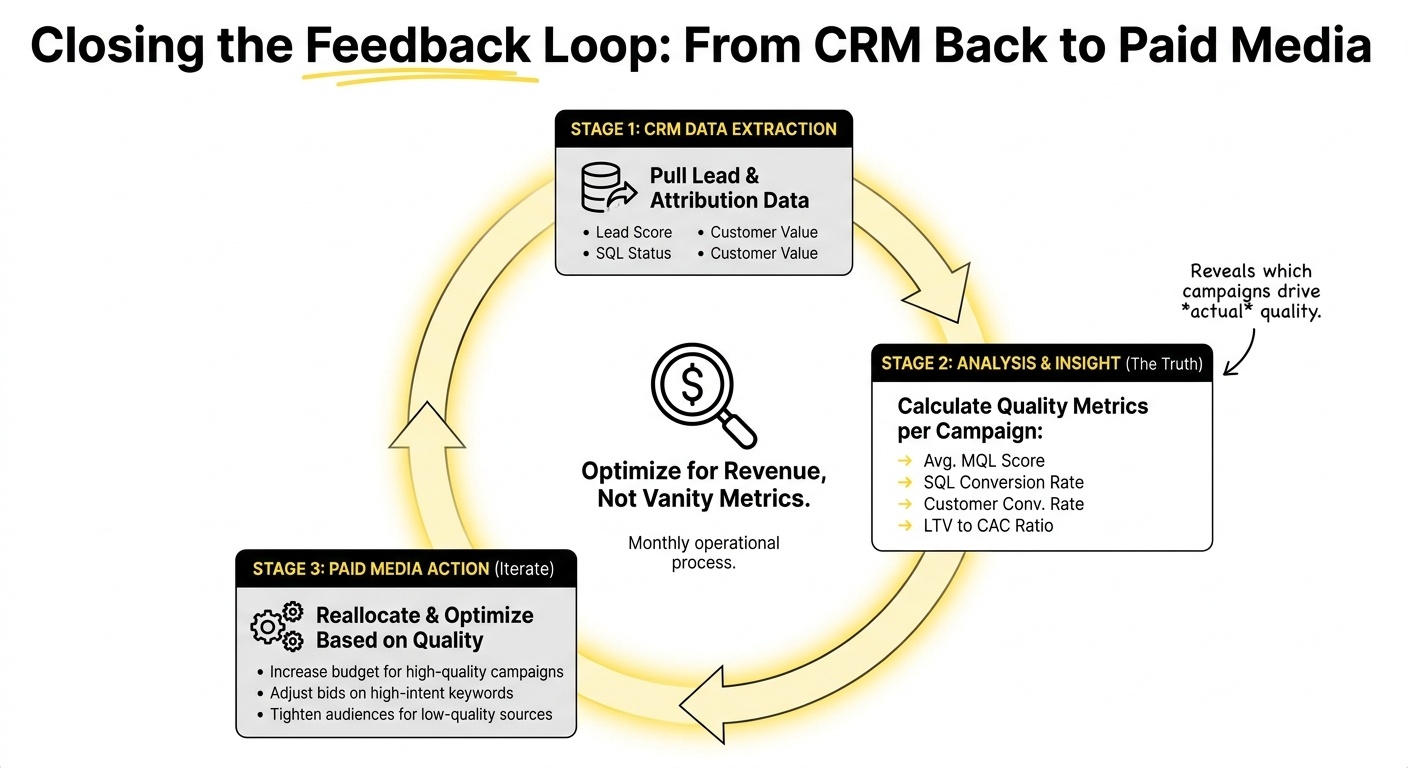
Closing the Feedback Loop: From CRM Back to Paid Media
The final piece is feedback. Your CRM data should inform your paid media decisions. This feedback loop is fundamental to the broader framework of designing paid media that supports the entire SaaS lifecycle.
Once you're capturing campaign attribution and you're scoring leads consistently, you can answer the question: "Which campaigns drive the highest-quality leads?"
Pull your lead data and calculate these metrics for each campaign:
Average MQL score: Of all leads from campaign X, what's the average CRM score?
SQL conversion rate: Of all leads from campaign X, what % converted to SQL?
Customer conversion rate: Of all leads from campaign X, what % became customers?
CAC by campaign: Total spend on campaign X divided by customers acquired.
LTV to CAC ratio: Average customer lifetime value divided by CAC.
These metrics reveal truth. Campaign A drives leads that score 45 on average and convert to SQL at 10%. Campaign B drives leads that score 60 and convert to SQL at 40%. Campaign B is clearly more efficient. You should allocate more budget to Campaign B.
The operational process: run this analysis monthly. Calculate these metrics for each campaign. Share the results with your paid media team. Together, decide: which campaigns are driving high-quality leads? Which are underperforming? Are there any surprises? Are there campaigns that drive volume but poor quality? Should you reallocate budget?
Use this data to iterate:
If high-intent campaigns are underperforming, increase bids on high-intent keywords. If brand awareness campaigns are driving low-quality leads, tighten audience criteria. If a competitor campaign is driving high-quality leads, increase budget there.
This feedback loop closes the gap. Your paid team now knows which of their efforts are actually working. They're not optimizing for vanity metrics (clicks, form fills). They're optimizing for lead quality and revenue. Your CRM scoring model proves them right or wrong every month.
Overcoming Common Integration Challenges
Data silos don't break themselves. Here are the obstacles you'll face and how to solve them.
Challenge One: Multiple paid platforms with inconsistent data structures.
Google Ads tracks conversions differently than LinkedIn. Facebook uses different metrics. It's hard to unify them.
Solution: Create a standardised data warehouse (even a simple Google Sheet or Looker Studio) where all campaign data is imported weekly. Map each platform's conversion data to your CRM's lead source field. Accept that data from different platforms will never be perfectly consistent. Focus on the highest-volume channels first (likely Google Search and LinkedIn). Build the others in phases.
Challenge Two: CRM data quality is poor.
Leads are missing campaign source. Contact information is incomplete. Company size is blank.
Solution: Before you align CRM and paid data, fix your CRM data. Implement data validation rules. Require key fields before leads can be scored. Run a monthly data audit. Flag and correct bad data. Only once your CRM data is clean can you trust the insights you pull from it.
Challenge Three: Sales and marketing have different definitions of lead quality.
Marketing thinks a lead who visited the product tour is an SQL. Sales wants someone who filled out a custom proposal request form.
Solution: Align on criteria together. Don't let scoring live in marketing's spreadsheet. Involve sales. Show them your scoring model. Ask them: "Do you close these types of leads?" Adjust criteria based on their feedback. Make scoring a shared model, not a marketing tool.
Challenge Four: Attribution technology is expensive or complicated.
You can't afford a full marketing operations platform like Marketo or Salesforce Marketing Cloud. You don't have the engineering resources to build a custom solution.
Solution: Start simple. Use native integrations first. Google Ads integrates with many CRMs. LinkedIn integrations are improving. HubSpot is relatively affordable. Build a manual process using UTM parameters and spreadsheets if you have to. Automation can come later. The important thing is getting the data connected, not having a perfect technical solution.
Challenge Five: Historical data is incomplete.
You want to analyse the past 12 months of campaigns, but your CRM only has clean source data for the past 3 months.
Solution: Work backwards. Tag the last 3 months of leads correctly. Let that become your baseline. After 6 months, you'll have meaningful data trends. Don't try to retrofit old data. Focus on getting future data right.
The Operational Framework: Building Your System
Here's a roadmap for implementing CRM scoring and paid media alignment:
Month 1: Audit and Plan. Audit your current CRM scoring model. Document all the criteria. Check if they're explicit or vague. Audit your paid platforms. Document your targeting rules. Check if they map to your scoring criteria. Identify data silos. Where are leads coming from? Is campaign source captured in your CRM? Create a project plan. Define success metrics. How will you measure improvement?
Month 2: Clean Data and Build the Bridge. Fix CRM data quality. Implement UTM parameter standards. Set up integrations so campaign source flows automatically into your CRM. Test the flow with a small campaign. Validate that leads from paid campaigns are properly attributed. How to Build a SaaS PPC Engine for B2B SaaS (Not Just Run Ads), also on this blog, takes this further.
Month 3: Define or Refine Scoring Criteria. Document your scoring model explicitly. Assign point values. Validate against your customer base. Adjust as needed. Create a CRM field for final score. Set up automation so leads are scored continuously.
Month 4: Align Paid Targeting. Review your paid targeting against your scoring criteria. Create a targeting matrix for each paid channel. Adjust audiences and keywords to align. Brief your paid media team on the changes.
Month 5: Analyse and Iterate. Pull data from the first month of aligned campaigns. Calculate metrics by campaign. Which are driving high-quality leads? Which are lagging? Present findings to the team. Decide on budget reallocations.
Month 6 and Beyond: Optimize Continuously. Run the same analysis monthly. Continuously refine scoring criteria based on actual outcomes. Continuously adjust paid targeting based on CRM insights. Track whether lead quality is improving, CAC is declining, and customer conversion rates are rising.
This is the operational work of marketing operations: building systems that let other teams do their jobs better.
Frequently Asked Questions
How can CRM scoring models enhance lead quality in B2B SaaS?
CRM scoring predicts which prospects are most likely to convert to customers by combining explicit signals (company size, industry, job title) and implicit signals (engagement, product interaction). By scoring consistently, you can qualify high-fit leads early, prioritise sales efforts on the most promising prospects, and filter out poor-fit leads before they waste sales time. This improves conversion rates and sales efficiency.
What are the best practices for integrating CRM scoring with paid media campaigns?
Best practices include: capturing campaign source data in your CRM via UTM parameters; defining explicit, measurable scoring criteria that map to your ICP; aligning paid targeting rules to your scoring criteria; analysing which campaigns drive highest-scoring leads; and feeding insights back into paid optimization. The key is making the data connection systematic, not one-off.
How do data silos impact the effectiveness of CRM and paid media alignment?
Data silos prevent you from knowing which campaigns drive high-quality leads. You can't optimize paid media for lead quality if you don't know which leads convert. You can't validate your scoring model if you don't track source. You can't report true CAC or attribution. The result is inefficient budget allocation and missed opportunities to improve lead quality.
What metrics should be used to evaluate the success of aligned CRM and paid media strategies?
Key metrics include: average CRM score by campaign (do high-intent campaigns drive higher-scoring leads?), SQL conversion rate by campaign, customer conversion rate by campaign, CAC by campaign, and CAC to LTV ratio. These metrics reveal which paid efforts are actually generating revenue, not just volume.
How can marketing operations specialists overcome attribution discrepancies between CRM and paid media?
Implement consistent UTM parameter standards. Build integrations so campaign source flows automatically into your CRM. Validate the data by spot-checking 100 leads. Accept that multi-source attribution is imperfect, but single-source attribution is worse. Use the data you have to make directionally correct decisions, even if it's not 100% accurate.
What role does Ideal Customer Profile (ICP) play in CRM scoring and paid media alignment?
Your ICP defines your target buyer. Your scoring criteria should operationalize your ICP (translate ICP characteristics into measurable signals). Your paid targeting should reflect your ICP (target companies and people who match those characteristics). When all three align, you attract high-quality leads and recognise them when they convert.
What are common challenges faced when integrating CRM scoring with paid media?
Common challenges include: poor CRM data quality; multiple paid platforms with different data structures; alignment disagreements between sales and marketing on what "quality" means; expensive attribution technology; and incomplete historical data. Solutions involve starting simple, involving all teams in defining criteria, and accepting imperfect but directionally correct data.
How can reliable reporting improve decision-making in marketing operations?
Reliable reporting gives you transparency into which campaigns drive which outcomes. Instead of guessing about lead quality, you have data. Instead of arguing about attribution, you have a systematic answer. This lets you make confident budget decisions, allocate resources efficiently, and continuously improve based on evidence.
What tools and technologies are essential for integrating CRM and paid media?
Essential tools depend on your stack. At minimum: a CRM (Salesforce, HubSpot), paid platforms (Google Ads, LinkedIn), and integrations between them. Optional but helpful: marketing automation platform, data warehouse, BI tool for reporting. Start with what you have. Add tools only if they solve specific problems.
How can marketing ops leaders ensure their strategies remain agile in a changing digital landscape?
Build flexible systems. Don't hard-code rules. Make scoring criteria easy to update. Review your targeting and scoring quarterly, not annually. Track industry changes (new platforms, algorithm shifts, market dynamics) and adjust accordingly. Make alignment a continuous process, not a one-time project.