Designing Paid Media Strategies for the Full SaaS Customer Lifecycle
Learn how to design paid media strategies that support the entire SaaS customer lifecycle, from activation and expansion to retention, for sustained revenue growth and predictable scaling.

Most B2B SaaS companies allocate 80-90% of their paid media budget to acquisition. They optimize relentlessly for the first conversion, the lead form completion, the demo request, the free trial signup. But then what? The customer activates. They expand. They churn. And somewhere in that journey, the paid media investment becomes invisible. Revenue-accountable VPs of Marketing face constant pressure from boards and CFOs to justify marketing spend, yet traditional acquisition-focused paid media reporting tells an incomplete story: it shows you the top of the funnel but obscures the actual revenue impact of your campaigns. The gap between what you spent to acquire a customer and what they're worth by month 12 is where the real ROI lives, and most teams aren't measuring it.
A holistic paid media strategy encompasses the entire customer lifecycle: activation, expansion, and retention. This isn't acquisition-focused marketing followed by random nurture campaigns. It's a deliberate design of paid media touchpoints at every stage that drives not just leads, but revenue-generating customers. It means understanding how paid media can support activation efforts, ensuring new users find value in your product quickly. It means designing expansion campaigns that remind existing customers of features they haven't used. It means using retention-focused paid campaigns to prevent churn before it happens. When you approach paid media this way, you move beyond acquisition reporting to true multi-touch attribution, and suddenly you can tell the board exactly why your paid media strategy drives consistent, predictable revenue growth. Implementing proper SaaS marketing analytics across all stages enables you to track attribution accurately and measure ROI throughout the entire lifecycle. For marketers working at product-led growth companies, this approach shifts even further; learn more in our guide on Product-Led Growth SaaS Marketing to understand how to design paid media around the product itself. And as you scale beyond Series A, strategies outlined in Series B and Beyond show how to maintain ICP focus while expanding your reach and investment across multiple channels.
Why Paid Media for the Full SaaS Customer Lifecycle Matters Now
The economics of SaaS have shifted. Five years ago, a VP of Marketing could blame acquisition costs on market conditions and move on. Today, that conversation happens in the context of unit economics and CAC payback.
Board expectations have become explicit: revenue growth must outpace spend growth. For Series B+ companies, that means either capturing more market share (at escalating cost) or extracting more value from the customers you already have.
Paid media applied to activation, expansion, and retention does both. It simultaneously reduces churn (retention spend protects existing ARR), accelerates expansion (expansion spend captures upsells and cross-sells), and supports smoother onboarding (activation spend ensures customers can use what you sold them).
The multi-touch attribution picture changes when you design paid media this way. Instead of "paid media generated X leads," the narrative becomes "paid media drove £Y in pipeline, £Z in closed deals, and protected/expanded A in customer lifetime value." That's the language board members care about.
The Three Phases of Paid Media in the SaaS Lifecycle
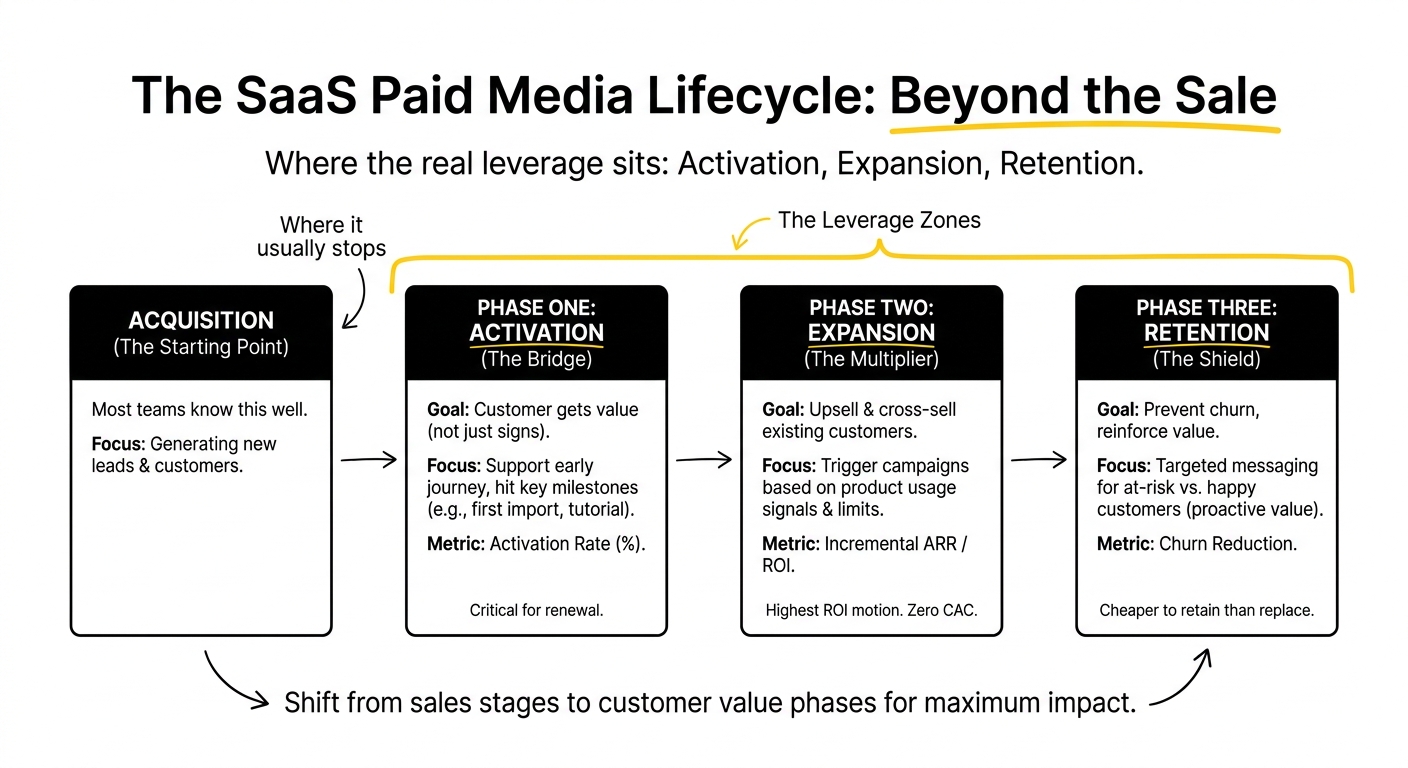
Most teams think of the SaaS lifecycle in terms of sales stages: awareness, consideration, decision. That's useful for sales teams. For paid media, you need to think in terms of customer phases: acquisition, activation, expansion, and retention.
Acquisition is the phase most teams know well. Activation, expansion, and retention are where the leverage sits.
Phase One: Activation
Activation is the bridge between the sale and the customer getting value. Your new customer has signed the contract, but they haven't yet experienced the outcome they bought the solution to achieve.
This is where most SaaS companies fail. Sales closes the deal, then throws it over the wall to customer success. The customer logs in, finds the onboarding experience confusing, and never progresses beyond the first workflow. Ninety days later, they churn.
Paid media can change this. During the activation phase, your paid media strategy should focus on supporting the early customer journey inside the product.
This looks like retargeting customers who've signed on (with internal tracking) to visit help articles, watch tutorial videos, or join product training sessions. It means audience-specific messaging for different user roles (end users vs. administrators vs. decision-makers) and touchdown campaigns timed to critical milestones ("You've imported your first dataset. Here's what to do next").
The metric here isn't leads. It's activation rate (the % of new customers who reach key milestones). And it directly impacts renewal probability. Customers who hit key milestones in their first 30 days renew at 80%+. Those who don't often churn by month three.
Phase Two: Expansion
Expansion is upselling and cross-selling to existing customers. It's the highest-ROI motion in SaaS because your CAC is zero (they're already in the system) but your ability to generate revenue is multiplicative.
Most teams leave expansion to their sales and customer success teams. Those teams operate reactively: they wait for a customer to outgrow their current plan or identify a use case that maps to another product, then pitch.
Paid media can create demand instead of waiting for it. You can use in-product signals (a customer's usage data crosses a threshold, they've reached the limit of a certain feature) to trigger targeted expansion campaigns. External channels (email, display, retargeting) can promote new product tiers, modules, or capabilities directly to existing customers who've shown intent or readiness. Scaling Demand Generation for Series B+ SaaS: Keeping Your ICP in Focus, also on this blog, takes this further.
The economics are astonishing. An expansion deal might cost £500 in paid media spend but generate £5,000 in incremental ARR. That's a 10x return on spend with a payback period of weeks, not months.
Phase Three: Retention
Retention is preventing churn. Most teams think of retention as a customer success function. In reality, retention is also a product experience and positioning problem. And paid media has a role.
At-risk customers often need different messaging, offers, or reassurance than happy customers. Paid media can deliver that. If a customer's product usage drops, you can retarget them with "Here's why customers like you choose to stay" messaging or offer them a customer success check-in or feature upgrade at a discount.
Alternatively, retention campaigns can be proactive: showing happy customers ongoing value they might not be aware of (new features launched, success stories from similar companies, webinars on maximising their current spend).
The payback on retention spend is high because the alternative (replacing a lost customer with a new one) is expensive.
Measuring Success Across the Entire Lifecycle
Acquisition paid media is easy to measure. You spend £1,000, get 20 MQLs, and the cost-per-lead is £50. Done. Use SaaS Analytics Solutions to implement these metrics.
Lifecycle paid media is harder. You might spend £500 on activation campaigns, but the benefit isn't a single metric, it's higher activation rates, lower churn, and faster time-to-value. Tracing that back to spend requires proper tracking infrastructure.
Here's what you need to measure:
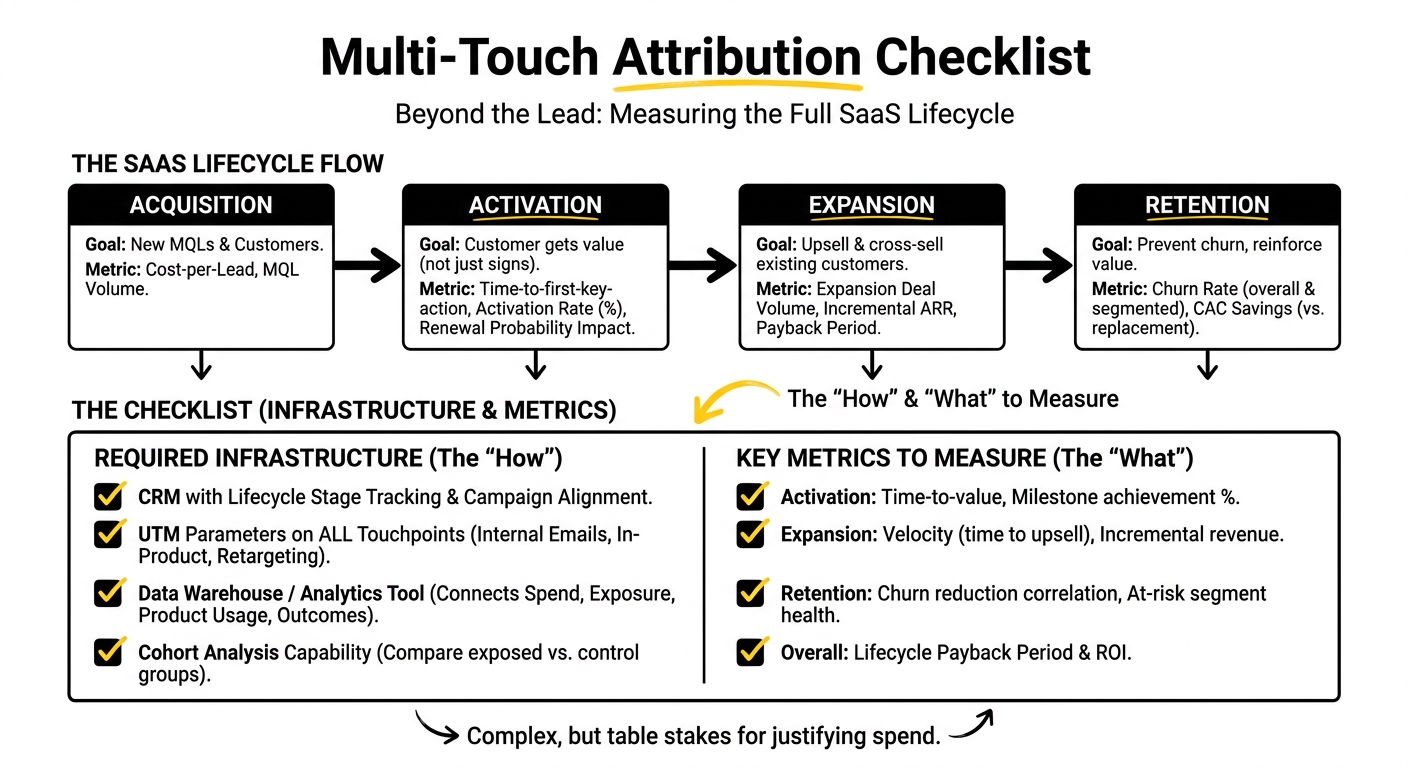
Activation metrics: Time-to-first-key-action, activation rate (% of customers reaching key milestones), correlation between paid media touchpoints and activation milestones, and impact on 30/60/90-day renewal probability.
Expansion metrics: Expansion deal volume (deals generated from expansion campaigns), incremental ARR from expansion, payback period on expansion spend, and velocity (time from campaign to closed deal).
Retention metrics: Churn rate (overall and by segment), correlation between retention campaigns and churn reduction, and CAC savings from prevented churn (vs. cost to acquire a replacement customer).
To measure these, you'll need:
A CRM that tracks customer lifecycle stage and aligns it with paid campaigns. UTM parameters on all paid touchpoints (even internal ones: emails, in-product banners, retargeting).
A data warehouse or SaaS analytics tool that connects paid spend, campaign exposure, product usage, and outcomes (activation, expansion, churn).
Cohort analysis: comparing customers exposed to lifecycle campaigns against control groups who weren't.
This infrastructure is more complex than lead tracking, but it's table stakes for justifying lifecycle spend to leadership.
Audience Segmentation for Lifecycle Paid Media
Your targeting must change when you move from acquisition to lifecycle paid media.
Acquisition targeting is straightforward: ICP profile, job title, company size, buying signals. Everyone in the funnel gets the same message (though possibly in different creative).
Lifecycle targeting is granular. You're targeting existing customers (activation and expansion), not prospects. And they're at different points in their journey.
For activation campaigns, segment by onboarding milestone. Customers who've completed module one get messaging about module two. Those who've gone dormant get re-engagement messaging. Different segments, different messaging, different offers.
For expansion campaigns, segment by usage. Customers hitting feature limits get upgrade messaging. Those using a specific module get cross-sell messaging about adjacent modules. Usage-based targeting is dramatically more relevant than broad demographic targeting.
For retention campaigns, segment by churn risk. Identify customers at risk (declining usage, support tickets, low NPS) and target them separately from stable customers. At-risk messaging is different: it's about reassurance and value rediscovery. Stable customer messaging is about expansion and loyalty.
This level of segmentation requires investment in data integration (linking usage data to ad platforms) and testing. But the payoff is precision: every campaign hits the right person at the right moment with the right message.
Allocating Budget Across Lifecycle Phases
Here's the question every VP of Marketing dreads: "How much should I move from acquisition into expansion?"
The honest answer: it depends on your unit economics and your current activation/expansion gaps.
If your activation rate is 70% and you're losing 15% of customers to churn annually, fixing those problems may have higher ROI than acquiring more customers. If your expansion rate is 20% and it takes 6+ months to expand an existing customer, accelerating that cycle could unlock significant revenue.
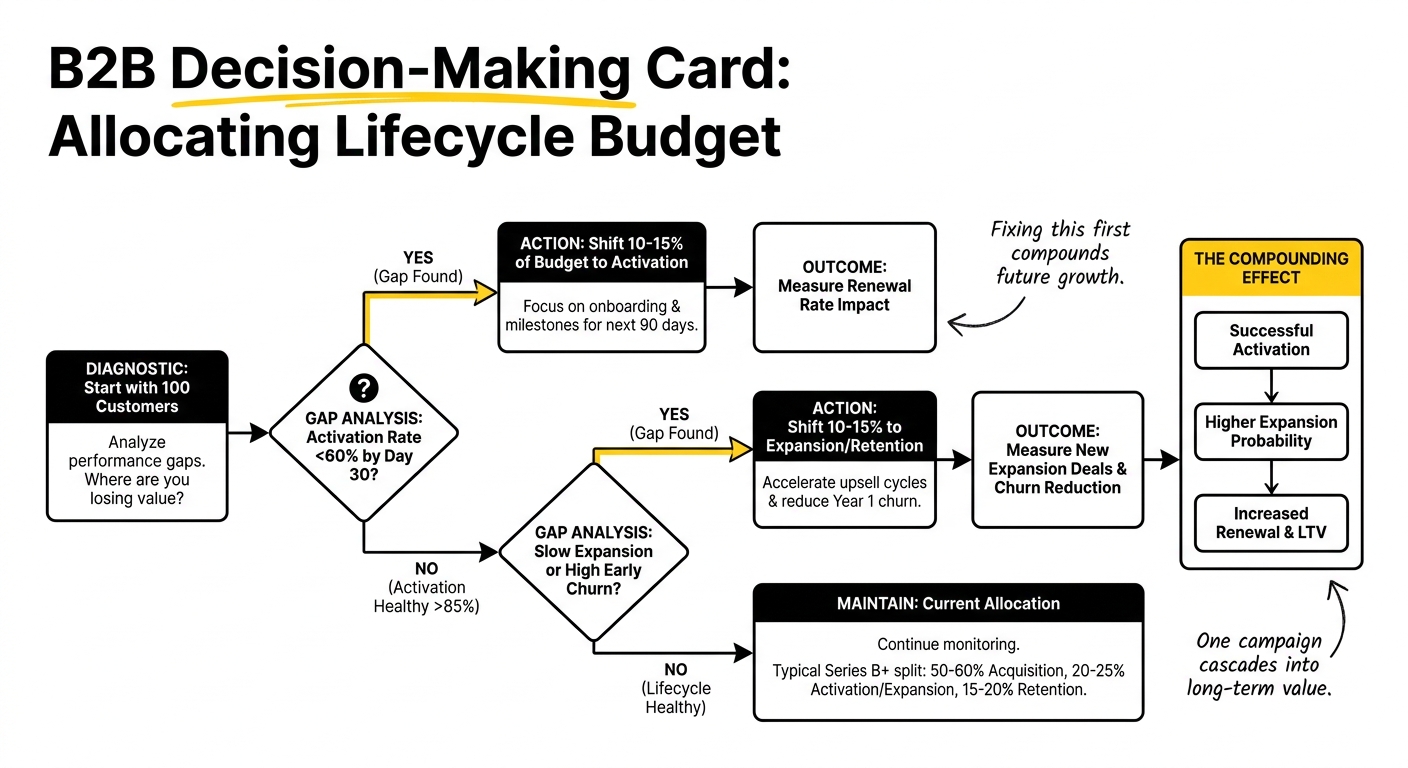
Start with a diagnostic. For every 100 customers you acquire:
How many hit your key activation milestones by day 30? If it's below 60%, activation is a problem. If it's 85%+, you might have solved that. Similarly, what % of customers never expand, expand once, or expand repeatedly? And what % churn within the first year?
Those gaps show you where paid media can have the highest impact. If activation is the gap, move 10-15% of acquisition budget to activation campaigns for the next 90 days and measure the impact on renewal rate. If expansion is the gap, allocate 10-15% to expansion campaigns and measure new expansion deals.
Over time, you'll see a curve: as lifecycle spend increases, it compounds. A customer you help activate successfully is more likely to expand, which makes them more likely to renew. One lifecycle campaign doesn't just generate one outcome, it cascades.
For most Series B+ companies, the eventual allocation looks like: 50-60% acquisition, 20-25% activation/expansion, 15-20% retention. Some land differently based on their business model, but that's a reasonable starting point.
Integrating Lifecycle Paid Media with Organic Channels
Lifecycle paid media works best when it's reinforced by organic channels. The two amplify each other.
A retention campaign that tells at-risk customers "Here's what you might have missed" is more effective when combined with email sequences, in-product messaging, and organic content (blog posts, customer stories) hitting the same themes.
An expansion campaign that promotes a new product tier is more effective when supported by:
An organic launch blog post explaining the new tier. In-product announcements and education. Email campaigns to engaged segments. Customer webinars or tutorials on the new tier.
Paid media accelerates awareness and reach. Organic content builds credibility and allows deeper education. Together, they create a cohesive experience.
For activation, paid media reaches dormant customers who haven't engaged with email in weeks. Organic content (tutorial videos, help articles) serves as the destination. Email nurtures based on which content they consumed.
The integration requires alignment between marketing (who manages paid), content (who owns organic), and product (who owns in-product messaging and data). Many teams siloed these functions. Lifecycle paid media requires breaking down those silos.
Common Pitfalls and How to Avoid Them
Pitfall One: Assuming Acquisition Logic Scales to Expansion
Acquisition audience targeting is broad. Expansion targeting must be precise. The customer who's a perfect prospect (right size, right industry, right problem) might be a terrible expansion candidate if their usage patterns don't match the expansion offer.
Avoid this by building usage-based targeting. Don't just "expand all customers." Target customers using specific features, hitting usage limits, or showing intent signals for related modules.
Pitfall Two: Underinvesting in Activation
Activation campaigns have the longest payback period of any lifecycle campaign. It takes months to see the impact on renewal rates. Many teams abandon activation spend after a quarter because they didn't see immediate ROI.
Avoid this by setting a longer measurement window (6-12 months, not 30-90 days) and measuring renewal rate impact, not lead volume.
Pitfall Three: Using Customer Acquisition Messaging for Expansion
"Get started with [product]" lands differently when the reader is already a customer using your product. Expansion messaging must emphasise new capabilities, not the original value prop.
Avoid this by building separate creative and messaging for expansion audiences. Different campaign, different ad copy. Building a Scale-Ready SaaS PPC Engine After PMF: From Ad-Hoc to Operating System, also on this blog, takes this further.
Pitfall Four: Not Tracking the Full Journey
A customer becomes an MQL from a paid acquisition campaign, converts to a customer, then upsells six months later from an expansion campaign. If you only attribute the expansion deal to the expansion campaign, you miss that paid acquisition set up the expansion opportunity.
Avoid this by using a multi-touch attribution model that traces customers through the entire lifecycle. Attribution is complicated, but it's essential for justifying lifecycle spend.
Pitfall Five: Forgetting to Communicate Impact to Stakeholders
Lifecycle paid media is harder to explain to boards than acquisition. "We spent £X and got Y leads" is simple. "We spent £X on activating customers and protected/expanded A in customer lifetime value" requires more explanation.
Avoid this by creating a clear ROI narrative before you launch. How much churn will activation spend prevent? How much incremental ARR will expansion spend generate? Present it as a business case, not a marketing tactic.
Designing Lifecycle Paid Media for Your Organisation
The shift from acquisition-focused to lifecycle-inclusive paid media is not a light switch. It's a gradual reallocation based on your specific gaps and unit economics.
Start by diagnosing where your leaks are. Calculate your activation rate, expansion rate, and churn rate. For each, estimate the revenue impact if you could move the needle by 5-10%. That's your opportunity.
Allocate a small portion of budget (10-15%) to test lifecycle campaigns in the area with the highest leverage. Measure carefully. Extend or reallocate based on results.
Over 12-18 months, you'll reach a more balanced state where paid media supports the entire customer journey, not just the first touch.
The board will see the difference: growth that outpaces spend growth, improved unit economics, and a clear multi-touch ROI narrative that justifies budget decisions for years to come.
Frequently Asked Questions
What are the key components of a paid media strategy for B2B SaaS?
A comprehensive paid media strategy for B2B SaaS includes: audience segmentation (targeting prospects and customers at different lifecycle stages), messaging tailored to each stage, channel selection (search, social, display), creative development (ad copy and visuals), tracking infrastructure (UTM parameters, CRM integration, attribution), and measurement frameworks (ROI, cost-per-outcome, cohort analysis). It should encompass not just acquisition, but activation, expansion, and retention.
How can paid media support customer activation in the SaaS lifecycle?
Paid media supports activation through retargeting campaigns (targeting new customers to visit tutorial content, help articles, or training sessions), audience-specific messaging (different messaging for different user roles), and milestone-triggered campaigns (campaigns timed to key onboarding milestones). The goal is to accelerate customers' time-to-value, which directly impacts renewal probability. Customers who hit key milestones in the first 30 days renew at significantly higher rates.
What strategies can be implemented for paid media during the expansion phase of the customer lifecycle?
Expansion paid media uses usage-based targeting to identify customers ready to expand, creates dedicated expansion campaigns (different creative and messaging than acquisition), and offers specific expansion opportunities (new product tiers, add-ons, cross-sells). This can include in-product signals (a customer hits a feature limit), external touchpoints (email, display, retargeting), and customer-specific offers based on their usage patterns and expansion readiness.
How can paid media be optimised for customer retention in SaaS businesses?
Retention-focused paid media segments at-risk customers (those showing declining usage or engagement) and targets them with specific messaging: value rediscovery, customer success check-ins, or feature upgrades at a discount. Proactive retention campaigns can also target happy customers with new features, success stories, or content that deepens their engagement. Measurement focuses on preventing churn rather than generating new revenue.
What metrics should B2B SaaS marketers track to measure the effectiveness of their paid media campaigns?
Key metrics vary by lifecycle phase: acquisition (cost-per-lead, lead quality, MQL-to-SQL conversion); activation (time-to-first-key-action, activation rate, impact on renewal probability); expansion (expansion deals generated, incremental ARR, payback period); retention (churn rate reduction, CAC savings from prevented churn). Multi-touch attribution should connect paid spend to these outcomes across the full customer journey.
How does multi-touch attribution improve the understanding of paid media ROI in SaaS?
Multi-touch attribution traces customers through their entire journey: from initial paid acquisition, through activation and expansion campaigns, to retention touchpoints. Instead of attributing an expansion deal solely to the expansion campaign, it shows how the initial acquisition campaign set up the opportunity. This reveals the true ROI of lifecycle paid media by showing compounding returns across the customer lifecycle.
What are some best practices for integrating paid media with other marketing channels in the SaaS lifecycle?
Best practices include: aligning messaging across channels (paid, organic, email, in-product); using organic content as destinations for paid traffic; building email sequences that nurture customers exposed to paid campaigns; ensuring product teams support messaging with in-product content and features; and coordinating timing so campaigns reinforce each other rather than competing for attention.
How can B2B SaaS companies ensure their paid media strategies align with revenue goals?
Align by defining specific revenue outcomes for each lifecycle phase (e.g., "increase activation rate from 65% to 75% to improve renewal rate by 5%"), estimating the revenue impact of each outcome, then building paid media budgets to support those targets. Use business case frameworks: if I spend £X on activation, I prevent Y churn and protect Z in ARR. Track outcomes monthly and adjust allocation based on actual impact.
What role does audience segmentation play in designing effective paid media for SaaS?
Segmentation ensures relevance and precision. Acquisition audiences are broad (ICP profile). Activation audiences are based on onboarding milestone. Expansion audiences are based on usage data and feature adoption. Retention audiences are based on churn risk. The more granular your segmentation, the more relevant your messaging and the higher your conversion rates. Segmentation requires investment in data infrastructure but pays dividends in campaign efficiency.
How can marketers effectively communicate the value of a holistic paid media strategy to stakeholders?
Communicate using business outcomes rather than marketing metrics. Instead of "We generated 500 leads," frame it as "We spent £X on activation campaigns, increased our 30-day activation rate from 65% to 72%, and improved our annual renewal rate by 4%, protecting £Y in customer lifetime value." Build a multi-year revenue model showing the compounding impact of lifecycle paid media. Present it as a capital allocation decision, not a marketing tactic.
See our guide on designing paid media strategies for product-led growth in SaaS for more information. Learn more in our guide on Product-Led Growth SaaS Marketing.