Designing Paid Media Strategies for Product-Led Growth in SaaS
Learn how to create effective paid media strategies for PLG SaaS using in-app signals to drive growth and qualified leads.

Product-led growth has fundamentally changed how B2B SaaS companies acquire customers. Rather than relying on sales teams to drive conversations, PLG companies put their product front and centre, prospects experience value before they ever talk to a salesperson. But most paid media strategies haven't caught up to this shift. They're still built around lead generation and sales conversations, not product activation and user engagement. When your go-to-market model is product-led, your paid media needs to reflect that reality: your ads aren't selling a demo, they're selling product access. Your landing pages aren't asking for a meeting, they're asking for a free trial signup. Your entire funnel is designed around getting users into the product as quickly as possible.
This requires a fundamentally different approach to paid media design, measurement, and optimization. In PLG companies, the metrics that matter aren't leads or cost-per-acquisition in the traditional sense, they're activation rates, trial-to-paid conversion, and expansion velocity. Your paid media needs to drive the right kind of users into your product: those who will experience immediate value and activate quickly. You need to understand which campaigns, audiences, and messaging drive users most likely to become paying customers. And you need to track this end-to-end, from ad click through product activation and beyond. This is where B2B SaaS Analytics Solutions become essential, they enable you to connect paid media performance directly to product behaviour and revenue. For a deeper understanding of how product experience shapes your entire marketing strategy, see our guide on Product-Led Email and Lifecycle Marketing with Shay Howe. And as your PLG business scales to Series B and beyond, learn strategies for scaling demand without losing your ICP focus. Cost Per Acquisition (CPA) - The Most Critical PPC Metric, also on this blog, takes this further.
What Product-Led Growth Actually Means for Paid Media
Product-Led Growth is a go-to-market motion where the product itself is the primary driver of customer acquisition, retention, and expansion. Contrast this with sales-led growth, where a sales team sells the solution, or marketing-led growth, where demand generation campaigns create qualified leads that sales then converts.
In PLG, the product experience is the marketing. Users experience the core value proposition before they ever commit to a contract. They get to try, evaluate, and adopt entirely self-serve. If the product delivers value, they convert. If it doesn't, they don't. There's no sales team to close the gap or talk prospects around objections.
This has radical implications for how paid media works.
First, your conversion path is shorter. Traditional SaaS might look like: ad click, landing page, form fill, demo, sales call, contract. PLG looks like: ad click, product signup, product usage, expansion or churn. There's no middle ground. Either the product delivers fast, or the user leaves.
Second, your measurement window shifts. In traditional SaaS, you measure success weeks or months later when a deal closes. In PLG, you measure success in hours or days. Did the user sign up? Did they activate? Did they hit a key milestone in their first session? These metrics replace MQLs and SQLs because they're better predictors of actual value delivery. For tracking these metrics, implement B2B SaaS Analytics Solutions.
Third, your audience targeting becomes product-centric. Instead of targeting "CFOs who care about cost reduction," you target people who will benefit from using the product. The selection criteria is often narrower, because there's nowhere to hide. The product has to work for them immediately, or they'll churn.
Understanding these shifts is critical before you design your paid media strategy. Generic SaaS PPC tactics will not work.

Designing Paid Media Campaigns That Align With PLG Principles
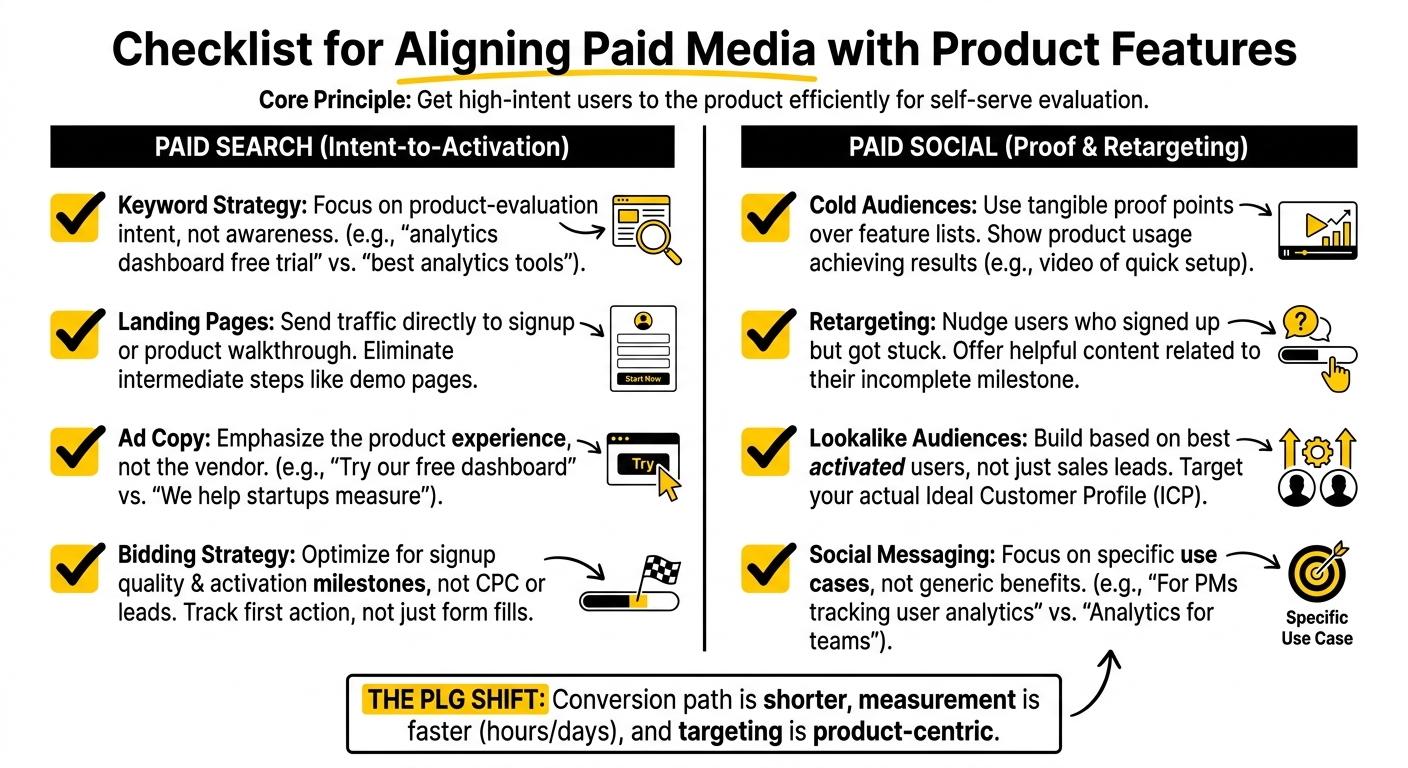
The core principle of PLG paid media is this: get high-intent users to the product as efficiently as possible. Everything else follows from that.
Paid Search for PLG: Intent-to-Activation
Paid search works well for PLG because search intent is clear. Someone searching "SaaS analytics dashboard for startups" or "free crm for sales teams" has signalled that they're looking to solve a problem and want to evaluate solutions independently. They're a PLG prospect.
Your paid search strategy should map this intent directly to product signup and first activation. This means:
Keyword strategy matters. Focus on keywords that indicate product-evaluation intent, not awareness-stage keywords. "Best analytics tools" is too broad. "Analytics dashboard free trial" or "crm that syncs with slack" is specific to your product or feature. Bid aggressively on keywords that map directly to your core use case.
Landing pages should send traffic to the product, not intermediate pages. This is the biggest difference from traditional SaaS. You're not sending search traffic to a features page or demo page. You're sending them directly to signup or a product walkthrough. Every step between search and the product is friction. Eliminate it.
Ad copy should emphasise the experience, not the vendor. "Try our analytics dashboard free" beats "We help startups measure growth." You're not trying to convince them your solution exists or is good. You're trying to get them into the product.
Bidding strategy should optimize for signup quality, not cost-per-click. PLG requires a different metric. You're not optimizing for leads or demos. You're optimizing for signups that activate, or signups that reach your key milestone (first analysis run, first data import, first workflow created, whatever indicates adoption). Set up conversion tracking that matches your product, not your sales funnel.
Paid Social for PLG: Proof and Retargeting
Paid social is harder for PLG than paid search because social intent is weaker. But it works when positioned correctly.
Cold audiences on social benefit from proof points over features. A video of someone using your product and achieving a result (5 minutes to set up, 10 templates ready to use) outperforms "Introducing X, the Y-as-a-service platform." You're competing for attention, not responding to active intent. Make the experience tangible.
Retargeting on social is your highest-ROI lever. Users who visited your site, signed up, or started using your product but didn't reach a key milestone are candidates for gentle nudges. "Stuck on your first dashboard? Here's a template to get started" is more useful than another awareness message.
Lookalike audiences drawn from your best users, not your best leads. In traditional SaaS, you'd build lookalikes from sales-qualified leads. In PLG, build lookalikes from users who activated and expanded. These are your actual ICP. Target more of them.
Social messaging should focus on use case, not benefit. "For product managers who need to track user analytics" is more specific than "Analytics for teams." The more specific you are, the smaller your addressable market, but the higher your conversion rates. In PLG, that trade-off wins.
Leveraging In-App Signals for Targeted Paid Media
This is where PLG paid media diverges most from traditional approaches. In traditional SaaS, your only signals are website behaviour (visited pricing page, spent 3+ minutes on features page). In PLG, you have product signals.
Product signals are pieces of in-app data that indicate user intent, progress, or at-risk status. Examples: user completed onboarding, user created their first report, user hasn't logged in for 14 days, user upgraded from free to paid, user hit the free plan limit on a critical feature.
These signals are infinitely more valuable for targeting than website behaviour. They indicate actual product engagement, not just interest.
Using activation signals to drive expansion campaigns. If you have data (via CRM or CDP sync) that a user completed their first workflow or imported their first dataset, that's a signal to expand messaging. Run a campaign targeting these engaged users: "You've learned the basics. Here's how to automate your workflows." You're not reacquiring them. You're helping them get more value, which drives expansion revenue.
Using usage limits as conversion signals. If your free plan has limits (storage, data points, reports, team members), when a user approaches that limit, that's a natural conversion moment. An in-app message can drive the conversation. Paid media can amplify it. A targeted campaign to users approaching the limit ("Your storage is at 85%. Upgrade to unlimited") has near-certain conversion timing.
Using churn signals to drive retention campaigns. If a user hasn't logged in for 30 days, that's a churn signal. Paid media can reach them (via email, display retargeting) with value-focused messaging. "Here's what you're missing" or "Your competitors are using this feature" drives reactivation. This is cheaper than acquiring a new user.
Segmenting your audiences by product cohort. Don't run the same paid campaigns to all users. Segment by activation status (activated vs. dormant), by feature adoption (power users vs. light users), by expansion readiness (approaching limits vs. comfortable). Design messaging for each cohort. Run separate campaigns. Measure impact by cohort.
Measuring Success: The Metrics That Matter for PLG Paid Media
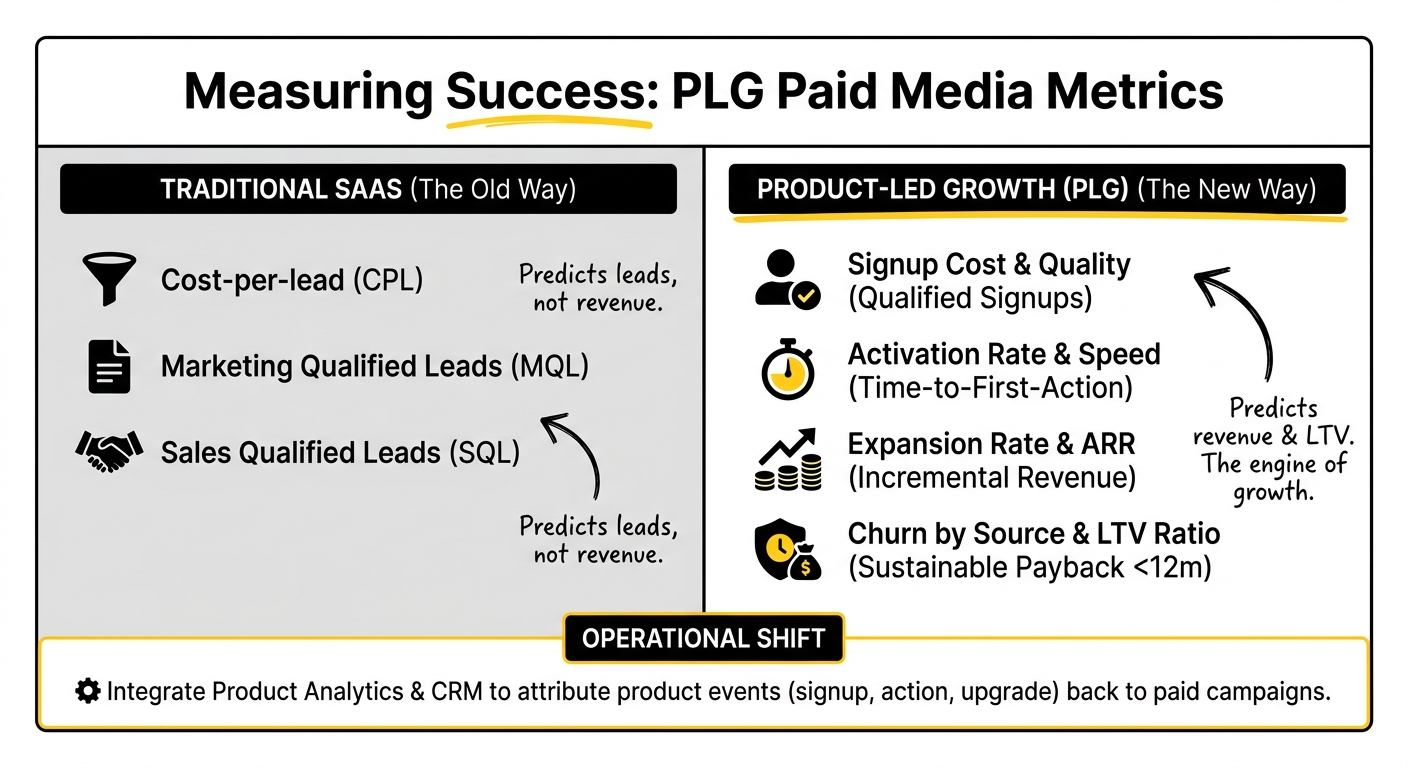
Traditional SaaS measures paid media success through cost-per-lead and lead quality (MQL, SQL). These metrics don't work for PLG. You need metrics that actually predict revenue.
Signup cost and signup quality. Cost-per-signup is your primary metric. But quality matters. A £5 signup that churns in three days is worse than a £15 signup that activates and converts. Build your measurement model to prioritise qualified signups, not just volume.
Activation rate and time-to-first-action. What % of signups reach your key milestone? How long does it take? A 40% activation rate with 2-day average time-to-first-action is a healthier signal than 60% activation with 7-day lag. Optimise for both rate and speed.
Expansion rate and expansion ARR. Of users who activated and converted to paid, what % expand? How much incremental ARR do they generate? If expansion rate is 5% and expansion ARR is £50 per user annually, that's a relatively predictable unit. If expansion is 25%, you have a different revenue profile entirely.
Churn rate by acquisition source. Not all signups are equal. Users acquired via a specific paid campaign might have 40% annual churn. Users from another campaign might have 20%. Track churn by source so you can model LTV by channel. This drives budget allocation.
CAC payback and LTV ratio. Calculate the blended cost-to-acquire a user (including all paid media spend), then measure how long it takes to recover that cost through subscription revenue. In fast-growing PLG companies, CAC payback under 12 months is healthy. Under 6 months is excellent. Compare this against the user's LTV (total revenue they'll generate before churn) to ensure your paid media is sustainable.
The operational change: you'll need product analytics and CRM integrated. Your marketing platform needs to see product events (signup, first action, upgrade, churn) so you can attribute them back to the paid campaign that drove the user.
Balancing Brand Awareness With Performance Marketing
A common tension for Series A marketing directors: PLG is performance-focused (drive users to the product, measure activation), but the company still needs brand awareness. How much budget goes to each.
The honest answer: it depends on your stage and market position. A PLG company with weak brand equity in a crowded market needs brand spend. But early-stage SaaS often doesn't have the budget for both. You need to prioritise.
Performance-first positioning: If you're constrained on budget (which most Series A companies are), prioritise paid search and expansion campaigns. These have measurable ROI and short feedback loops. Brand awareness can come from organic content, word-of-mouth, and earned media as you grow.
Brand awareness approach: If you do allocate budget to brand, do it efficiently. Invest in content marketing (organic search, blogs, guides) for education. Run paid social campaigns focused on use case education, not brand slogan repetition. Partner with complementary vendors or industry communities. Sponsor relevant communities or events. These generate brand lift without requiring huge media budgets.
Hybrid approach: Over time, mature PLG companies add brand campaigns. But they keep them separate from performance campaigns. Performance campaigns are measured on signup cost and LTV. Brand campaigns are measured on aided/unaided awareness and brand lift studies. Different objectives, different metrics.
Common Challenges and How to Solve Them
Challenge One: Short Payback Pressures You Toward Low-Intent Audiences
With short payback windows (many PLG companies need positive unit economics within 60-90 days), there's pressure to cast a wide net. Low-intent audiences seem cheaper per signup because intent is lower and competition is lower. But quality suffers.
Resist this. Optimise for signups that activate, not just signups. A higher cost-per-signup that converts is cheaper than a lower cost-per-signup that churns. Your measurement window is short, but your optimisation target should be activation and early LTV signals, not signup volume.
Challenge Two: Product Signals Aren't Available Yet
Many Series A companies haven't integrated their product analytics with their CRM or marketing automation platform. They can't easily segment campaigns by product behaviour. So they run generic campaigns instead.
Start simple. Even without a full integration, you can manually export lists of activated users from your analytics and upload them to your paid media platform for retargeting. You can set up basic conversions (signup, paid conversion) and work backward to optimise. Full product signal integration is a nice-to-have, not a prerequisite.
Challenge Three: Landing Page Testing Takes Months
In traditional SaaS, you A/B test landing pages. In PLG, you're sending people directly to the product, so landing page testing is less relevant. But you still want to test signup experiences. The problem: you need statistical significance, which takes time at small scale.
Run smaller tests. Test messaging, audiences, and offers (free trial length, onboarding structure) in parallel across campaigns. Use sequential testing rather than waiting for statistical significance. Prioritise tests that have the biggest impact: landing page headline, CTA clarity, and signup friction.
Challenge Four: Attribution Is Hard Across Free and Paid
A user might see your ad, sign up for free, use the product, then upgrade two weeks later. How much credit does the paid campaign get. The question isn't academic. Your budget allocation depends on the answer.
Use multi-touch attribution. Assign credit across touchpoints (paid campaign, onboarding, product emails, etc.) rather than last-click attribution. If the paid campaign drives signup and the product drives conversion, split the credit. This gives you a more honest view of ROI.
Designing Your PLG Paid Media Strategy
The shift from traditional SaaS paid media to PLG paid media isn't a small tweak. It's a fundamental reimagining of what paid media is supposed to do.
Start by auditing your current approach. Are you optimising for lead volume or signup quality? Are you sending people to features pages or directly to product? Are you measuring campaign success in cost-per-lead or cost-per-activated-user? The answers reveal how far you are from a true PLG motion.
Then, build your strategy around product signals and activation metrics. Design campaigns to drive signups that activate. Measure success by expansion rate and LTV, not by MQLs or demo requests. Integrate your product analytics and CRM so you can segment, target, and measure by actual product behaviour.
The payoff is substantial. PLG companies that nail their paid media strategy have predictable, scalable unit economics. They know that a £10 signup that activates has a 70% chance of converting, generating £120 in LTV, with a 6-month payback. That's a machine you can scale with confidence.
Frequently Asked Questions
What is Product-Led Growth (PLG) and how does it impact SaaS marketing strategies?
Product-Led Growth is a go-to-market approach where the product is the primary driver of acquisition, retention, and expansion. Users can access and experience core features without sales involvement. This impacts SaaS marketing by shifting focus from lead generation to user activation and in-app engagement. Campaigns are measured on signup quality and activation rates rather than leads generated.
How can paid media campaigns be designed to align with Product-Led Growth principles?
Align paid media with PLG by focusing on intent-driven campaigns that send users directly to product signup, not intermediate landing pages. Use messaging that emphasises the product experience over vendor benefits. Optimise for activated signups, not just clickthrough or form fills. Segment audiences by product behaviour and activation status. Measure success through activation rate, time-to-value, and expansion ARR rather than cost-per-lead.
What are the key benefits of leveraging in-app signals for targeted paid media campaigns?
In-app signals reveal actual product engagement, not just web interest. You can target activated users for expansion campaigns, approaching-limit users for upgrade campaigns, and dormant users for reactivation campaigns. This precision dramatically improves conversion rates and ROI. Campaigns become contextual and timely, delivering relevant messages based on product behaviour.
How can marketing directors measure the effectiveness of paid media in driving qualified leads?
In PLG, "qualified leads" are signups that activate. Measure by tracking signup cost, activation rate, time-to-first-action, and early-stage expansion signals. Build cohort analysis comparing signups from different campaigns to see which channels produce activating users. Calculate CAC payback and LTV ratio by source. Use multi-touch attribution to credit paid campaigns fairly across the signup-to-conversion journey.
What role does data-driven decision-making play in optimizing paid media strategies for SaaS?
Data-driven decision-making lets you optimise beyond surface metrics. Instead of optimising for low cost-per-click, optimise for cost-per-activated-signup. Instead of maximising reach, maximise reach to high-intent audiences with data suggesting they'll activate. Use product data to segment audiences and personalise messaging. Iterate quickly based on activation and LTV data, not just vanity metrics.
How can marketing leaders justify their paid media spend in a Product-Led Growth context?
Build a LTV model showing that activated users generate predictable revenue. Demonstrate that paid campaigns drive signups with specific activation rates and expansion patterns. Show CAC payback timelines. Present cohort analysis proving that users acquired via paid media have better retention and expansion than organic users. Frame spend as an investment in scalable unit economics, not just cost-per-lead.
What are the best practices for integrating product signals into paid media campaigns?
Integrate your product analytics with your CRM or CDP. Export lists of users at key milestones (activated, approaching limits, dormant). Segment your audience in your paid media platform based on these signals. Run separate campaigns for each segment with messaging tailored to their status. Measure impact on activation, expansion, and churn by campaign. Iterate based on results.
How can SaaS companies balance market education with brand awareness in their marketing efforts?
At Series A, constrained budgets mean prioritising performance over brand. Invest in content marketing (organic search, blogs, guides) for education. Run paid search and expansion campaigns for performance. If you allocate brand budget, do it efficiently through community partnerships, sponsorships, and use-case-focused social content. Separate brand and performance campaigns so both are measured correctly.
What metrics should be tracked to assess the impact of paid search on revenue outcomes?
Track signup cost and signup quality, activation rate, time-to-first-action, expansion rate and expansion ARR, churn rate by source, and CAC payback period. Build a LTV model incorporating activation and expansion signals. Use cohort analysis to compare users acquired through different paid campaigns. Measure impact on quarter-end revenue, not just lead count.
What are common challenges faced by marketing directors when implementing PLG strategies in paid media?
Common challenges include: optimising for short payback pressures toward low-intent audiences; product signals may not be integrated yet; landing page testing takes time; attribution across free and paid is complex. Solve by optimising for activation, not volume; starting with manual lists if integration isn't ready; running smaller, sequential tests; using multi-touch attribution.