How to Craft Effective Demo Page Copy for Sales-Ready SaaS Conversations
How to write SaaS demo page copy that qualifies intent, sets expectations, and primes sales-ready conversations while making PPC spend defensible.

The demo page is where your PPC spend either becomes a real sales conversation or quietly evaporates. Everything upstream, the keyword, the ad, the click, has done its job to get a buyer here. Now the copy has one task: qualify intent, set clear expectations, and hand sales a conversation worth having.
For a growth-focused marketing director scaling a Series A SaaS beyond early traction, this page is also an accountability point. When you sit in a monthly budget review defending paid search, “we generated 200 demo requests” means little. “We generated 200 demo requests, 70% showed up, and half became qualified pipeline” is a different conversation. The demo page copy is what moves you from the first sentence to the second.
This guide covers how to write engaging demo content for SaaS that does more than collect form fills. The best demo page copy examples for SaaS do three things at once: they help the right buyer self-identify, they tell that buyer exactly what the demo will be, and they prime the sales-ready conversation that follows. Get this right and you improve conversion rates for SaaS while defending every pound of PPC spend.
What demo page copy is really for
Demo page copy for sales-ready SaaS conversations is copy that qualifies user intent, sets expectations for the meeting, and prepares both buyer and rep for a productive conversation, rather than simply persuading a visitor to submit a form.
A demo page has a different job from the pages before it. It should:
- Confirm product fit, so the right buyer recognises themselves and the wrong one leaves.
- State what the demo covers, who should attend, and which decision it helps resolve.
- Reduce friction on the path from intent to a booked, high-context meeting.
- Set up the sales conversation with the context a rep needs to open at a higher level.
Miss the qualification and expectation-setting, and you get the classic failure: plenty of form fills, poor show rates, and a sales team complaining that paid search sends junk. The copy, not the traffic, is usually the problem.
The demo page is different from every other page
By the time someone reaches your demo page from a PPC campaign, they have usually done the research. They know the category, they have likely compared you to alternatives, and they are close to a decision. This visitor does not need to be sold from scratch. They need a frictionless path to a calendar slot and enough clarity to feel confident booking.
That changes what the copy has to do. Earlier landing pages work to turn ICP pain into demo intent, which we cover in our guide to SaaS landing page copy. The demo page picks up a warmer visitor and does something narrower: it qualifies that intent and sets expectations for a sales conversation. Persuasion gives way to confirmation and clarity.
Practically, that means stripping distraction. Remove the navigation menu and secondary links so the page has one obvious job. Any element that is not helping the visitor qualify themselves or book the meeting is competing with the action you want. High-intent visitors reward focus, and our conversion rate optimisation services hub goes deeper on how these pages fit the wider funnel.
Qualifying user intent without adding friction
Qualifying user intent is a balancing act. Ask too little and sales fields unqualified demos. Ask too much and you crush conversion, since every field beyond the essentials measurably lowers completion. The copy is how you qualify without interrogating.
Two techniques do most of the work. First, use the copy itself to help buyers self-qualify. State plainly who the product is for (“built for RevOps teams at 50 to 500-person B2B SaaS companies”) so a poor-fit visitor self-selects out before they ever reach the form. This protects sales time better than any hidden filter. Second, keep the form lean and let one well-chosen qualifying question do the heavy lifting, something that helps a rep prepare, such as the buyer's main goal or current tooling, rather than a dozen firmographic fields.
You can also route by readiness. A visitor who wants to explore should not be forced into a heavy sales process, and one who is ready to buy should not be slowed down. Copy that explains why someone would book a demo rather than start a trial helps each buyer choose the right path, which raises the quality of everyone who lands in the demo queue.
Setting expectations: what the demo covers, who should attend, what it resolves
This is the most underused lever in demo page copy, and it is where reducing friction in the user journey pays off twice, once in conversion and again in show rates. Buyers request demos when they expect practical value, not a generic walkthrough. Copy that states what the session covers, who should attend, and which decision it helps resolve improves fit and cuts no-shows and low-context meetings.
A value proposition headline paired with a short meeting agenda tends to have the highest impact on demo page conversion. Something as simple as “In 30 minutes, we'll map your current attribution setup and show exactly where pipeline is leaking” tells the buyer what they are getting and makes the calendar slot feel worth protecting. It also quietly frames the sales conversation before it begins.
Expectation-setting does not stop at the form. The confirmation page and email are prime real estate that most teams waste on a bare “thanks, we'll be in touch.” Use that moment to reinforce the value of attending, confirm what to expect, and ask one simple pre-demo question. Show rates matter enormously here: industry benchmarks put the median B2B SaaS demo show rate around 55 to 65%, with disciplined teams reaching 75 to 85%, and much of that gap comes down to expectation-setting and how quickly the meeting happens. Intent decays fast after a form fill, so copy that encourages same-day or next-day booking protects the conversion you worked for.
Copy that supports the sales conversation
A booked demo is not a finished conversion if the rep opens cold. The demo page and its follow-up copy should feed the first sales conversation, so it starts with context rather than discovery from zero. This is what turns effective sales-ready demo scripts from a sales-team concern into a shared marketing responsibility.
The mechanism is message continuity. The pain named in the ad, the fit confirmed on the demo page, and the qualifying question answered at submission should all carry into the rep's opening. When a buyer sees the demo pick up exactly where the page left off, the conversation feels prepared rather than templated, and prepared conversations convert. Executive buyers in particular disengage quickly from generic walkthroughs, so the earlier your copy captures their specific goal, the sooner the rep can show a relevant outcome.
In practice, the highest-leverage piece of demo content is the single question that surfaces the buyer's primary goal. Captured on the page and passed to sales, it lets a rep open with the prospect's problem instead of a company-history slide. That is how demo page content for sales-ready SaaS conversations earns its name.
Aligning demo page messaging with your PPC campaigns
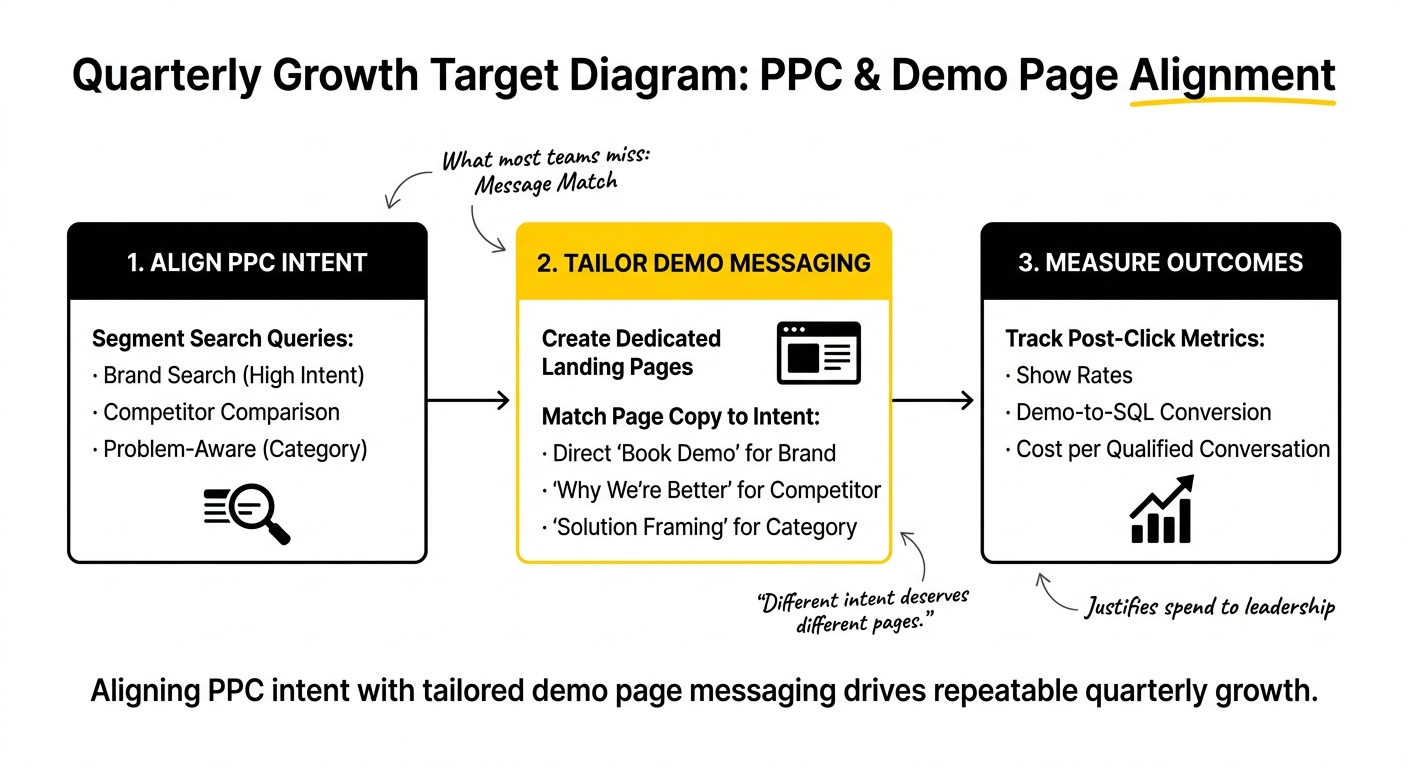
For PPC in digital marketing, message match is not a cosmetic detail, it is a conversion mechanic. Aligning demo page messaging with the ad and keyword that produced the click is one of the clearest ways to protect both conversion rate and quality. A visitor from a “book a tailored walkthrough” ad who lands on a generic homepage-style page feels the disconnect and bounces.
Different intent deserves different pages. Brand searches, competitor comparisons, and problem-aware queries arrive at different commercial temperatures, and lumping them onto one demo page drags down performance. A searcher using your product name plus “demo” is close to action, while a category searcher still needs fit framing. Matching demo page copy to that intent is a core part of any serious PPC strategy, and it is the discipline that makes paid search defensible in a budget review. For the messaging-block patterns that make this repeatable across campaigns, see High-Performance SaaS PPC Landing Page Messaging Blocks.
Measuring PPC outcomes then closes the loop. When your demo page qualifies intent and sets expectations well, the improvement shows up not in clicks but in show rates, demo-to-SQL conversion, and cost per qualified conversation, exactly the numbers that justify spend to leadership.
A/B testing and measuring what matters
Treat demo page copy as testable, not fixed. The elements worth testing first are the ones that move qualification and show rates: the value proposition headline, the meeting agenda copy, the qualifying question, and the CTA wording (“Book your walkthrough” rather than “Submit”). Change one meaningful element at a time and run each test long enough to trust the result, typically four to six weeks on B2B traffic.
Measure the full funnel, not the form. The metrics that matter for a demo page:
- Demo request conversion rate, benchmarked against your vertical rather than a blended average.
- Show rate, since a booked demo that no one attends is not pipeline.
- Demo-to-SQL rate, the truest signal that the page is qualifying well.
- Cost per qualified sales conversation, the number that connects PPC spend to pipeline.
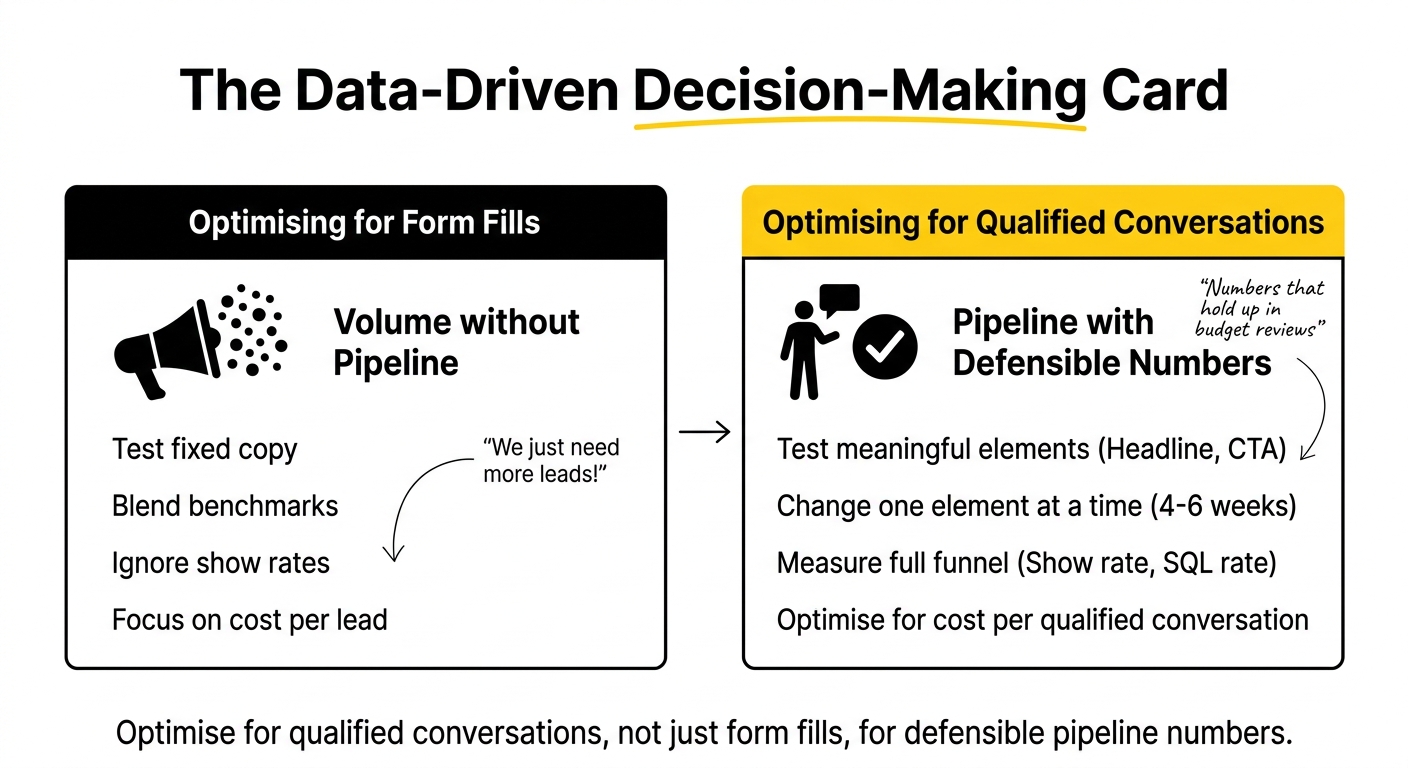
Optimising to form fills alone trains your campaigns on the wrong signal and produces volume without pipeline. Optimising to qualified conversations is what lets a director of marketing walk into a budget review with numbers that hold up.
Common mistakes to avoid
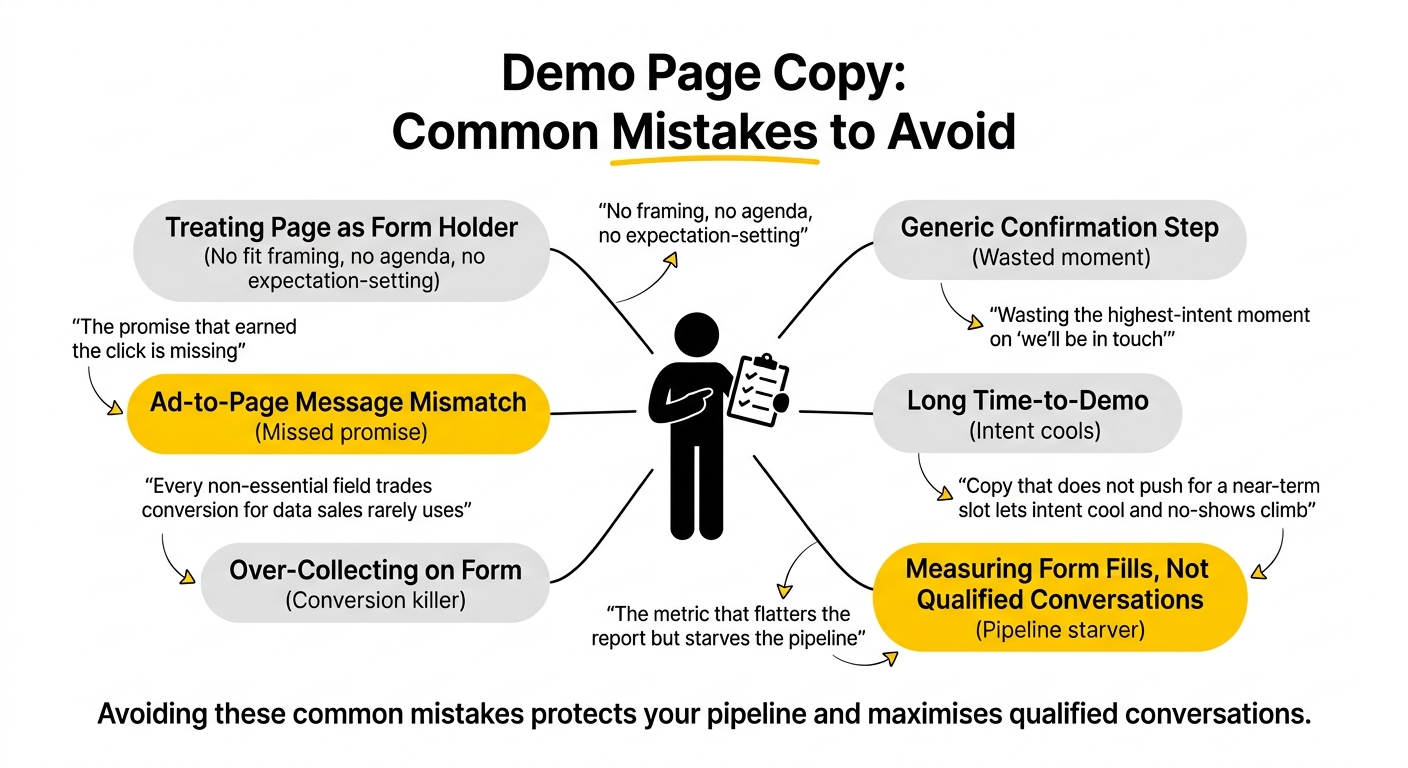
A handful of errors account for most underperforming demo pages:
- Treating the page as a form holder. No fit framing, no agenda, no expectation-setting, just a headline and fields.
- Ad-to-page message mismatch. The promise that earned the click is missing from the page.
- Over-collecting on the form. Every non-essential field trades conversion for data sales rarely uses.
- A generic confirmation step. Wasting the highest-intent moment on “we'll be in touch.”
- Long time-to-demo. Copy that does not push for a near-term slot lets intent cool and no-shows climb.
- Measuring form fills instead of qualified conversations. The metric that flatters the report but starves the pipeline.
If you are auditing your own demo page against this list and want a second view on where qualified conversations are leaking, that is the kind of work we do with SaaS teams regularly.
Frequently Asked Questions
How to create effective demo page copy for SaaS?
Start from the job the page actually does: qualify intent, set expectations, and prime a sales conversation. Lead with a value proposition headline and a short meeting agenda so the buyer knows what the demo covers and why it is worth their time. State who the product is for so poor-fit visitors self-select out, keep the form lean, and remove navigation and secondary links so the page has one clear purpose.
What are the key elements of a successful SaaS demo page?
A strong demo page has a clear value proposition headline, a short agenda stating what the session covers and which decision it resolves, explicit fit framing for who should book, credible proof near the call to action, a lean form with one useful qualifying question, and a single focused CTA. Removing the navigation menu keeps high-intent visitors on task. The confirmation step should reinforce value and set expectations rather than simply acknowledging the request.
How can demo pages qualify user intent for SaaS companies?
Use the copy to let buyers self-qualify. Stating plainly who the product is for lets a poor-fit visitor leave before the form, which protects sales time better than hidden filters. Keep the form lean and add one well-chosen qualifying question, such as the buyer's main goal or current tooling, that helps a rep prepare. Routing visitors between demo and trial by readiness raises the quality of everyone who reaches the demo queue.
What role does demo page copy play in reducing friction in the user journey?
Copy reduces friction by giving high-intent visitors clarity and a fast path to a booked meeting. Removing distractions, stating fit and agenda up front, and keeping the form short all lower the effort required to convert. Encouraging a same-day or next-day slot matters too, because buyer intent decays quickly after a form fill and long gaps drive no-shows.
How to align demo page messaging with PPC strategies for SaaS?
Match the demo page to the ad and keyword that produced the click. A visitor from a specific, tailored-walkthrough ad should not land on a generic page, since that disconnect causes bounces. Separate intent levels, brand, competitor, category, and problem-aware searches deserve different pages, because each arrives at a different commercial temperature. Consistent message continuity from ad to page to demo protects both conversion rate and lead quality.
What are best practices for crafting demo pages that support sales conversations?
Feed the sales conversation from the page. Capture the buyer's primary goal with one qualifying question and pass it to the rep so the demo opens on the prospect's problem, not a company overview. Maintain message continuity so the ad, page, and call tell one story. Use the confirmation email to reinforce value and ask a simple pre-demo question, which lets the rep start the conversation at a higher level.
How can demo pages lead to higher conversion rates for SaaS companies?
By matching copy to a high-intent visitor's needs: fast clarity on fit, a concrete meeting agenda, credible proof, and minimal friction. Demo request pages average roughly 1.5 to 4% conversion, while top-quartile pages reach 8 to 15%, and the gap is usually about clarity and friction rather than traffic. Better qualification and expectation-setting also lift show rates and demo-to-SQL rates, so the gains compound down the funnel.
What metrics should be tracked to measure the effectiveness of a SaaS demo page?
Track the full funnel rather than form fills alone: demo request conversion rate against your vertical benchmark, show rate, demo-to-SQL rate, and cost per qualified sales conversation. Show rate matters because an unattended demo is not pipeline, and demo-to-SQL is the clearest signal that the page is qualifying well. Measuring qualified conversations, not raw requests, is what connects PPC spend to revenue in a budget review.
How to tailor demo page content for growth-focused Series A marketing directors?
Speak to the pressure they carry: quarterly growth targets and monthly budget scrutiny. Frame the demo page around measurable, defensible outcomes, qualified conversations and pipeline, not vanity form counts. Give them copy that makes paid search accountable by tying each campaign's intent to a matched page and a qualified-conversation metric. This lets a director demonstrate reliable PPC outcomes to leadership and investors rather than clicks.
What common mistakes should be avoided when creating demo page copy for SaaS?
Avoid treating the page as a bare form holder, mismatching the ad promise and the page, over-collecting form fields, and wasting the confirmation step on a generic acknowledgement. Do not let time-to-demo stretch out, since intent cools and no-shows rise. The most costly mistake is measuring form fills instead of qualified conversations, which trains campaigns on the wrong signal and produces volume without pipeline.