Enterprise SaaS PPC: How Strategy Changes with Long Sales Cycles
Enterprise SaaS PPC needs different strategy: buying committees, longer attribution windows, ABM intent layers, and pipeline-proof measurement.

You launch campaigns. Demos come in. Platform metrics look healthy. Three months later, the board asks where the pipeline is, and you’re left explaining why Google Ads calls this a success while sales says the leads are useless.
This is the core tension in enterprise SaaS PPC. And it’s not a campaign problem. It’s a strategy problem.
Enterprise B2B SaaS deals don’t behave like mid-market deals. Sales cycles routinely run 6 to 12 months. Buying committees now average 10 to 11 stakeholders across IT, finance, procurement, operations, and the end users who’ll actually live with the product. Optimising PPC to demo form fills in this environment doesn’t just produce weak results. It can actively make performance look strong while pipeline quietly deteriorates.
This article covers what actually changes in an enterprise SaaS PPC strategy: how you layer intent, how you build proof for committees, how you set up measurement that works across 90 to 180-day cycles, and how to get from your current setup to one that holds up in front of a CFO.
Why Standard SaaS PPC Falls Short in Enterprise
Most PPC frameworks were designed around shorter cycles: a user searches, clicks, fills a form, gets called by sales. The conversion signal is clean, the optimisation loop is tight.
Enterprise breaks every assumption in that model.
The person who searches “enterprise contract management software” may be a legal operations manager doing early research. They may have no authority to buy. Three months later, procurement gets involved. Then IT runs a security review. The original champion may move on before the deal closes.
When you optimise your campaigns to demo form fills in this context, you’re training Google’s algorithms on the wrong signal. You’re rewarding intent that doesn’t correlate with pipeline. And because Google Ads’ default attribution window is 30 days, the actual sequence of touchpoints leading to a closed deal is mostly invisible.
The result is an optimisation loop that rewards volume over quality, producing platform metrics that look compelling until sales reviews the CRM.
What Actually Changes in Enterprise SaaS PPC
The fundamentals of paid search don’t disappear. High-intent keywords still matter. Message match still matters. Landing pages still matter. What changes is the goal you’re optimising to, the assets you need to support the journey, and the way you measure success.
Buying committees mean multiple intent types, not one funnel. In a mid-market deal, your champion is often also the budget holder. In enterprise, the champion who found you in search is rarely the person who signs. Finance needs an ROI case. IT needs a security architecture overview. Procurement needs contract flexibility. These are distinct needs that may never surface in a form fill, but they can stall a deal for months if left unaddressed.
Longer cycles create attribution gaps. Gartner’s research on enterprise buying behaviour consistently shows that B2B buyers complete a significant portion of their evaluation before engaging with sales. When someone clicks a Google Ad, then returns via direct, then downloads a whitepaper via email, then attends a webinar, and finally books a demo six months later: the demo form fill gets the credit. The PPC contribution is invisible.
Higher stakes per deal change the proof requirements. An enterprise SaaS deal worth £100k or more will face scrutiny that a £5k SaaS subscription won’t. Security questionnaires, compliance sign-off, implementation planning, references from comparable accounts. None of this is reflected in a CPC or a conversion rate. If your landing page and retargeting assets don’t speak to these concerns, you’re losing deals in the middle of the funnel where no paid channel can see.
The 3 Intent Layers Enterprise PPC Needs
Enterprise PPC strategy is most useful when organised around three distinct intent layers. Each layer requires a different budget allocation, different creative, and different measurement.
Capture. High-intent searches: category terms, competitor names, comparison queries. These are the people who already know they have a problem and are actively evaluating solutions. Capture should still be a priority in enterprise PPC, but with aggressive negative keyword lists to filter out SMB noise (company size qualifiers, “free”, “small business”, “startup”), and with copy and landing pages tuned to enterprise credibility signals rather than generic SaaS benefits.
Create. Problem-aware and role-specific search terms: the terms a VP of Operations or a Chief Information Officer might search when they’re feeling the pain your product solves, but haven’t yet committed to a solution category. These terms have lower commercial intent but reach stakeholders earlier in the buying process. Mapping this layer by role (finance-facing terms, IT-facing terms, ops-facing terms) is what separates an enterprise intent strategy from a standard mid-market keyword plan.
Convert. Retargeting sequences and proof assets targeted at visitors who’ve engaged but haven’t converted. In enterprise, the Convert layer is doing more work than in shorter cycles. A prospect may visit your site four or five times over three months before reaching out. Retargeting here isn’t about urgency; it’s about progressively building the proof required to move a committee toward a decision. Case studies by industry or deal size, security overview content, ROI tools, implementation guides.
Budget splits will vary by company stage and competitive landscape, but a rough starting point for enterprise-focused accounts: 50-60% toward Capture, 25-30% toward Create, and 15-20% toward Convert. As your retargeting audiences grow and your proof asset library deepens, the Convert layer can punch well above its budget weight.

Keyword and Campaign Structure for Enterprise
The structural implication of targeting buying committees is that your keyword strategy needs to reflect multiple stakeholders, not just the person most likely to search for your category.
In practice, where search volume allows, this means separate ad groups or campaigns for different stakeholder intent types. A security operations platform might have:
- Category/solution terms for the buyer who already knows they need the product
- “Data breach risk” and “compliance audit” terms for the CISO doing early research
- “Security tool cost” and “security ROI” terms for the finance stakeholder validating the business case
Volume on role-specific terms is often thin. That’s expected. These are not high-volume commercial queries. The rationale for including them is influence: reaching stakeholders before they enter a vendor comparison means your brand is part of the conversation before the formal evaluation begins.
On negative keywords: the biggest structural mistake in enterprise PPC accounts is failing to aggressively filter SMB signals. Terms like “free trial”, “small business”, pricing terms that suggest single-seat purchases, and company size qualifiers (“for startups”, “for small teams”) should be systematically excluded. SMB leads create CRM noise that pollutes your optimisation data and wastes sales capacity on deals that will never close.
Offer and Asset Strategy for Long Cycles
The typical enterprise B2B buyer is not going to hand over their details for a generic “book a demo” CTA. Not in the early stages of a 9-month evaluation.
The assets you promote via PPC need to reflect where buyers actually are. Earlier-stage assets (ROI calculators, benchmark reports, comparison guides) lower the barrier to engagement and deliver genuine value before asking for a sales conversation. These are worth gating lightly (job title, company size) to qualify interest without triggering procurement-level scrutiny.
Mid-funnel assets (security one-pagers, implementation case studies, integration overviews) support the committee members who need to satisfy their specific concerns. These are often best ungated: the goal is to remove friction from a committee conversation, not to capture a net-new lead.
Demo and consultation CTAs belong on high-intent landing pages, for visitors who’ve arrived via Capture terms and have already engaged with your site. Pushing them too early on Create-layer traffic is a conversion mistake that inflates demo volume at the cost of pipeline quality.
Landing Page Strategy for Enterprise Buyers
Enterprise landing pages have a different job than mid-market ones. The mid-market landing page needs to convince one person. The enterprise landing page needs to survive being shared internally by a champion to stakeholders who weren’t in the original search session.
Credibility above the fold. Logos, compliance certifications, and enterprise-specific customer names at the top, not in a footer. Enterprise buyers are risk-averse and are scanning for signals that your product won’t embarrass them internally.
No feature dumps. Enterprise buyers have seen every SaaS feature list. What moves them is outcomes tied to their role: reduced audit preparation time, faster vendor onboarding, fewer security incidents. Lead with the outcome, not the feature.
Proof that matches the deal size. A case study with a company half the size of your prospect doesn’t land the same way as one from a peer organisation. Segment your social proof by company size, industry, or use case where you can.
Form strategy. Shorter forms convert better, but enterprise requires some qualification. The trade-off: ask for what routes the lead correctly (company size, role, use case) rather than what satisfies your CRM schema. You can enrich with tools like Clearbit or Cognism after submission.
Measurement That Works Across 90–180 Day Cycles
Attribution is the part of enterprise PPC that makes most CMOs want to look away. It doesn’t have to be precise, but it does have to be honest.
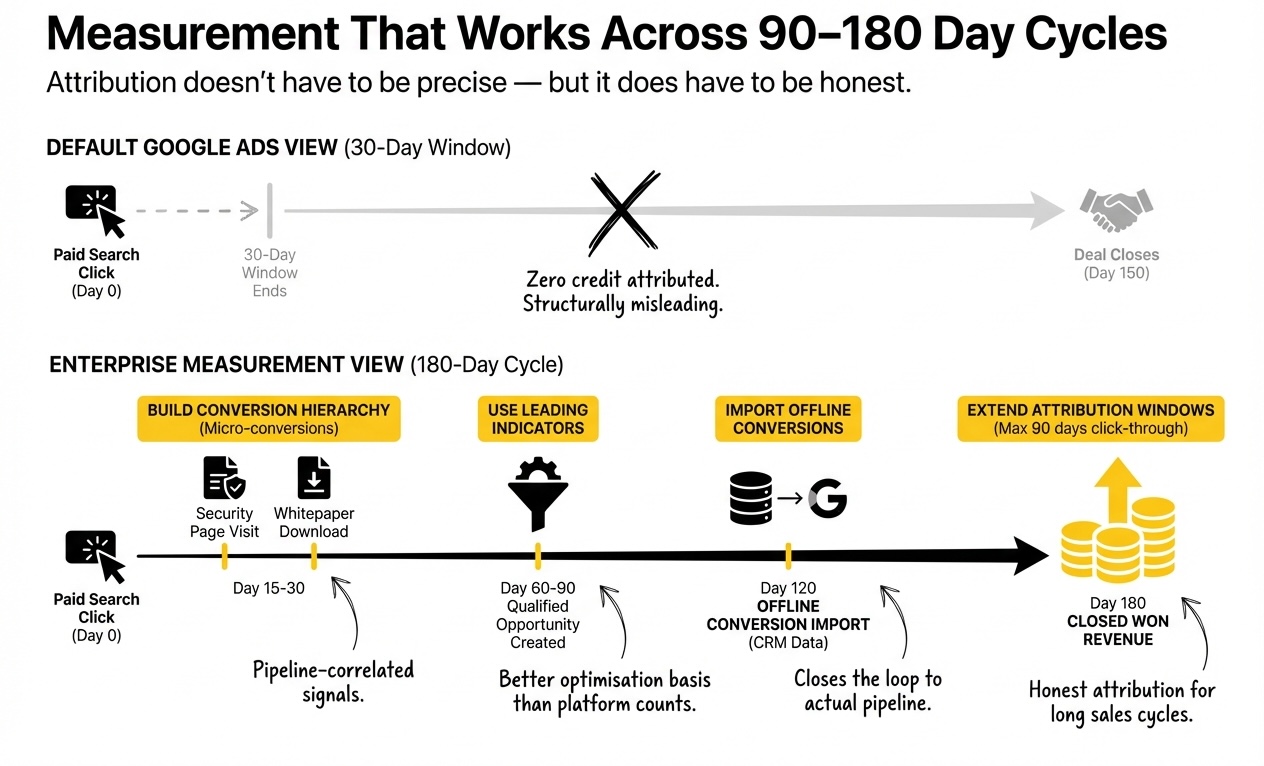
The default Google Ads attribution model attributes conversion to the last click within a 30-day window. For a deal that closes in month nine, this model will attribute zero credit to the paid search click that started the journey. That’s not a minor inaccuracy. It’s structurally misleading.
Build a conversion hierarchy. Not everything is a demo request. Define which micro-conversions indicate genuine enterprise intent: a visit to the security or compliance page, a whitepaper download, a pricing page view paired with a return visit. These are pipeline-correlated signals that fire earlier than a demo form and give the algorithm something to optimise toward in the absence of sufficient closed revenue signals.
Import offline conversions. This is non-negotiable for enterprise accounts with long sales cycles. Passing opportunity creation and won deal data back to Google Ads via the offline conversions API (through your CRM; HubSpot and Salesforce both support this natively) is what closes the loop between campaign activity and actual pipeline. Without it, you’re optimising to form fills, not revenue.
Extend attribution windows. Google Ads allows attribution windows up to 90 days for click-through and 30 days for view-through. For enterprise accounts, set both to their maximums. This won’t give you the full 180-day picture, but it will stop you from writing off campaigns that are contributing to pipeline on cycles your default settings can’t see.
Use leading indicators. Revenue data lands too late to be useful for month-to-month optimisation in enterprise. Identify the metrics that correlate with pipeline 60 to 90 days in advance: qualified opportunities created from paid traffic, opportunity-to-demo rate by campaign, account-level engagement depth. These aren’t perfect proxies, but they’re a better basis for optimisation decisions than platform conversion counts.
PPC and ABM: Where They Connect
Enterprise PPC and account-based marketing (ABM) are increasingly expected to work in concert, but the coordination doesn’t need to be complex to be effective.
The most practical overlap is using PPC to reinforce named-account or named-segment targeting. If sales has identified a list of 50 target accounts, paid search can’t directly target those companies, but paired with LinkedIn’s company targeting or a Customer Match list, you can ensure your brand is visible to buying committee members from those accounts when they’re doing research on adjacent topics. Service Blueprint: What ‘SaaS PPC & Paid Search Management UK’ Should Actually Include, also on this blog, takes this further.
Retargeting lists built from CRM data (visitors from target accounts, contacts at specific deal stages) are among the highest-leverage segments in enterprise PPC accounts. They’re small in volume, but the quality of engagement is completely different from cold traffic, and they deserve disproportionate budget and tailored creative.
This isn’t a full ABM programme. The point is to use what’s already in your CRM to make PPC smarter, not to build an entirely separate motion.
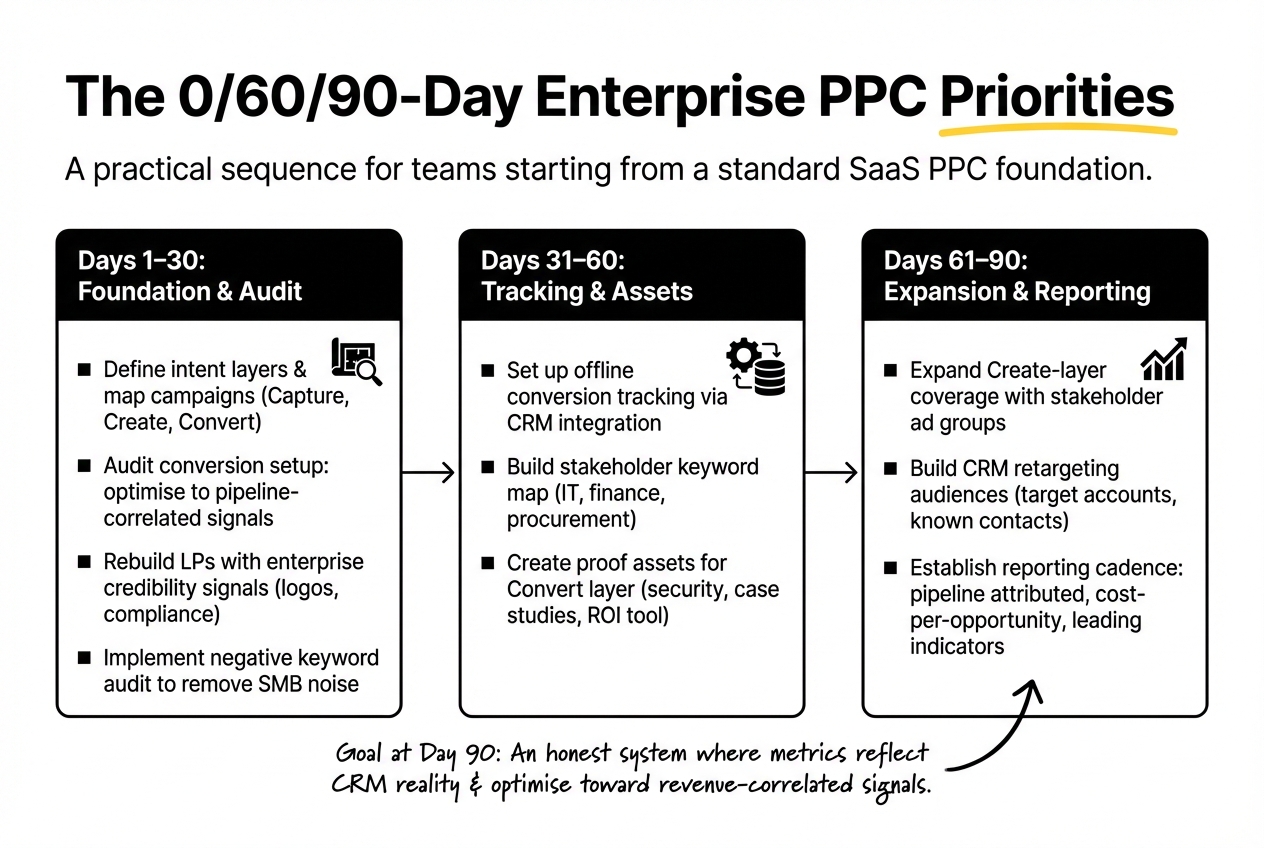
30/60/90-Day Enterprise PPC Priorities
Changing an enterprise PPC setup doesn’t happen in a sprint. Here’s a practical sequence for teams starting from a standard SaaS PPC foundation:
Days 1–30:
- Define your intent layers and map existing campaigns to Capture, Create, or Convert
- Audit your conversion setup: what are you actually optimising to, and does it correlate with pipeline?
- Rebuild or update landing pages to lead with enterprise credibility signals (logos, compliance, enterprise case studies)
- Implement a negative keyword audit to remove SMB noise from all campaigns
Days 31–60:
- Set up offline conversion tracking via CRM integration and import pipeline data into Google Ads
- Build a stakeholder keyword map: identify where IT, finance, and procurement-facing search terms have sufficient volume
- Create or surface the proof assets needed for the Convert layer: security overview, customer case study by segment, ROI tool
Days 61–90:
- Expand Create-layer coverage with stakeholder-specific ad groups where volume justifies
- Build retargeting audiences from CRM data (target account visitors, known contacts at open opportunities)
- Establish a repeatable reporting cadence: pipeline attributed to PPC by month, cost-per-opportunity by campaign, leading indicators tracked alongside platform metrics
The goal at day 90 is not a perfect system. It’s an honest one: the metrics you’re reporting reflect what’s actually happening in the CRM, and where the account is optimising toward signals that correlate with revenue.
Frequently Asked Questions
How is enterprise SaaS PPC different from PPC for SMB or mid-market?
The difference is structural. Enterprise deals involve more decision-makers, longer evaluation periods, higher stakes per deal, and more complex proof requirements. Standard SaaS PPC optimises to demo form fills, which is a reasonable proxy in short-cycle deals. In enterprise, that signal is too weak and too late. It tells you someone engaged, not whether they’ll become a qualified opportunity. Enterprise PPC needs a conversion hierarchy, stakeholder-mapped keywords, committee-grade proof assets, and offline conversion tracking to connect campaign activity to pipeline.
What should you optimise for when the sales cycle is 90–180+ days?
In the short term, optimise to pipeline-correlated micro-conversions: security page visits, ROI tool completions, high-intent content downloads. In the medium term, import offline conversions from your CRM so Google Ads can optimise toward opportunity creation and won deals. Platform conversion counts are a poor proxy for enterprise revenue. The sooner you replace them with downstream signals, the better your bidding decisions will be.
How do you build PPC around a buying committee (IT, finance, ops, security)?
Map keyword intent by role, not just by product category. IT stakeholders search for integration and security terms. Finance stakeholders search for ROI, cost reduction, and payback period terms. Operations stakeholders search for efficiency and workflow terms. Where search volume justifies it, create separate ad groups by stakeholder type with role-specific ad copy and landing content. For lower-volume role terms, consider running them consolidated but tracking engagement by landing page type.
What are the best leading indicators for enterprise PPC before revenue shows up?
The most reliable leading indicators are: qualified opportunity creation rate from paid traffic, account-level engagement depth (multiple visits, multiple page types), and content consumption that signals commercial intent (pricing page views, security documentation downloads, case study views by industry). These appear 30–90 days before revenue data and give you enough signal to make optimisation decisions without waiting for deals to close.
How do offline conversions help when PPC can’t see pipeline?
Google Ads has no visibility into what happens after a form fill. Offline conversion imports allow you to pass CRM data (opportunity created, opportunity qualified, deal won) back to the platform against the original click. This closes the loop between paid traffic and actual pipeline, allowing smart bidding to optimise toward downstream revenue signals rather than form fills. For enterprise accounts with long cycles, this is the difference between optimising on 1% of the available signal and optimising on something that actually predicts revenue.
What landing page proof matters most for enterprise buyers?
Security certifications, compliance standards (SOC 2, ISO 27001, GDPR), and enterprise customer logos from recognisable companies in their sector. After that: outcome-based case studies (measurable results, not capability descriptions), and content that addresses implementation and switching costs: the two concerns that most consistently stall enterprise deals in the middle of the funnel.
How should budget split across capture, create, and convert intent layers?
A starting framework: 50–60% toward Capture (high-intent category, competitor, and comparison searches), 25–30% toward Create (problem-aware and role-specific terms), and 15–20% toward Convert (retargeting with proof assets). These ratios shift as retargeting audiences build and as you gather data on which layers are generating qualified pipeline. The Create layer is often underfunded in enterprise accounts because it has lower direct conversion rates, but it’s where you reach stakeholders before the formal evaluation begins.
When does enterprise PPC need an ABM-style approach?
When your target account list is defined and sales has identifiable high-priority accounts, PPC should be reinforcing those plays, not operating independently. Use Customer Match with CRM-sourced contact lists for retargeting, layer company targeting on LinkedIn to stay visible to buying committee members from target accounts, and create deal-stage-specific retargeting audiences that reflect where open opportunities are in the sales process. This isn’t ABM in the full sense. It’s using what’s already in your CRM to make PPC targeting smarter.
If you’re managing enterprise PPC and the measurement setup doesn’t reflect what’s happening in your CRM, that’s the first thing worth fixing. It’s the kind of thing we work through with SaaS teams regularly. Worth a conversation if you’re at that point.