The Essential One-Page Briefing Template for SaaS PPC Partners
Streamline your SaaS PPC onboarding with our one-page briefing template, ensuring alignment and efficiency for growth-focused marketing teams.

You’ve selected a new PPC agency. You’ve signed the contract. Now you have a kick-off call booked for Thursday, and you’re wondering how much of your calendar the next four weeks are going to consume just getting them up to speed.
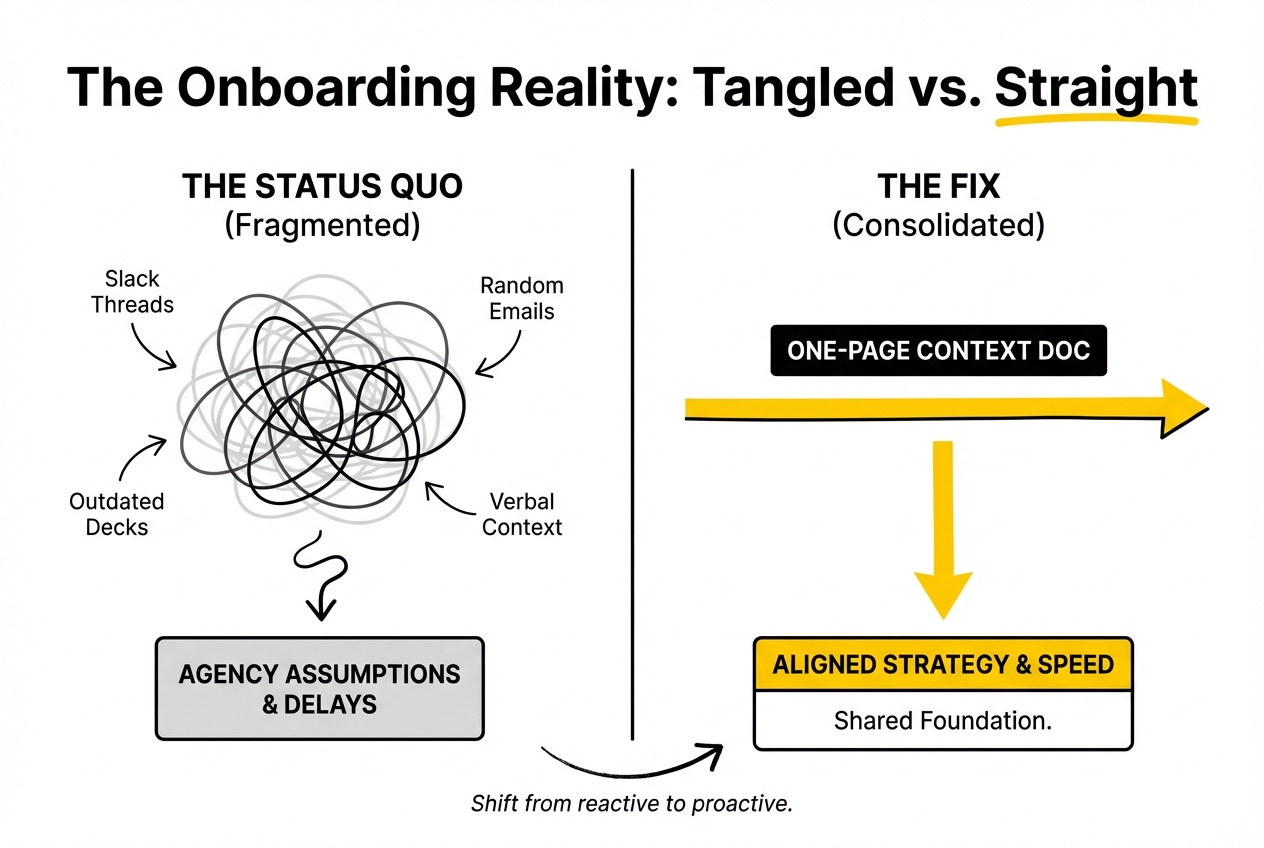
This is where most SaaS onboarding goes wrong. Not in the agency selection, and not in the campaign build. In the gap between “contract signed” and “campaigns live,” where critical context gets shared in fragments across calls, decks, and Slack threads, and the agency builds strategy around a version of your business that’s already outdated or incomplete.
The fix is not a longer onboarding programme. It is a single, well-constructed document.
This article explains what goes into a one-page context document for PPC partners, why each element matters, and how to build one that gets a new agency to correct assumptions faster, with fewer expensive misunderstandings on the way.
Why Most PPC Onboarding Wastes the First 30 Days
A new PPC partner typically enters onboarding knowing your target keyword list, your budget, and whatever they could piece together from your website. That is not enough to run campaigns that generate qualified pipeline.
What they actually need to build effective campaigns is context: who your buyers are, what makes your ICP convert versus bounce, what constraints you’re operating under, what success looks like in the board meeting, and what you will not compromise on regardless of what the data suggests.
Most of that context lives in the marketing director’s head. Without a structured transfer mechanism, it surfaces reactively, in response to questions or problems. The agency discovers your non-negotiables when they try to cross one. They learn about your sales cycle length when they’re pushing for ROAS targets that don’t fit a 90-day deal cycle. They find out your attribution model is broken when the numbers stop reconciling.
Best practices for onboarding SaaS PPC partners consistently point to the same root cause of ramp-up delays: the agency is operating on assumptions the client has not actively challenged. A one-page context document is the mechanism that challenges them upfront.
What the One-Page Format Actually Forces You to Do
There is a reason this is a one-page document rather than a full onboarding pack. Brevity requires prioritisation. When you are limited to a single page, you cannot include everything, which means you are forced to decide what actually matters most for this agency to get right in the first 90 days.
That decision process is itself valuable. If you cannot summarise your ICP in two or three sentences, that is a positioning problem worth surfacing before a new agency starts spending budget. If you cannot state your measurement reality concisely, that is a conversation you need to have internally before the kick-off call.
The one-page format is not a substitute for deeper onboarding conversations. It is the document you hand over before those conversations, so the conversations start from a shared foundation rather than a blank slate.
The Six Sections Your SaaS PPC Briefing Document Needs
1. Ideal Customer Profile
This is not a persona document. Your ICP section should tell the agency who is actually worth spending money to reach, and how to recognise them in campaign targeting.
Cover: company size (headcount and ARR range), industry verticals you convert in, job titles in the buying committee, and any firmographic signals that indicate a poor fit. If your sales team regularly discards inbound leads from a specific segment, say so here. Budget spent acquiring leads sales will not touch is budget wasted.
For a Series A SaaS product targeting mid-market financial services teams in the UK and Germany, a good ICP section might read: “CFO-driven buying decision, 200-500 employees, regulated sector (FS, insurance, professional services). Head of Finance typically the economic buyer, with IT sign-off. Out of ICP: SMB under 50 employees, e-commerce, B2C.”
That is 43 words. It is enough to shape keyword strategy, audience layers, and exclusion lists before a single campaign brief is written.
2. GTM Motion and Where PPC Fits
Your GTM strategy determines what PPC can and cannot do. An agency that does not understand this will optimise for the wrong outcomes.
If you are sales-led, PPC needs to generate demo requests that sales can work. If you are product-led, the conversion path runs through a free trial or freemium sign-up, and the meaningful metric is activation downstream, not the trial start. If you are running a hybrid motion, PPC may serve different purposes at different stages of the funnel, and the agency needs to know which part they are responsible for.
Include: your GTM motion (PLG, sales-led, or hybrid), your primary conversion event (demo, trial, contact form), your sales cycle length, and a single line on how PPC connects to revenue in your model. This section prevents an agency from treating your funnel like a direct-response play when you are running a 90-day consultative sales cycle.
3. Targets and the Metrics That Matter
State your targets clearly, but also state which metrics will be reviewed in which context. There is a difference between what you report to your investors, what you report to your leadership team, and what you use operationally to judge campaign health.
At minimum, include: your pipeline target for the quarter, your cost-per-opportunity target or acceptable range, your MQL-to-SQL conversion rate (so the agency can work backwards from pipeline to lead volume), and your CAC payback target if you track it.
The agency also needs to know which metrics you do not care about. Clicks, impressions, and quality scores are not irrelevant, but they are not what your next board meeting will focus on. Making that explicit avoids a situation where the agency reports on a dashboard full of platform metrics and you are sitting in a QBR unable to connect any of it to pipeline.
.jpeg)
4. Measurement Realities
This is the section most marketing directors skip, and it is the one that causes the most problems three months in.
Your measurement setup is almost certainly imperfect. Attribution gaps, CRM integration delays, offline conversion lag, the fact that your HubSpot and Google Ads numbers never fully reconcile. Document all of it here so the agency is not discovering these gaps through live campaign data.
Specifically cover: how conversions are tracked, which attribution model is in use, where the gaps are, and how long it typically takes for a conversion to show up in your reporting. If you are tracking form fills but not downstream pipeline, say so, and flag that MQL quality is something you review manually with sales rather than through automated reporting.
Chris Walker’s work at Refine Labs is useful framing here: the gap between what your ads platform reports and what your CRM records is not a technical problem to solve, it is a reality to manage. The agency should know going in that their platform numbers will not tie to your pipeline numbers, and by roughly how much.
5. Constraints
Every marketing director is operating under constraints the agency will not see until they bump into them. Stating them upfront saves everyone time.
Common constraints worth documenting:
- Budget approval process: Can the agency spend up to X without prior sign-off, or does any budget adjustment require your approval?
- Brand and messaging guardrails: What claims can and cannot be made in ad copy? Are there legal or compliance considerations?
- Landing page ownership: Can the agency request landing page changes, or do they have to work with what exists?
- Channel restrictions: Are there any channels you have already ruled out, or specific competitor terms you are not bidding on?
- Reporting cadence: What does the agency need to produce, at what frequency, and in what format?
A constraint the agency does not know about is a constraint that will surface as a disagreement. A constraint they know about from day one is a working parameter.
6. Non-Negotiables
Non-negotiables are different from constraints. Constraints are operational. Non-negotiables are the lines you will not cross regardless of what the data shows.
Examples: you do not bid on competitor brand terms. You do not run comparison-style ad copy. You do not optimise for MQL volume at the expense of MQL quality. You will not trade short-term conversion rate against longer-term brand positioning.
Stating non-negotiables upfront is not about being difficult. It is about ensuring the agency’s optimisation strategy never moves in a direction you cannot support. The earlier this is established, the less chance of a situation where the agency recommends something commercially logical that you cannot accept, and neither side fully understands why.
Putting the Document Together: Format and Length
One page. In practice, that means roughly 300-400 words across the six sections, or a structured table format that fits on a single screen without scrolling.
The format matters less than the discipline of keeping it short. A document that runs to three pages is not a one-page context document. It is a longer document that starts to resemble the kind of onboarding material that takes two weeks to produce and another two weeks for the agency to digest.
Build this as a shared Google Doc you update each time you onboard a new partner. The act of updating it also forces a useful reflection on whether your ICP, targets, or constraints have shifted since the last time you wrote them down.
.jpeg)
How This Connects to the Broader Onboarding Process
The one-page context document is the starting point, not the whole onboarding plan. It feeds the kick-off call, the first campaign brief, and the measurement framework the agency sets up in the first two weeks.
If you are working through the full 30/60/90-day onboarding structure, the context document belongs in week one, before any campaign work begins. The deeper onboarding conversations around ICP, GTM, and offer testing build on it rather than replacing it. How to Build a SaaS PPC Engine for B2B SaaS (Not Just Run Ads), also on this blog, takes this further.
For more on the selection process that precedes onboarding, our b2b saas ppc agency hub covers the criteria and process in detail.
Frequently Asked Questions
What key elements should be included in a one-page briefing document for a new SaaS PPC partner?
The six core elements are: Ideal Customer Profile, GTM motion and where PPC fits, targets and priority metrics, measurement realities (including attribution gaps), operational constraints, and non-negotiables. Together, these give an agency the context they need to build a strategy aligned with your actual growth model, not a generic SaaS PPC playbook.
How can a clear Ideal Customer Profile impact the success of a PPC campaign?
Your ICP directly shapes targeting decisions, exclusion lists, keyword strategy, and audience layering. An agency working from a vague ICP will optimise for volume. An agency working from a precise ICP will optimise for the right kind of volume. The difference shows up in MQL-to-SQL ratios, not click-through rates.
What are common mistakes to avoid when onboarding a new PPC agency for a SaaS product?
The most common mistakes are: sharing context reactively rather than proactively, failing to document measurement gaps before campaigns launch, not establishing non-negotiables until the agency crosses one, and treating the kick-off call as the context transfer mechanism rather than a follow-up to a written document.
How can a GTM strategy influence PPC campaign performance?
Your GTM motion determines the conversion event PPC should optimise for, the downstream metric that signals genuine success, and the sales cycle length that informs attribution windows and budget allocation. A sales-led motion needs demo volume and pipeline quality. A PLG motion needs trial activation. An agency that does not know which one you are running will make the wrong optimisation calls.
What metrics should be included in the measurement realities section of a PPC briefing document?
Document your attribution model, conversion tracking setup, which metrics connect to your CRM versus which live only in the ad platform, typical lag time between a conversion event and CRM visibility, and any known gaps in your tracking. The goal is not to present a perfect measurement story but to give the agency an accurate picture of what the numbers will and will not show.
What constraints should be communicated to a PPC partner to ensure alignment with marketing goals?
Budget approval thresholds, brand and messaging guardrails, landing page change permissions, channel restrictions, and reporting requirements are the most important constraints to document. Each one affects how the agency operates day-to-day. Constraints discovered mid-campaign create friction that slows everything down.
How can non-negotiables be effectively communicated to a new PPC agency?
State them plainly in the briefing document, and revisit them at the kick-off call. Non-negotiables work best when they include a brief rationale. “We do not bid on competitor brand terms because our sales team has confirmed it creates friction in active deals” is more useful than a bare rule, because it helps the agency understand the business logic rather than just the boundary.
What role does collaboration between marketing teams and PPC agencies play in campaign success?
The agency controls the platform. You control the context, the offers, the landing pages, and the downstream data. Neither side can optimise effectively without the other. The context document is the mechanism for transferring your side of that equation. Regular structured reviews are what keep the transfer current as your market, product, and targets evolve.
How can Growth-Focused Series A Marketing Directors ensure accountability in PPC efforts to leadership and investors?
Define the metrics you will report on before campaigns launch, and ensure those metrics connect directly to pipeline and revenue. If your leadership team reviews cost-per-opportunity and sales-qualified pipeline, those are the numbers the agency should be optimising toward and reporting against. Platform metrics belong in the operational layer, not the board deck.
What are the benefits of using a one-page context document for PPC partner onboarding?
It accelerates ramp-up time by front-loading the context transfer. It prevents the most common misalignments, which tend to emerge from unstated assumptions rather than capability gaps. It creates a shared reference point for disagreements. And it disciplines your own thinking about what actually matters in the partnership, which is useful regardless of who the partner is.
If you are working through a new agency onboarding and want a second pair of eyes on the briefing document or the measurement setup, this is the kind of thing we work through with SaaS teams regularly.