Onboarding Process for Series A+ Teams with a SaaS PPC Agency
A strategic onboarding plan for Series A+ teams to align ICP, GTM, and measurement with your new SaaS PPC agency from day one.

You hire a new PPC agency. The kickoff call is energetic. Everyone agrees the previous setup had problems. Campaigns go live in week three. Six weeks later, leadership is asking why pipeline hasn’t moved.
This is the most common failure pattern in SaaS PPC agency relationships, and it almost always starts in the onboarding phase. Not because the agency is bad, and not because the strategy is wrong. It fails because the first 90 days are treated as a ramp rather than a foundation.
For Series A+ marketing directors, the stakes are different to an early-stage experiment. You have quarterly targets, board scrutiny, and a CFO who wants to see CAC payback trends. You need your new b2b saas ppc agency to be productive quickly, and that requires a structured approach from both sides.
This is a practical guide to the SaaS PPC agency onboarding process for the first 30, 60, and 90 days. It covers what you should be doing, what you should be asking for, and where most teams waste time they don’t have.
What Happens When SaaS PPC Agency Onboarding Goes Wrong
The most expensive mistake in the first 90 days is not the wrong bid strategy. It is misaligned definitions.
When the agency thinks your ICP is “mid-market SaaS companies” and you mean “ops teams at Series B SaaS companies with 50 to 200 employees and a Salesforce instance,” you are not targeting the same people. When the agency measures success by MQL volume and your sales team only cares about SQLs, the data will look different to each side of the table every week.
These gaps are not uncovered in the kickoff call. They surface in week seven, when you are looking at a campaign that has driven 40 leads and zero qualified pipeline.
The 30/60/90 structure below is designed to surface these gaps early, get both sides aligned on what matters, and build a measurement framework that holds up in board meetings.
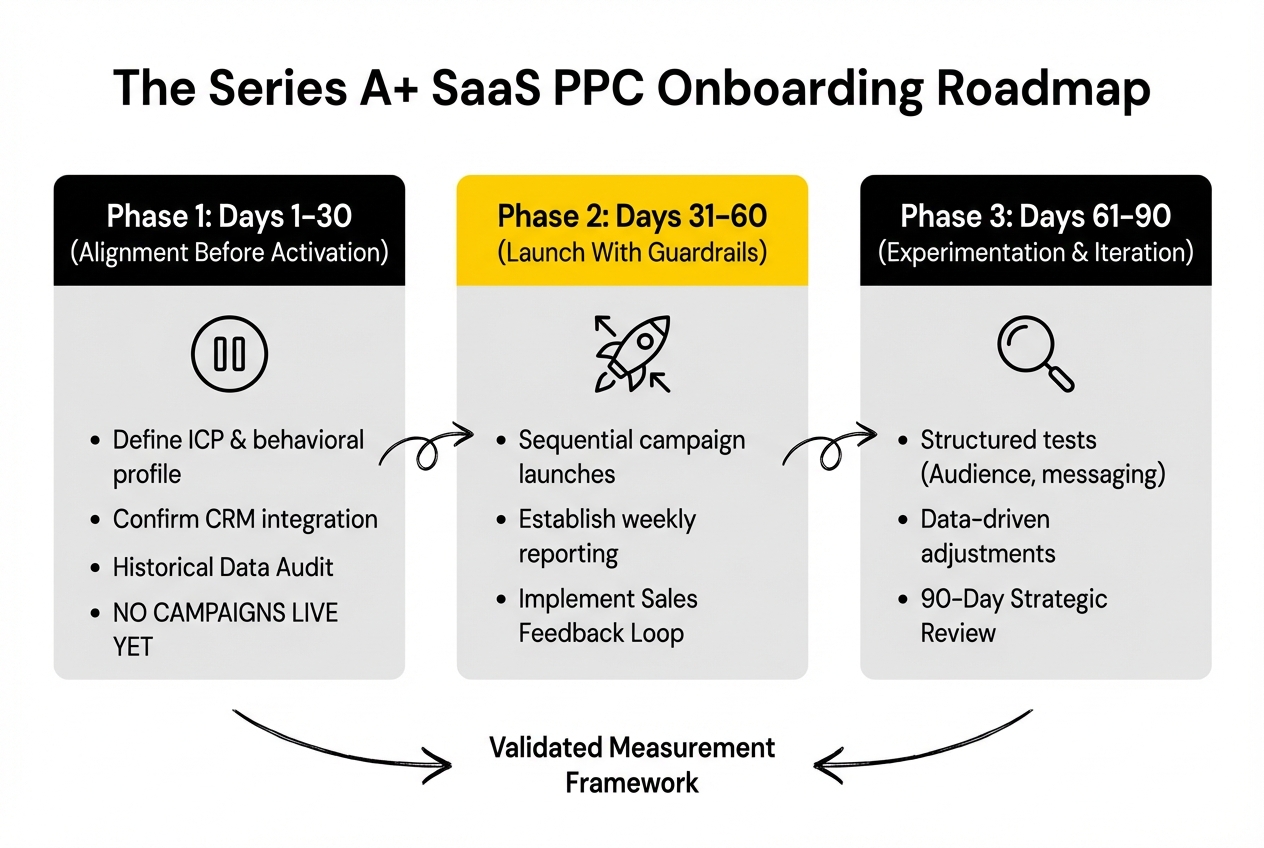
Days 1 to 30: Alignment Before Activation
The instinct in the first 30 days is to move fast. But fast onboarding with a SaaS PPC agency does not mean rushing campaigns live. Campaigns are paused or underperforming, and there is pressure to show activity. Resist it.
Month one should be spent on alignment, not activation. Specifically:
ICP documentation. Your agency cannot target the right people without a precise definition of who the right people are. This is not your marketing positioning. It is a specific, behavioural profile: company size, tech stack indicators, job titles that actually convert, deal sizes that are worth pursuing, and the signals that suggest a buying committee is forming. If this document does not exist, build it now. If it does exist, hand it over and walk through it with the agency.
GTM motion clarity. A sales-led GTM and a product-led GTM require entirely different PPC strategies. Campaigns that work for a demo-request flow will not work for a freemium trial conversion model. The agency needs to understand not just what you sell, but how your buyers buy.
CRM and attribution setup. Before any new campaigns go live, the measurement infrastructure needs to be in place. This means CRM integration is confirmed, conversion events are mapped to the right stages, and both sides agree on what a conversion means. Fixing this in month two costs far more than doing it in month one.
Access audit. The agency should have full access to historical campaign data, not just the current account. Six months of historical data tells the agency more about your market than any briefing document can.
The output of month one is not campaign launches. It is a shared briefing document that defines ICP, GTM motion, conversion definitions, and the metrics that will matter in your board deck.
Days 31 to 60: Launch With Guardrails
Month two is where campaigns go live, but under a specific constraint: you are not trying to optimise yet. You are trying to generate reliable signal.
The biggest error in month two is launching everything at once. If you run six campaign types simultaneously across three channels and results are mixed, you will not know what to fix. Launch in sequence, or at minimum, isolate variables clearly enough that performance can be attributed to specific decisions.
Setting the Right KPIs for This Stage
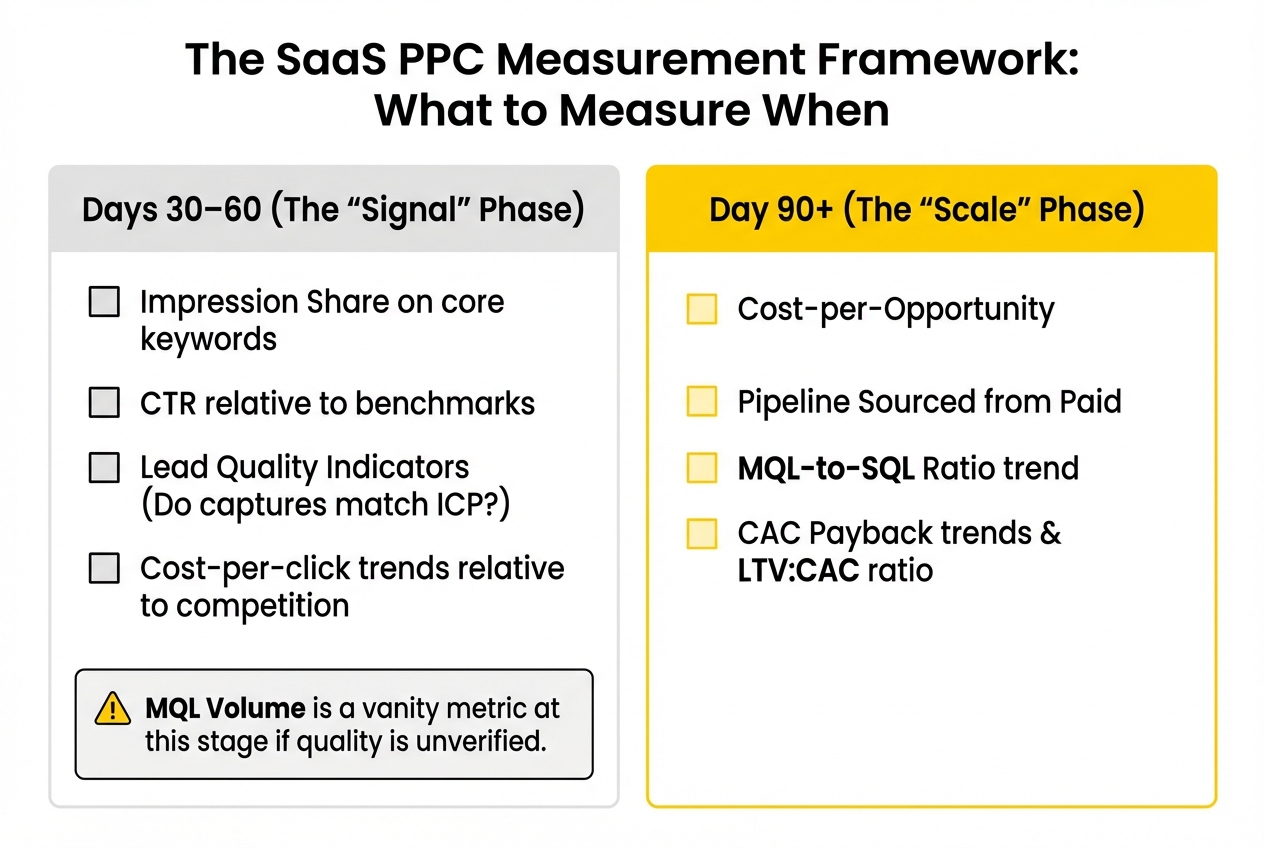
The metrics that matter in month two are different to the metrics that matter at month six. At this stage, you are not measuring against fully-formed CAC targets. You are measuring against:
- Impression share on your most important keywords (are you actually visible?)
- Click-through rates relative to benchmarks for your category
- Lead quality indicators (do the leads being captured match your ICP profile?)
- Cost-per-click trends (is spend behaving as expected given competition in this space?)
MQL volume is a vanity metric at this stage if the quality is unknown. A campaign that generates 20 leads matching your ICP is more useful than one generating 80 leads that sales will not touch.
The Weekly Rhythm
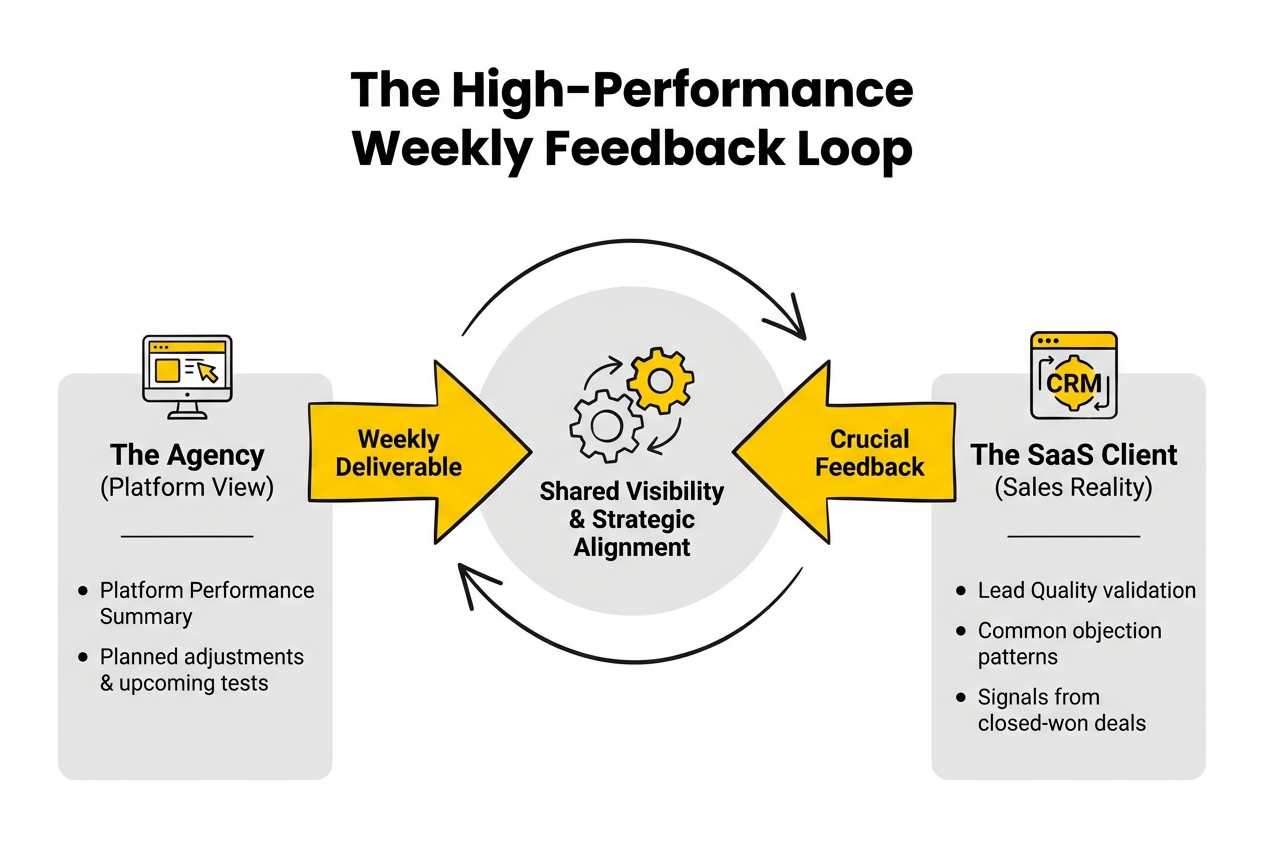
Establish a weekly reporting cadence in month two, not to micromanage but to create shared visibility. The agency should be delivering a brief weekly summary that covers what is running, what the numbers are showing, and what they are going to test or adjust. You should be feeding back anything from the sales side: are the leads coming in relevant, what are the common objection patterns, are there signals from closed-won deals that should inform targeting?
This two-way flow is where most agency relationships fail. The agency optimises for platform metrics. The client waits for results. Nobody is adjusting for what the other side is seeing.
Days 61 to 90: Experimentation and Iteration
By month three, you should have enough data to start making deliberate changes rather than reactive ones. This is the point where a structured experimentation process becomes important.
Experimenting with PPC campaigns at this stage means something specific: running controlled tests with a hypothesis, a defined time window, and a clear success metric. It does not mean changing bids, copy, and targeting simultaneously and seeing what happens.
What to Test First
Prioritise tests in this order:
- Audience targeting variations. If you are running broad keyword coverage, test a tighter ICP-specific layer. Are the people clicking actually matching your customer profile?
- Ad messaging. Test copy that addresses different pain points against copy that addresses outcomes. For B2B SaaS with long sales cycles, problem-awareness messaging often outperforms solution-first copy in the capture phase.
- Landing page alignment. High click-through with low conversion is almost always a landing page problem, not an ad problem. Test whether tighter message match between ad and page improves conversion rate.
The 90-Day Review
At the end of month three, run a structured review that covers three things: what the data shows, what the team has learned, and what the strategy looks like for the next quarter.
This review should not be a campaign performance report. It should be a strategic document that connects PPC performance to pipeline, identifies the highest-leverage opportunities, and sets the measurement framework for the next 90 days. According to OpenView Partners’ SaaS benchmarks, high-performing SaaS growth teams treat each quarter as a structured experiment, not a continuation of the last. The first 90 days with a new agency is the best time to establish that discipline.
If you are not getting this kind of structured thinking from your agency at the 90-day mark, that is a signal worth acting on.
The Measurement Framework That Actually Works
One of the most important outcomes of the first 90 days is a measurement framework that you and the agency both believe in and that holds up when leadership or investors ask questions.
The most common failure here is measuring too many things. When every metric is important, no metric is. A working measurement framework for scaling paid search efforts at Series A+ looks like this:
Leading indicators (weekly): impression share, CTR, cost-per-click by campaign type, lead volume by source.
Lagging indicators (monthly): cost-per-opportunity, MQL-to-SQL ratio, pipeline sourced from paid, closed-won revenue influenced by paid.
Strategic indicators (quarterly): CAC payback period by channel, LTV-to-CAC ratio trend, paid’s share of total pipeline.
The agency should be responsible for the leading indicators. You and the agency together own the connection between leading indicators and pipeline outcomes. The lagging and strategic indicators are what you take to the board.
This separation matters because it prevents the agency from being evaluated only on what they can directly control (platform metrics), while also preventing leadership from only seeing the lagging indicators without understanding what drives them.
Common Pitfalls in the First 90 Days
A few patterns that consistently derail the early stages of a new agency relationship:
Treating the brief as a one-time document. The ICP and GTM context you share in week one will be out of date in month three. Markets shift, positioning evolves, sales learns what converts. Build a lightweight update process so the agency is working from current information.
Conflating activity with progress. Campaigns running, reports being sent, calls happening: these are inputs, not outputs. The output that matters is qualified pipeline. Keep that as the north star, even when it takes time to show up in the data.
Skipping the sales feedback loop. The agency only sees what happens on the platform. If your sales team is telling you that the leads coming in are from companies too small to close, that information needs to reach the agency within days, not weeks. Build a formal mechanism for passing this signal back. Structuring SaaS PPC Accounts for PLG vs Sales-Led Funnels, also on this blog, takes this further.
Optimising too early. Making significant changes to campaigns before you have statistically meaningful data is one of the most common errors in B2B SaaS PPC, where conversion volumes are lower than in consumer categories. Let the data accumulate before drawing conclusions.
Frequently Asked Questions
What should SaaS PPC agency onboarding look like in the first 30 days?
The first 30 days of the SaaS PPC agency onboarding process should be almost entirely alignment, not activation. The priority is sharing ICP documentation, clarifying your GTM motion, confirming CRM and attribution setup, and giving the agency access to historical campaign data. Launching campaigns before these foundations are in place typically leads to six weeks of wasted budget and a difficult conversation with leadership.
How can Series A+ teams align their Ideal Customer Profile with their PPC strategy?
Start with a written ICP document that goes beyond demographics: include firmographic signals, tech stack indicators, job titles that actually convert, ACV ranges, and buying committee structure. Walk the agency through this in the first week. Then validate it against historical closed-won data, not just marketing’s assumptions. The ICP should be treated as a living document updated quarterly as the sales team learns more.
What are the key metrics to establish in the first 60 days of working with a PPC agency?
In month two, the most important metrics are lead quality indicators (does what is coming in match your ICP?), cost-per-click trends, and conversion rates at the top of funnel. MQL volume matters only if you have defined quality criteria. Cost-per-opportunity is more important than cost-per-lead, but you may not have enough volume to measure this reliably until month three.
What experimentation processes should be implemented in the first 90 days with a PPC agency?
By month three, run structured A/B tests on audience targeting, ad messaging, and landing page alignment. Each test should have a clear hypothesis, a defined success metric, and a minimum run time before conclusions are drawn. In B2B SaaS, conversion volumes are typically lower than in consumer categories, so testing windows need to be longer. Avoid changing multiple variables simultaneously.
How can marketing leaders ensure their PPC agency understands their Go-To-Market approach?
Do not assume this is conveyed in a kickoff call. Provide the agency with your sales deck, recent win/loss analysis, and any positioning documentation you have. Walk them through how a deal typically progresses from first touch to closed-won. If your GTM is shifting, for example from sales-led to product-led, make sure the agency understands the implications for conversion strategy.
What strategies can be used to foster a productive relationship with a PPC agency from day one?
Establish a weekly feedback loop from the start. The agency reports on platform performance. You report back on what sales is seeing from the leads generated. This two-way information flow is what separates agencies that improve over time from those that optimise in isolation. Set shared KPIs that connect platform metrics to pipeline, not just to impressions and clicks.
How can data-driven decisions impact the onboarding process with a PPC agency?
A data-driven approach to onboarding means making decisions based on what the data is showing, not on assumptions or preferences. In practice this means waiting for sufficient conversion volume before making structural campaign changes, using historical CRM data to inform targeting rather than starting from scratch, and defining in advance what a meaningful result looks like before the first campaigns go live.
What common pitfalls should be avoided during the onboarding of a PPC agency?
The most expensive pitfalls are: misaligned definitions (ICP, conversion, success metrics), optimising before sufficient data has accumulated, skipping the sales feedback loop, and treating the initial briefing document as final. Each of these can be avoided with a structured onboarding plan that builds in alignment before activation.
How can marketing directors measure the success of their PPC campaigns in the first 90 days?
Success in the first 90 days is not primarily about pipeline. It is about establishing a reliable measurement framework and generating early signal. By day 90, you should know: which campaigns are generating ICP-matched leads, what the cost-per-opportunity trend looks like, and whether the landing page and ad message alignment is working. Full CAC payback analysis becomes meaningful from month four or five, depending on your sales cycle length.
What are the best practices for communicating expectations to a new PPC agency?
Put it in writing. A one-page briefing document that covers your ICP, GTM motion, conversion definitions, and the metrics that will appear in your board deck gives the agency a fixed reference point. Agree on what success looks like at 30, 60, and 90 days before campaigns launch. Review these expectations formally at each milestone, and update them as your understanding of the market develops.
If you are working through the early stages of a new agency relationship and want a second opinion on your onboarding setup, we are happy to take a look. This is the kind of thing we work through with Series A+ teams regularly.