Questions Enterprise CMOs Should Ask Before Hiring a SaaS PPC Partner
Enterprise CMOs: ask the right questions before hiring a SaaS PPC partner: scale, governance, measurement, and risk.

Most PPC pitches go the same way. The agency shows you a polished deck, a case study with strong numbers, and a confident senior person who will apparently run your account personally. You leave the room with good vibes. Three months in, the senior person has moved on, reporting is opaque, and the campaigns that worked for their previous client are underperforming on yours.
At SMB scale, a bad agency hire is painful but recoverable. At enterprise scale, it can cost you a quarter of pipeline and six months of credibility with the board.
The questions in this article are designed to surface the difference between an agency that looks enterprise-ready and one that actually is. They are not tactics questions. They are risk, control, and resilience questions, the kind that belong in an RFP and in the room when you are deciding who to trust with significant budget across multiple markets and buying cycles.
Why Enterprise SaaS PPC Fails Differently
The standard PPC evaluation process was built for smaller accounts. Ask for case studies. Check their Google certifications. See if they have industry experience. That process works well enough when the downside risk is limited.
Enterprise SaaS is a different context entirely. Attribution windows of six months or longer mean you cannot run quick tests and read results cleanly. Buying committees with five to twelve stakeholders mean a single campaign cannot carry the conversion weight you would expect at SMB scale. Multi-market operations with different compliance requirements, different ICPs, and different competitive landscapes mean a one-size approach will fail somewhere.
The agency that excelled with a Series A SaaS company spending £30k per month may have no idea how to handle a Series D organisation with multiple product lines, regional sales teams, a procurement function, and a board that wants pipeline forecasts tied to paid activity.
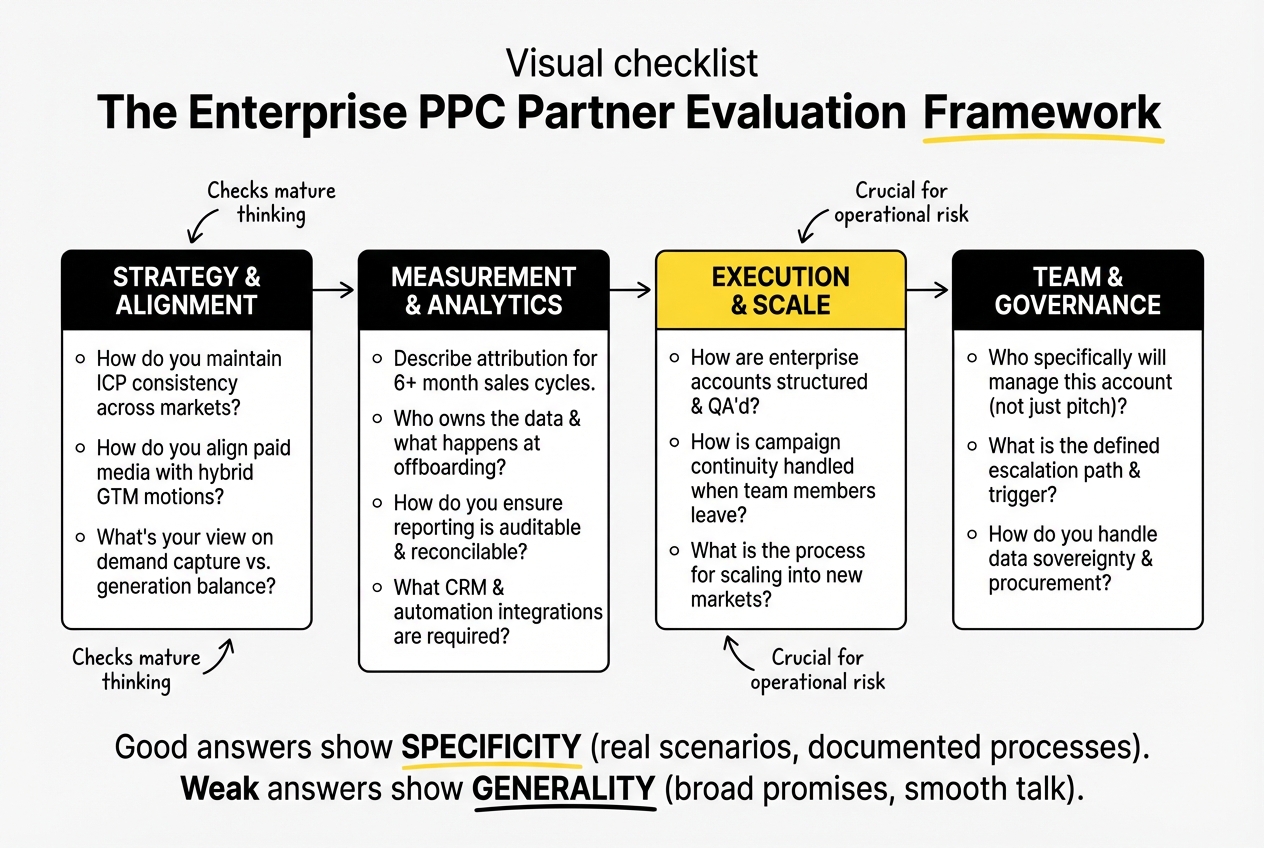
The questions below are grouped by risk area. Use them as a framework for evaluation, not as a checklist to run through mechanically. What you are listening for is not the correct answer: it is whether the agency has actually thought about these problems, or is answering them for the first time in front of you.
Strategy and Alignment Questions
How do you maintain ICP consistency when campaigns run across multiple markets or product lines?
An enterprise SaaS PPC partner needs to understand that the ICP for a UK financial services deal is not the same as the ICP for a US healthcare deal, even if the product is identical. The targeting parameters, the messaging, and the conversion thresholds will all differ.
A mature agency will describe how it documents ICP variation at the account level, not just at the campaign level. Weak answers describe the same targeting approach applied consistently across markets. Strong answers acknowledge the tension between consistency and localisation, and explain how they manage it.
How do you align paid media strategy with different GTM motions within the same account?
Series C+ SaaS companies frequently run a hybrid GTM: product-led acquisition for smaller seats alongside enterprise sales motions for large accounts. Campaigns serving both motions simultaneously require distinct logic, separate measurement frameworks, and clear rules about which audiences belong to which motion.
If the agency looks slightly blank at this question, that is relevant information.
What is your view on the balance between demand capture and demand generation at enterprise scale?
There is a ceiling on how much pipeline demand capture alone can generate, particularly in specialist B2B categories with defined TAMs. Enterprise SaaS companies that are still entirely capture-led at Series C are typically growing more slowly than they should be.
A good answer shows the agency understands that balance shifts as companies scale, and that they have a considered position on what that balance should look like at your stage, in your category. A weak answer describes demand capture optimisation and adds “we also do LinkedIn” as an afterthought.
Measurement and Analytics Questions
What does your attribution model look like for accounts with six-plus month sales cycles?
Last-click attribution is meaningless when a deal closes nine months after the first ad interaction. An enterprise SaaS PPC partner should be able to describe exactly how they attribute credit across a long cycle, which CRM data they require to do it, and what they do when the data is incomplete.
This is also a useful question for surfacing dependency on first-party data. Agencies that are still primarily reliant on platform-reported conversions for accounts with long sales cycles are not set up for enterprise reporting.
Who owns the data, and what happens to it when the engagement ends?
This question is simple to ask and surprisingly revealing. All campaign data, audience lists, conversion history, and account structures should remain with you when the relationship ends. Some agencies structure their tech stack in ways that make data extraction difficult or incomplete at offboarding.
Get the answer in the contract, not just verbally. This matters for board governance as much as for continuity.
How do you ensure reporting is auditable, and what is your process when platform data and CRM data diverge?
Platform-reported performance and CRM-recorded pipeline almost never match exactly. The question is whether the agency has a documented process for reconciling them, and whether that process produces outputs you can take into a board meeting.
Vague references to “regular reporting” and “custom dashboards” are not the same as a described methodology for connecting ad spend to closed-won revenue over a twelve-month attribution window.
What CRM and marketing automation integrations do you require, and what level of technical access do you need?
This is a governance question as much as a technical one. You need to understand what systems the agency will touch, what data they will access, and what your IT and security teams will need to review before any access is granted. Agencies that have worked at enterprise scale will have an established security review process and data handling documentation. Those that have not will be encountering it for the first time with you.
Execution and Scale Questions
How do you structure accounts at enterprise scale, and what QA process governs campaign changes?
Account architecture at enterprise scale is genuinely complex. Hundreds of ad groups, multiple conversion actions, layered audience strategies, and bid strategies that interact with each other in ways that are difficult to predict. The question is whether the agency has documented processes for managing that complexity, or whether it depends on the individual knowledge of whoever is managing the account.
Ask specifically about change management: what is the approval process for significant budget reallocation, campaign pauses, or structural changes to account architecture? If the answer is “we communicate it in the weekly call,” that is a scaling risk.
How have you handled campaign continuity when a key team member leaves mid-engagement?
This question makes some agencies uncomfortable, which is exactly why it belongs in the evaluation. Senior practitioners leave. The test of a mature agency is whether the institutional knowledge lives in documented systems or in individual heads.
Strong answers describe structured onboarding documentation, account playbooks, and a defined transition process. Weak answers describe the stability of their team, which is not the question you asked.
What is your process for scaling campaigns into new markets or channels?
For enterprise SaaS operating across UK, Europe, and potentially further, the operational lift of launching in a new market is significant. Keyword research, competitive analysis, landing page adaptation, compliance review, and local CRM configuration all need to happen before a campaign goes live.
An agency that treats this as a straightforward extension of existing campaigns is telling you something important about how they manage operational risk.
Team and Governance Questions
Who specifically will manage this account, and what is their background with enterprise SaaS?
This is not the same as asking who the senior person is on the pitch. You are asking who will be in the accounts on a Tuesday morning making optimisation decisions. Ask for that person’s background, their current account load, and how decisions escalate when they are uncertain or when something goes wrong.
Knowing the answer protects you from the most common agency disappointment: the experienced team on the pitch and the junior team on the account.
What does your escalation path look like, and what constitutes an escalation trigger?
A SaaS paid media partner working at enterprise scale should have clear definitions for what constitutes a performance problem requiring escalation, and a clear process for who handles it and how quickly. This should not be defined for the first time during the relationship.
Ask them to describe a real escalation they have handled. What triggered it, what was their process, and what was the outcome? Specific examples are more informative than described processes.
How do you handle governance requirements: data sovereignty, regional compliance, procurement?
Depending on the markets you operate in and the stage you are at, your procurement function may have specific vendor requirements, your legal team may have data handling requirements, and your finance team will have contracting requirements. An enterprise PPC partner that has only worked with growth-stage companies may encounter these requirements as surprises. One that has worked in regulated enterprise contexts will have standard templates and a familiar process.
Experimentation and Learning Questions
What is your testing methodology, and how do you ensure tests reach statistical significance given long sales cycles?
Testing in enterprise SaaS PPC is structurally harder than in most other categories. Sample sizes are smaller, conversion windows are longer, and the signal-to-noise ratio in platform data is lower. An agency that applies standard A/B testing frameworks without accounting for these constraints will reach conclusions that do not hold under scrutiny.
Ask them how they size tests. What is their minimum sample size for a creative test? How do they handle tests where significance cannot be reached within a reasonable timeframe? What do they do with inconclusive results?
How do you transfer learnings between markets or product lines within a single account?
Insights from one region or product line should inform strategy across others. This sounds obvious but requires deliberate process. Agencies managing complex enterprise accounts without documented learning transfer tend to reinvent the same experiments repeatedly across different markets.
Commercial and Risk Questions
How are you incentivised, and how does that incentive structure affect your decisions?
This question is worth asking directly. Percentage-of-spend fee models create a structural incentive to grow budgets regardless of efficiency. Fixed retainers can create an incentive to minimise scope. Neither is inherently wrong, but understanding the incentive structure helps you interpret the agency’s recommendations throughout the relationship.
What SLAs do you commit to, and how are they measured?
Response times, reporting delivery, onboarding timelines, and escalation response windows should be specified contractually. If an agency is hesitant to commit to SLAs in writing, that is worth noting.
What does the exit process look like, and how long does transition take?
Ask this before you sign anything. A well-structured exit should take four to six weeks and should include full account documentation, audience and data export, and a structured handover to your incoming team or agency. Agencies that cannot describe this clearly either have not thought about it or have had difficult exits that they would prefer not to discuss.
What Good Answers Sound Like
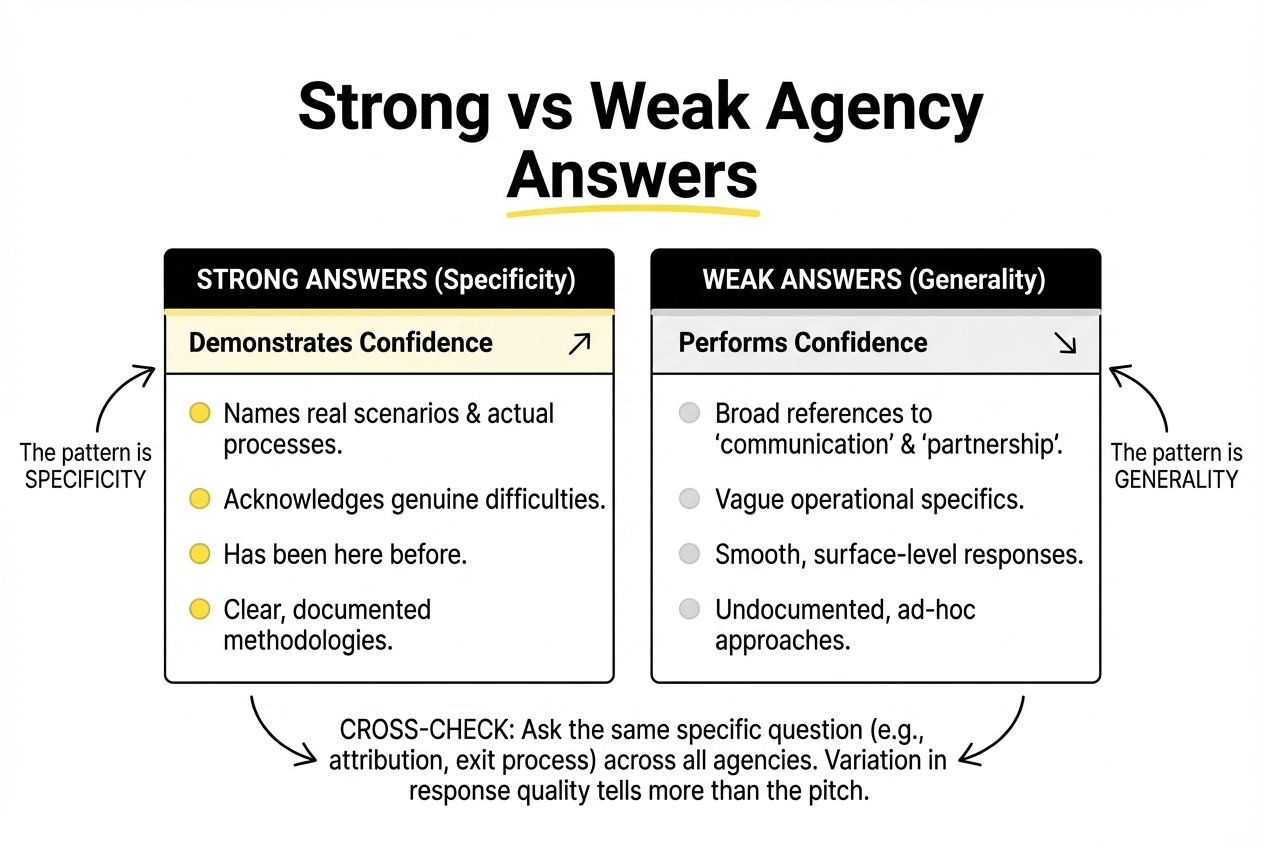
The pattern in strong answers is specificity. Good agency responses name real scenarios, describe actual processes, and acknowledge the genuine difficulties in their area of expertise. They do not perform confidence; they demonstrate it by showing you they have been here before.
The pattern in weak answers is generality. Broad references to “communication,” “transparency,” and “partnership” without the operational specifics that make those things real. Smooth answers to governance questions from agencies that have never had to navigate an enterprise procurement review.
A useful cross-check: take one or two of the most specific questions here (the attribution model question, the exit process question, the escalation trigger question) and ask the same question across every agency you evaluate. The variation in response quality will tell you more than most of the pitch. Cost Per Acquisition (CPA) - The Most Critical PPC Metric, also on this blog, takes this further.
Running a Low-Risk Enterprise Pilot
For high-value, long-cycle accounts, a structured pilot before a full engagement reduces risk on both sides. A well-designed pilot has a defined scope (one market, one product line, or one channel), clear success metrics agreed in advance, a fixed timeline (90 days is standard), and a documented evaluation framework.
The pilot should be treated as a live engagement with full governance and reporting requirements, not as a trial period with relaxed oversight. The goal is not just to assess performance; it is to assess how the agency operates under real conditions.
Frequently Asked Questions
What questions should enterprise CMOs ask before hiring a SaaS PPC partner?
Focus on governance, measurement, team continuity, and commercial structure. Beyond case studies, ask who will manage the account, how attribution works across long cycles, what the exit process looks like, and how escalation is handled. These questions surface operational maturity that pitch decks do not reveal.
How do you evaluate a PPC agency for enterprise SaaS?
Look for agencies that have explicitly worked with enterprise-scale accounts: multi-market, multi-product, with procurement, security, and compliance requirements. Ask for references from accounts of comparable complexity. Evaluate their attribution methodology, account structure documentation, and how they handle team transitions.
What governance and reporting should enterprise PPC partners provide?
Minimum requirements include monthly reporting tied to CRM pipeline data (not just platform metrics), a documented change management process for significant account changes, defined SLAs for reporting and escalation, and data ownership clauses in the contract. For multi-market operations, regional reporting with consistent methodology across markets is also standard.
How do enterprise SaaS companies manage PPC risk at scale?
Structure contracts with clear SLAs, data ownership clauses, and defined exit processes. Require documented account playbooks from day one, not just at offboarding. Run a structured pilot before full engagement where possible. Maintain at least one internal stakeholder with enough account knowledge to spot problems early.
What should be included in an enterprise PPC pilot or RFP?
An RFP should include: account complexity and technical requirements, measurement and attribution expectations, governance and compliance requirements, team structure requirements, SLA expectations, data ownership and security requirements, and a defined evaluation framework with success metrics. A pilot scope should be narrow enough to evaluate cleanly, with agreed metrics defined before it begins.
How do you ensure data ownership and auditability with agencies?
Specify data ownership in the contract before signing. All campaign data, audience lists, conversion histories, and account structures should be owned by you. Require regular data exports as part of the standard reporting process. Ensure your internal team has direct account access at admin level throughout the engagement, not just view access.
When should an enterprise SaaS build in-house vs partner for PPC?
Most enterprise SaaS companies at Series C or beyond benefit from a hybrid model: internal ownership of strategy and performance review, with execution managed by a specialist partner. Full in-house makes sense when PPC is a primary growth channel warranting a team of three or more, when institutional knowledge is critical to competitive advantage, or when data governance requirements make external access structurally difficult.
If you’re evaluating enterprise SaaS PPC partners and want a senior view on whether your current setup holds up to this standard, we’re happy to take a look. Get in touch.