Red Flags in SaaS Paid Media Pitches (From Both Sides of the Table)
Spot red flags in SaaS paid media pitches, from overpromising agencies to unclear internal briefs, before wasted budget and lost trust.

Most bad agency experiences are predictable. Not in hindsight, in the pitch itself. The signals were there: the guaranteed CPA, the slide that never mentioned sales cycle length, the senior consultant who went quiet after the contract was signed. The pattern repeats because most SaaS teams evaluate pitches on the wrong criteria.
This article covers the red flags worth watching for when you’re on the receiving end of a SaaS paid media pitch, and, just as importantly, the ones most SaaS marketing teams create themselves without realising it.
Why the Pitch Stage Matters More Than Most Teams Think
By the time you’re comparing proposals, you’ve already done the hard work. You’ve shortlisted agencies, made time for discovery calls, and aligned internally on the need for a new partner or approach.
But most of the risk in a paid media engagement is locked in at the point of signing. The questions you didn’t ask, the assumptions left unclarified, the deliverables that were vague enough to mean anything: these don’t surface as problems until month three, when the board asks where the pipeline is.
The goal of evaluating a pitch isn’t to find the most confident agency. It’s to find the one that understands your specific commercial reality and is honest about what it can and cannot control.
Agency-Side Red Flags in SaaS Paid Media Pitches
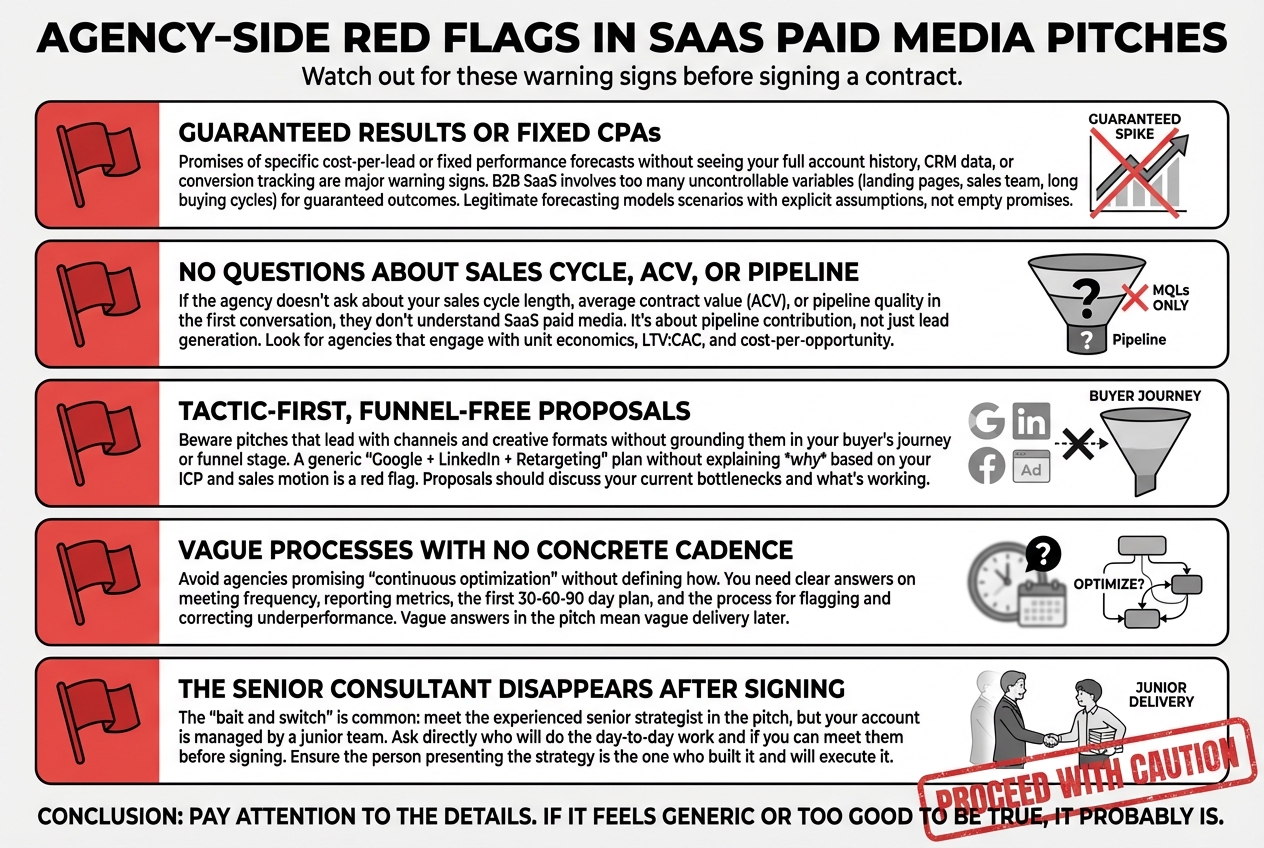
Guaranteed results, fixed CPAs, or precise performance forecasts
If an agency gives you a guaranteed cost-per-lead or a fixed CPA before they’ve seen your full account history, CRM data, or conversion tracking setup, walk slowly toward the exit.
Paid media in B2B SaaS involves too many variables an agency cannot control: the quality of your landing pages, the strength of your positioning, the conversion rate of your sales team, and the length of a buying cycle that can stretch across months. Any agency that promises you specific outcomes without caveating these dependencies is either inexperienced or is telling you what they think you want to hear.
The legitimate version of forecasting looks different. A good SaaS paid media agency will model scenarios, set expectations by funnel stage, and be explicit about what the forecast assumes. “We expect to drive X qualified pipeline at Y average CPO, assuming conversion rates hold from MQL to SQL in line with your current benchmarks” is honest. “We’ll get you 50 leads a month at £120 CPL” without that context is not.
No questions about sales cycle, ACV, or pipeline quality
A SaaS paid media agency that doesn’t ask about your sales cycle length in the first conversation doesn’t understand what it’s being hired to do.
Paid media in B2B SaaS isn’t a lead generation exercise. It’s a pipeline contribution exercise, and the difference matters enormously once you’re reporting to a board. An agency optimising for MQL volume while your average deal takes four months to close will build campaigns that look healthy on paper and produce almost nothing in qualified pipeline.
The questions worth listening for in a pitch: What does your typical deal cycle look like? What ACV are we working with? How does your sales team currently qualify inbound leads? What counts as a successful outcome in your CRM, not just your ad platform?
If those questions don’t come up naturally, ask them directly and pay attention to whether the answers land with any depth. An agency that can engage seriously with SaaS unit economics, LTV:CAC ratios, CAC payback period, cost-per-opportunity versus cost-per-lead, is signalling something real about how they’ll manage your campaigns.
Tactic-first, funnel-free proposals
Watch for pitches that lead with channels and creative formats without grounding them in where your buyers are in the funnel or what your current demand gen versus demand capture balance looks like.
“We’ll run Google Search, LinkedIn, and retargeting” is not a strategy. A genuine SaaS paid media proposal should explain why each channel earns its place given your ICP, your sales motion (PLG, sales-led, or hybrid), and where your current acquisition bottleneck sits.
A proposal that skips straight to channel selection without discussing your funnel stage, your current conversion rates, or what’s already working in your account is often covering for a lack of SaaS-specific depth. The playbook is generic. It’s dressed up in your logo, but it’s the same deck they send to everyone.
Vague processes with no concrete cadence
“We optimise continuously” and “we use a data-driven approach” are the agency equivalents of saying nothing. Every agency claims to optimise continuously. What matters is how.
Before signing, you should be able to answer: How often are we meeting and what will be discussed? What reporting cadence can I expect, and which metrics will be in the report? What does the first 30, 60, and 90 days look like in concrete terms? When something isn’t performing, what’s the process for flagging it and course-correcting?
If an agency gives you vague answers to these questions in the pitch, the answers will be vaguer still once you’re a client. The people who were sharp and responsive during the sales process are often not the people delivering your account.
The senior consultant disappears after signing
This one isn’t always visible during the pitch, but you can probe for it. Ask directly: who will be doing the day-to-day work on my account? Will I be able to meet them before we sign? What’s the typical team structure for an account our size?
Agencies built around senior sales and junior delivery are a known pattern in this industry. You meet the experienced practitioner during the pitch. Your account gets managed by someone three years into their career with a stack of clients. The quality of strategic thinking you were sold doesn’t show up in the work.
There’s a simple check for this: ask whether the person presenting the proposal is also the person who audited your account and built the strategy. In many agencies, those are different people. A salesperson who has shaped a brief into a deck versus a practitioner who has actually looked at your campaigns. If the answer is no, you have no way of stress-testing the thinking with the person who produced it.
The best pitches have the actual account lead in the room. You can ask hard questions about specific campaign decisions, about what they’d change in your current setup, about how they’d approach your funnel differently, and get answers from the person who will be making those calls once you sign. If that person isn’t present, ask why, and ask to meet them before you commit.
Client-Side Red Flags (Rarely Mentioned Elsewhere)
Most writing about agency red flags focuses exclusively on the agency. But the pitch process is two-directional. There are patterns on the client side that predict a difficult engagement before it starts, and if you recognise them in your own setup, addressing them before signing will save everyone time.
Unclear success metrics or conflicting stakeholder definitions of “results”
If your marketing team, your VP of Sales, and your CFO would each give a different answer to “what does paid media success look like in six months?”, you have a problem that no agency can solve for you.
Agencies can only optimise toward what they’re told to optimise toward. If the internal brief going into the pitch process is “we need more pipeline,” but what the board actually wants is “we need to reduce CAC,” and what sales actually means is “we need better-quality leads, not more volume,” those are three different briefs. The agency will respond to whichever one sounds clearest in the room, and they’ll be blamed for the other two.
Get alignment internally on your primary success metric before you start speaking to agencies. Define it at the point in the funnel that matters: not clicks, not MQLs, but qualified pipeline, cost-per-opportunity, or, if you have the tracking in place, influenced closed-won revenue.
Expecting an agency to fix positioning through ads alone
This comes up more than most SaaS teams want to admit. The symptoms: low conversion rates on landing pages, high click volume with almost no qualified enquiries, consistent feedback from sales that inbound leads don’t understand the product.
These are positioning and messaging problems. They can be partially addressed through better ad copy, landing page structure, and audience segmentation, but no paid media strategy will substitute for clear, differentiated positioning that resonates with the right ICP.
If your pitch brief includes “we need help communicating our value proposition through ads,” flag this as a dependency before you sign. A good agency will acknowledge it and discuss how they’d address it. An agency that doesn’t raise it at all is setting you both up for a difficult conversation in month two.
No access to analytics, CRM, or sales data
An agency that can’t see your GA4 conversion data, your CRM pipeline, or your historical campaign performance is flying blind. This sounds obvious, but it’s genuinely common: accounts held in-house, historical data not transferred, attribution not set up, or sales feedback siloed from the marketing team.
If any of these apply to your current setup, that’s not the agency’s problem to solve unaided. It’s yours to fix before the engagement starts, or to be transparent about so the first 30 days can include a proper tracking and data audit.
Agencies that don’t ask about this in the pitch are also a problem. If they’re not asking how you currently track leads to closed revenue, they’re not planning to manage to that standard.
Short-term thinking driven by board pressure
Paid media in B2B SaaS takes time to compound. You’re working with long sales cycles, committee buying decisions, and attribution challenges across multi-touch journeys. Expecting meaningful pipeline movement in weeks rather than months sets an unrealistic benchmark that no agency can meet.
If the internal brief going into the pitch has been shaped by “we need to show results in 60 days,” be honest with yourself about whether that’s a realistic expectation for your deal cycle and budget, or whether it’s pressure that needs reframing before you start.
The agencies that will tell you this directly are worth more than the ones who nod along and promise to make it work.
.jpeg)
What a Healthy Paid Media Pitch Actually Looks Like
For contrast: a pitch worth trusting is one where the agency spends more time asking than presenting in the early stages. They want to understand your current setup before they recommend anything. They flag trade-offs clearly. They talk about what paid media can and cannot do for your specific business.
A healthy pitch includes constraints: “Based on your deal cycle and budget, here’s what’s realistic in the first 90 days and here’s where we’d expect to see movement by the six-month mark.” It includes a clear process: specific reporting cadences, named team members, a structured onboarding plan. And it acknowledges risk: “If your landing page conversion rates are below X, we’ll need to address that before scaling spend.”
The opposite of theatre is honesty about difficulty. The agencies that tell you what you want to hear are not the ones who will be transparent with you when something isn’t working.
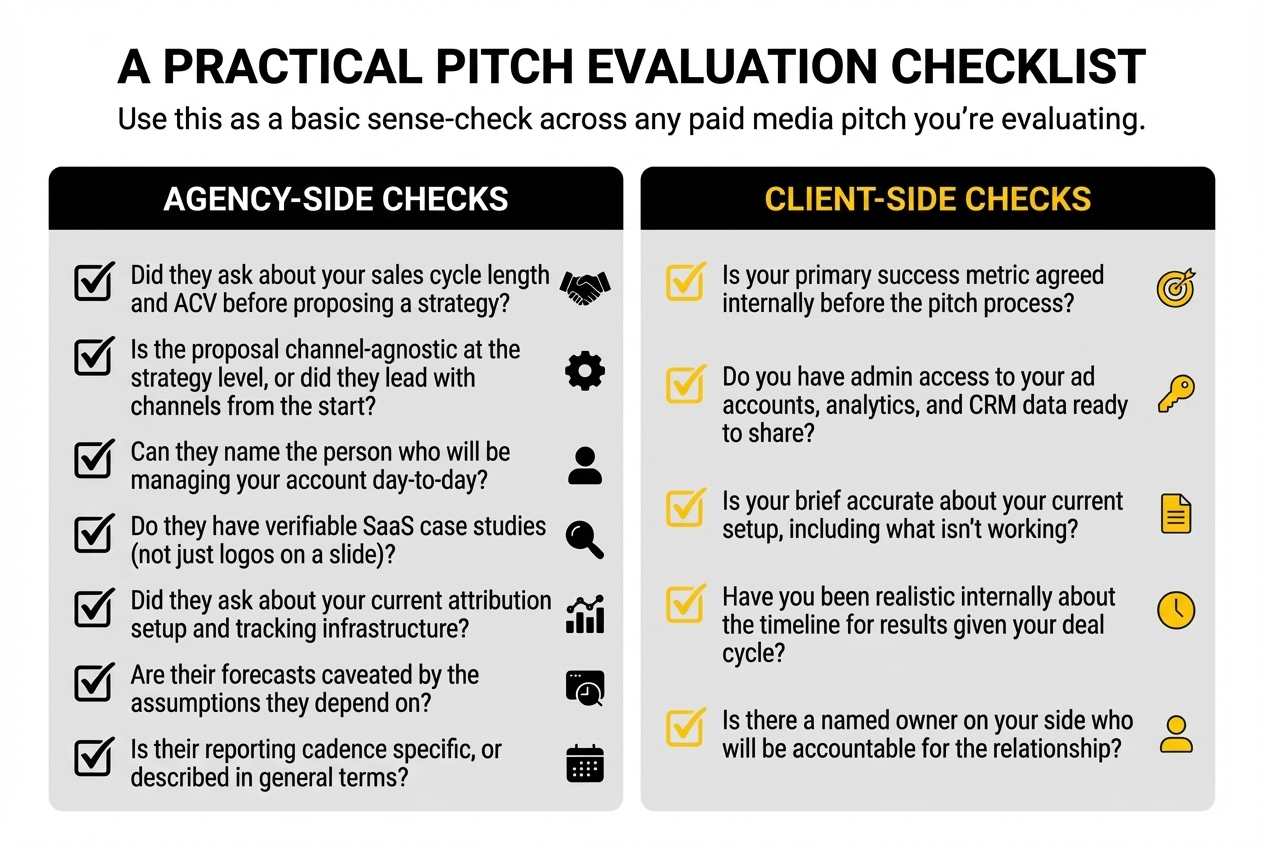
A Practical Pitch Evaluation Checklist
Use this as a basic sense-check across any paid media pitch you’re evaluating.
Agency-side checks:
- Did they ask about your sales cycle length and ACV before proposing a strategy?
- Is the proposal channel-agnostic at the strategy level, or did they lead with channels from the start?
- Can they name the person who will be managing your account day-to-day?
- Is the person presenting the proposal the same person who audited your account and built the strategy?
- Do they have verifiable SaaS case studies (not just logos on a slide)?
- Did they ask about your current attribution setup and tracking infrastructure?
- Are their forecasts caveated by the assumptions they depend on?
- Is their reporting cadence specific, or described in general terms?
Client-side checks:
- Is your primary success metric agreed internally before the pitch process?
- Do you have admin access to your ad accounts, analytics, and CRM data ready to share?
- Is your brief accurate about your current setup, including what isn’t working?
- Have you been realistic internally about the timeline for results given your deal cycle?
- Is there a named owner on your side who will be accountable for the relationship?
A Note on Starting with a Paid Deep Audit
For most SaaS teams going through a pitch process, the right next step after finding an agency they trust is straightforward: agree on scope, align on metrics, and get started. That’s how the majority of engagements begin.
But there’s a specific scenario where a more structured entry point makes sense: teams that have been through a damaging agency experience before, or where C-suite scepticism is high enough that committing to a full retainer feels like a significant internal risk. If your leadership has been burned before, or needs to see evidence of thinking quality before approving ongoing budget, a scoped piece of work before a retainer can be a sensible way to de-risk the decision.
At Upraw, we offer a paid deep audit for exactly these situations. It covers everything we’d do in month one of a full engagement: a thorough review of your current account structure, tracking and attribution setup, landing page performance, and campaign strategy, with a clear set of recommendations and a prioritised roadmap. You get a real deliverable, not a sales exercise. We get to understand your business properly before making any promises. Structuring SaaS PPC Accounts for PLG vs Sales-Led Funnels, also on this blog, takes this further.
This isn’t something we’d suggest as a default starting point. It works best when there’s a specific reason the standard path isn’t viable. But if you’re in that position, it’s worth knowing the option exists.
Frequently Asked Questions
What are the biggest red flags in SaaS paid media agency pitches?
The most consequential ones are: guaranteed performance metrics before seeing your account data, no questions about your sales cycle or pipeline quality, a proposal that goes straight to channel tactics without funnel context, and vague answers about who will actually manage the account day-to-day. Each of these signals misalignment between what the agency is selling and what B2B SaaS paid media actually requires.
Are guaranteed results in PPC pitches ever realistic for SaaS?
No. Any agency guaranteeing specific CPLs or pipeline volumes before they’ve seen your full setup is either inexperienced or overselling. Paid media in B2B SaaS involves too many variables outside an agency’s control: landing page conversion rates, positioning quality, sales qualification standards, and deal cycle length. What good agencies will do is provide scenario-based forecasting that’s explicit about the assumptions it rests on.
What questions should you ask a SaaS PPC agency before signing?
Ask who will manage your account day-to-day and whether you can meet them before signing. Ask how they measure success, and push for a metric further down the funnel than clicks or impressions. Ask what their reporting cadence looks like in practice. Ask what the first 30, 60, and 90 days look like in concrete deliverables. And ask them to walk you through a case study where something didn’t work as planned and how they responded.
How can SaaS teams tell if an agency really understands their business?
The clearest signal is the quality of the questions they ask. An agency that understands B2B SaaS will ask about your ACV, your sales cycle, your GTM motion, your ICP definition, and how your sales team currently qualifies inbound leads. An agency that defaults to talking about CPC benchmarks and ad formats without first understanding your funnel is not operating at the level B2B SaaS paid media requires. You can also test them: ask how they’d approach a PLG versus sales-led motion differently, and whether that’s relevant to your setup.
What are common client-side mistakes that derail paid media engagements?
The most common are: no internal agreement on the success metric before the process starts; expecting an agency to solve a positioning problem through ads; not having analytics, CRM access, or historical data ready to share at onboarding; and setting a 60-day ROI expectation for a business with a four-month average deal cycle. These aren’t agency problems, they’re brief problems. Address them before you sign and the engagement has a much better chance.
Is it better to start with a paid media audit before a full retainer?
For most teams, no. If you’ve found an agency you trust, the right move is to get started. But if you’ve been through a damaging agency experience before, or your C-suite needs evidence of thinking quality before approving ongoing budget, a structured entry point can make sense. At Upraw, we offer a paid deep audit for exactly these situations: a thorough review of your account, tracking setup, and strategy with clear recommendations, covering everything we’d do in month one. It’s not a default starting point, but it exists for the cases where committing to a retainer isn’t viable without seeing the work first.
How do you compare agency pitches without defaulting to price?
Score pitches against three criteria: quality of discovery (did they ask the right questions before recommending anything?), specificity of process (can you see exactly what the first 90 days looks like and who’s doing the work?), and honesty about constraints (did they acknowledge trade-offs, or only upsides?). Price matters, but it’s rarely the right tiebreaker. The most expensive agency that understands your business will outperform the cheapest one that doesn’t.
If you’re currently working through a pitch process and want a second opinion on what you’re seeing, we’re happy to take a look. Or if you want to understand more about how we approach SaaS PPC agency engagements, including what we ask clients before we take them on, we’re straightforward about that.