Comparing Multi-Channel SaaS Attribution Models: First-Touch, Last-Touch, Data-Driven, and Hybrid
Compare first-touch, last-touch, data-driven, and hybrid SaaS attribution models. Practical guidance on accuracy, MarTech integration, and data integrity.

Your attribution reports say paid search is driving 78% of conversions. Your customers say they found you through a LinkedIn post they saw six months ago. Both are true. Neither tells the whole story.
This is the core tension in multi-channel SaaS attribution: the model you choose doesn’t just describe your pipeline, it shapes which channels you invest in and which ones you quietly defund. Get it wrong, and you end up starving the programmes that actually build demand while over-crediting the ones that simply capture it.
This article compares the four main multi-channel SaaS attribution models, their practical trade-offs, and how to build a measurement setup that gives you directional confidence without creating a data operations nightmare.
What Multi-Channel Attribution Actually Means for SaaS
Multi-channel attribution distributes conversion credit across every touchpoint in the customer journey, rather than assigning it to a single interaction. In SaaS, where a prospect might read three blog posts, attend a webinar, click a retargeting ad, and then book a demo through branded search over the course of 90 days, this matters enormously.
The challenge is that no attribution model captures the full picture on its own. Software-based attribution is strong on tracking digital interactions but blind to the conversations, communities, and dark social channels that often do the heaviest lifting in B2B buying decisions. Refine Labs has documented this gap extensively: their research found that software-based tools reported 78% of conversions as sourced from web searches, while customers themselves attributed only 12% to search. Dark social channels (social media, podcasts, word of mouth, community) accounted for 85% of self-reported sources but were barely visible in the software data.
This isn’t a reason to abandon attribution software. It is a reason to understand what each model measures, and what it cannot.
First-Touch vs Last-Touch: The Trade-Offs That Actually Matter
First-touch attribution assigns 100% of conversion credit to the channel or campaign that first brought a prospect into your orbit. It answers the question: where did this relationship begin?
For SaaS teams investing in top-of-funnel content, SEO, or brand-led social, first-touch is often the only model that makes those investments look defensible. A blog post that introduced a prospect to the product six months before they booked a demo gets no credit under last-touch. Under first-touch, it gets all of it.
The weakness is the inverse: first-touch ignores everything that happened between awareness and conversion. A strong re-engagement email, a well-timed case study, a demo follow-up sequence, none of these show up. If you optimise purely for first-touch sources, you risk underinvesting in the nurture infrastructure that turns interested prospects into qualified pipeline.
Last-touch attribution assigns all credit to the final interaction before conversion. For most SaaS teams, this is often branded paid search or a direct visit. Prospects who’ve been warming up for months find your brand on Google, click the ad, and submit a demo form. Your last-touch report credits Google Ads.
This is how teams end up over-investing in branded campaigns that are capturing pre-existing demand rather than creating new demand. The pipeline exists because of everything that came before, but last-touch makes it invisible.
Last-touch is still worth tracking. It tells you which channels are effective at closing, and for high-velocity PLG funnels where the sales cycle is short, it can be directionally useful. But as the primary model for a SaaS business with sales cycles longer than 30 days, it consistently overstates the value of bottom-of-funnel capture activity.
The practical takeaway: run both. First-touch tells you what’s building demand. Last-touch tells you what’s closing it. Seeing them diverge is exactly the signal you need.

Data-Driven Attribution Models: When They Work, When They Don’t
Data-driven attribution uses machine learning to analyse your actual conversion paths and assign credit based on statistical contribution, rather than applying a fixed rule. If prospects who attend your webinars are converting at three times the rate of those who don’t, the model weights webinar attendance accordingly.
This is the most accurate approach available, and for established SaaS companies with sufficient volume, it is the right one. But the threshold matters: data-driven models require a minimum of around 1,000 deals to reach statistical significance. If you are closing fewer than 100 deals per month, the model doesn’t have enough data to identify meaningful patterns, and its outputs can be misleading.
There is a second practical constraint: data quality. A data-driven model is only as good as the tracking it runs on. Missing UTM parameters, broken CRM integrations, or inconsistent lead source fields all create gaps that skew the model’s conclusions. Before investing in a data-driven approach, it is worth auditing whether your current tracking is comprehensive enough to support it.
For companies that do meet the volume threshold, data-driven attribution changes how you evaluate marginal investment decisions. Rather than asking “which channel gets credit?”, you can ask “which touchpoints are actually correlated with deal velocity?” That is a more useful question, and it tends to surface less obvious answers.
You can explore how this connects to broader advanced analytics for B2B SaaS companies as part of building a full measurement framework.
Hybrid Attribution Models: The Practical Default
Most SaaS marketing operations teams do not run a single attribution model. They run a combination: software-based multi-touch data alongside self-reported attribution captured at the point of conversion.
This hybrid approach addresses the core limitation that no software model can capture. When someone fills out a demo form, asking “how did you hear about us?” adds a layer of qualitative data that bridges the gap between what the tracking saw and what the buyer actually experienced. It will not have the precision of GA4 conversion paths, but it surfaces information that is otherwise invisible, particularly for podcasts, LinkedIn content, and peer referrals.
Hybrid attribution is not about choosing between rigour and practicality. It is about acknowledging that a B2B SaaS buyer’s journey spans both tracked and untracked environments, and building a measurement system that accounts for both. Building a Scale-Ready SaaS PPC Engine After PMF: From Ad-Hoc to Operating System, also on this blog, takes this further.
Position-based models (U-shaped and W-shaped) sit within this hybrid category. W-shaped attribution, which assigns 30% credit each to first touch, lead creation, and opportunity creation, has become a common default for HubSpot users with defined marketing-to-sales handoff points. For sales-led SaaS businesses with clear pipeline stages mapped in the CRM, W-shaped often reflects the commercial reality more accurately than either first-touch or last-touch alone.
Time-decay models, which weight recent touchpoints more heavily, are better suited to sales cycles under 60 days. For enterprise SaaS with 90-day or 12-month cycles, a time-decay model will systematically undervalue the awareness and education work that happens at the beginning of the process.
The Data Silos Problem: Why Attribution Breaks Before It Even Starts
Most multi-channel SaaS attribution discussions focus on which model to choose. The more common failure point is upstream: attribution breaks because the underlying data is not connected.
The typical pattern looks like this: paid media data lives in Google Ads and LinkedIn Campaign Manager. Website behaviour is in GA4. Lead and opportunity data is in Salesforce or HubSpot. Each platform has its own attribution logic, its own conversion definitions, and its own way of counting. When a marketing ops specialist tries to reconcile these into a single view of pipeline by source, they are essentially doing manual data archaeology.
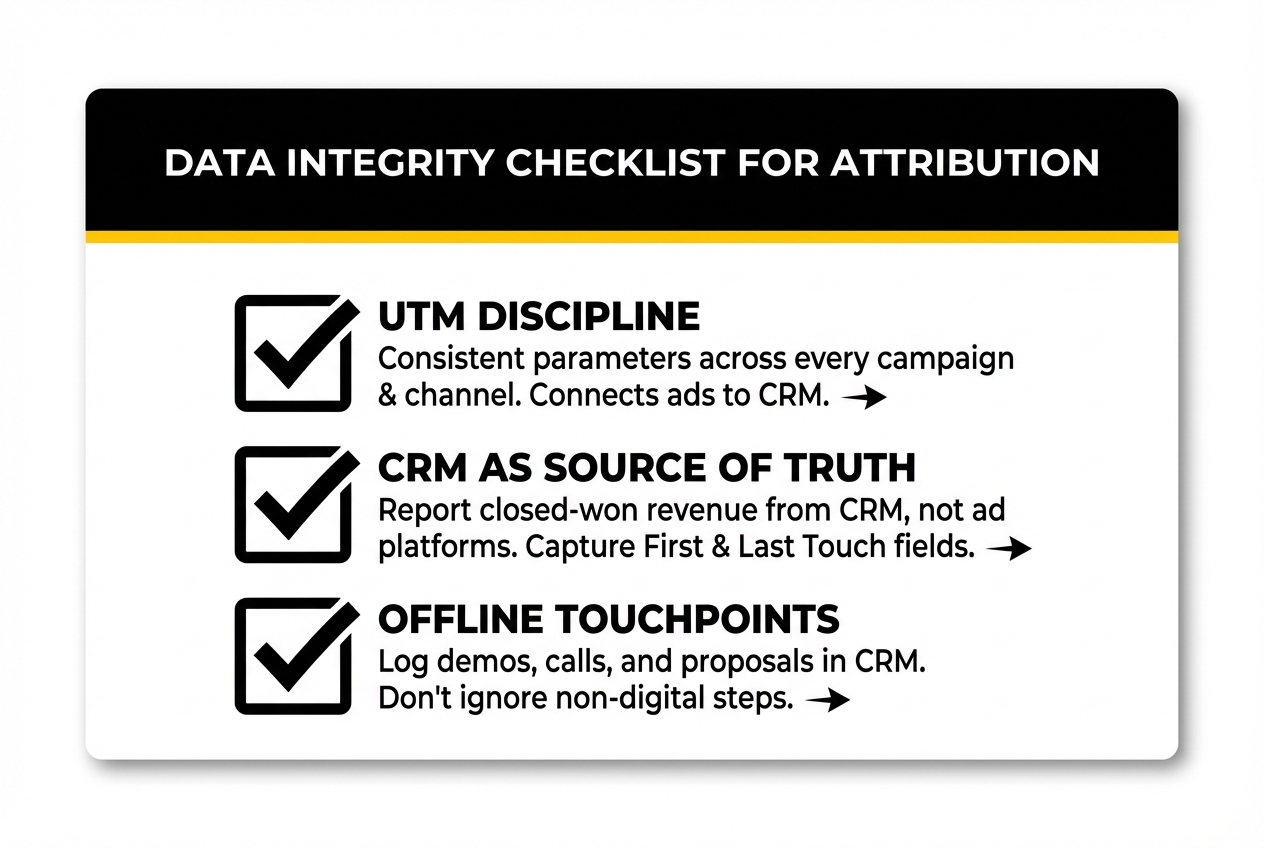
The practical fix requires decisions at three levels:
- UTM discipline. Every campaign, across every channel, needs consistent UTM parameters. This is the connective tissue between ad platforms and your CRM. Without it, lead source fields populate inconsistently, and every model downstream is built on incomplete data.
- CRM as the source of truth. Closed-won revenue should be reported out of the CRM, not out of ad platforms. When Salesforce or HubSpot is configured to capture first-touch and last-touch source fields, you have a foundation for attribution reporting that does not depend on each platform’s self-reported numbers.
- Offline touchpoints. For sales-led SaaS, demos, sales calls, and proposal stages are touchpoints that software attribution ignores entirely unless you actively log them. GCLID parameters, custom HubSpot properties, and CRM workflow automation can bring these into the attribution picture.
Teams that invest in this data infrastructure first get far more value out of whichever attribution model they choose. Teams that skip it find themselves running sophisticated models on unreliable inputs.
Building a Source-of-Truth Dashboard for SaaS Attribution
The goal of attribution is not a perfect model. It is a consistent, shared view of performance that holds up in pipeline reviews and board meetings. That means a dashboard that surfaces closed-won revenue by source, pipeline by channel, and CAC by acquisition path, all drawing from the same data.
A workable source-of-truth dashboard for B2B SaaS attribution typically includes:
- Pipeline by first-touch source (captured in CRM at lead creation)
- Closed-won revenue by last-touch source (captured at opportunity stage)
- Self-reported attribution summary (from demo form or post-conversion survey)
- CAC by channel (marketing spend divided by closed-won deals, not by MQL volume)
- Deal velocity by source (which channels produce deals that close faster)
This is not a single-click report. It requires CRM fields to be consistently populated, campaign spend to be categorised in a way that maps to the same channel taxonomy as the CRM, and someone accountable for keeping the methodology stable over time. Once it is built, it becomes the document that ends attribution debates in revenue meetings.
For detailed guidance on designing the tracking infrastructure that feeds this, see our piece on Building a Source-of-Truth Dashboard for B2B SaaS.
The question of how to adapt these models for PLG versus sales-led SaaS requires its own treatment, which we cover in Designing a Tracking Plan for PLG vs Sales-Led SaaS.
.jpeg)
Choosing the Right Model: A Practical Decision Framework
Attribution model choice is a function of three variables: sales cycle length, deal volume, and data infrastructure maturity.
ScenarioRecommended modelShort sales cycle (under 30 days), high volumeLast-touch or data-drivenLong sales cycle (over 60 days), defined pipeline stagesW-shaped or hybridHigh deal volume (1,000+ per year), clean CRM dataData-drivenLower deal volume, developing data infrastructureFirst-touch + last-touch + self-reportedEnterprise SaaS, multi-stakeholder dealsAccount-level + hybrid
The most common mistake is adopting a more sophisticated model than the underlying data can support. A data-driven model running on incomplete UTM coverage and a CRM that isn’t capturing offline touchpoints will produce confident-looking numbers that do not reflect reality.
Start with what you can measure reliably. Add complexity only when the data foundation can support it.
Frequently Asked Questions
What is the multi-channel attribution model?
Multi-channel attribution distributes conversion credit across multiple touchpoints in the customer journey, rather than assigning it to a single interaction. In practice, this means different rules for how credit is shared between first touch, last touch, and the touchpoints in between. The goal is a more accurate view of which channels and campaigns are actually contributing to pipeline and closed revenue.
How do first-touch and last-touch attribution models differ?
First-touch assigns all credit to the channel that first introduced a prospect to your brand or product. Last-touch assigns all credit to the final interaction before conversion. First-touch tends to surface the value of awareness and top-of-funnel activity. Last-touch over-credits demand capture channels like branded paid search. Both are useful when run in parallel, but neither is accurate on its own for SaaS businesses with long sales cycles.
What is data-driven attribution and how does it work?
Data-driven attribution uses machine learning to analyse conversion paths and assign credit based on statistical contribution rather than a fixed rule. It compares converting and non-converting customer journeys to identify which touchpoints correlate most strongly with deals closing. It requires a minimum volume of approximately 1,000 conversions to produce reliable outputs, making it most appropriate for established SaaS companies with consistent deal flow.
What are the advantages of using hybrid attribution models?
Hybrid models combine software-based multi-touch tracking with self-reported attribution captured directly from buyers. This addresses the core gap in software attribution: it cannot see dark social channels, peer referrals, or word-of-mouth influences that often drive B2B demand. By adding a simple “how did you hear about us?” question at the point of conversion, teams can capture qualitative data that changes how they interpret their channel performance.
What challenges do marketers face with data silos in attribution?
Data silos mean that paid media, website analytics, and CRM data sit in separate platforms with inconsistent taxonomies and conversion definitions. This makes reconciling a single source of truth for pipeline by source extremely difficult. The fix requires UTM discipline across all campaigns, CRM configuration to capture first-touch and last-touch source fields at lead and opportunity stages, and a shared channel taxonomy that maps consistently across platforms.
How can seamless integration with MarTech stacks enhance attribution processes?
When CRM platforms like Salesforce or HubSpot are configured to receive and store UTM data at lead creation, they become the source of truth for attribution rather than individual ad platforms. Connecting ad spend data, website behaviour, and CRM pipeline data through a consistent lead source taxonomy means attribution reporting reflects actual commercial outcomes, not platform-level proxy metrics. This is the foundation for reporting that holds up in revenue and board meetings.
What best practices ensure data integrity in attribution?
Three practices make the biggest difference: consistent UTM parameters across every paid and organic campaign; CRM fields for first-touch and last-touch source that populate automatically at lead creation and opportunity stage; and a stable, documented methodology that does not change with every reporting cycle. Attribution results are only comparable over time if the methodology is consistent. Changing models mid-year makes historical trend analysis unreliable.
What is an example of a multi-touch attribution model?
W-shaped attribution is a widely used multi-touch model in B2B SaaS. It assigns 30% of credit to the first touch (initial awareness), 30% to the lead creation touchpoint (the moment a prospect converts to a known contact), and 30% to the opportunity creation touchpoint (when sales qualifies the deal). The remaining 10% is distributed across all other touchpoints in between. It reflects the natural commercial milestones in a sales-led SaaS funnel and maps cleanly to HubSpot and Salesforce pipeline stages.
Attribution will never be perfect. The goal is consistent, directional data that helps you make better channel investment decisions and explain pipeline performance without a spreadsheet that takes three hours to reconcile. If you are working through your attribution setup and want a second perspective on the model or infrastructure choices, we are happy to take a look at what you have.


.png)