Understanding Net Revenue Retention, Expansion, and Churn in SaaS PPC
Explore how NRR, GRR, expansion, and churn shape CAC levels and PPC strategies for SaaS businesses focused on PLG and upselling.

You know what happens when you focus only on new customer acquisition. Your MQL volume hits targets. Your cost-per-opportunity stays manageable. But your finance team asks a different question: why isn't revenue growing faster if you're bringing in new customers every month.
The answer usually sits in three numbers: how much revenue stays with you (Net Revenue Retention), how much you're losing (churn), and how much you're adding from existing customers (expansion revenue). These metrics don't just shape your P&L. They reshape what you can actually afford to spend on PPC.
For detailed analysis of SaaS metrics, see SaaS Analytics.
When NRR is high, your acceptable Customer Acquisition Cost changes. When churn is eating revenue, your channel strategy needs rethinking. This is where most SaaS teams disconnect their retention metrics from their paid media decisions, and it costs them millions in misdirected spend.
Net Revenue Retention and Gross Revenue Retention: Two Different Stories
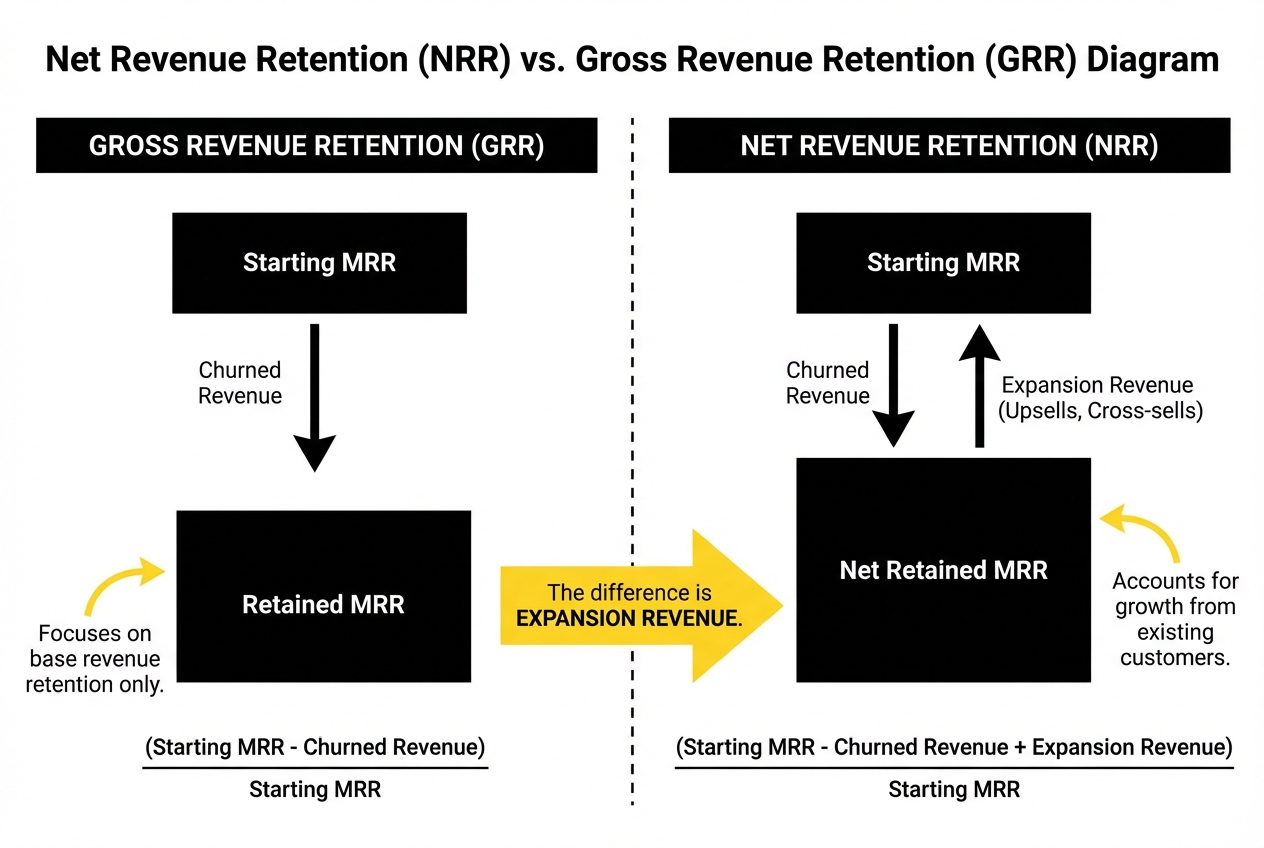
Net Revenue Retention (NRR) measures the percentage of recurring revenue that stays or grows from your existing customer base, after accounting for both churn and expansion. The calculation is straightforward: take your starting MRR, subtract churned revenue, add expansion revenue, then divide by starting MRR. Multiply by 100 to get your percentage.
Gross Revenue Retention (GRR) is simpler. It's just starting MRR minus churned revenue, divided by starting MRR. No expansion factored in. GRR tells you whether you're losing customers and revenue at the base level. NRR tells you whether, on net, existing customers are becoming more valuable.
The difference between GRR and NRR is expansion revenue. If your GRR is 90% but your NRR is 105%, that 15-point gap is expansion. Your customer base is shrinking slightly, but the customers staying are spending significantly more. Most SaaS teams need a GRR of at least 85% to be healthy at scale. Anything below 80% means churn is outpacing your ability to retain.
NRR sits on a spectrum. Below 100% means expansion isn't outweighing churn, and your revenue base is contracting month over month. This forces aggressive new customer acquisition just to stay flat. Between 100% and 110%, you're maintaining but not accelerating. Above 115%, you're building momentum from within, which is where the math of SaaS growth starts to compound.
How Churn Reshapes Your PPC Economics
Churn is the silent variable that most PPC teams ignore. You're buying a customer at a specific cost per opportunity. Sales closes it at a specific conversion rate. But if that customer is gone in six months, your CAC payback is broken.
Churn compounds over time. A 5% monthly churn rate means half your customer base turns over in about 14 months. A 2% monthly churn rate gives you roughly three years of customer lifetime. For companies running on 12-24 month sales cycles, that difference is existential. The PPC budget that makes sense at 2% churn doesn't make sense at 5%.
Think through a concrete scenario. You're a B2B SaaS company with an ACV of 50,000. Your CAC is 15,000. That's a CAC ratio of 3.3:1, which is healthy. Your payback is roughly 10 months, assuming standard revenue recognition timing. But here's where churn changes the math. If your annual churn is 25% (roughly 2% monthly), you lose 12,500 of that ACV in the first year. Your effective first-year revenue capture drops from 50,000 to 37,500. Payback now stretches to 13-14 months. Your cash flow problem just became real.
High-churn businesses either need dramatically better unit economics on acquisition or they need to address the retention problem first. Too many SaaS teams skip step two.
Churn typically falls into three buckets. Involuntary churn is companies that go out of business or get acquired. Downgrade churn happens when customers move to cheaper plans. And voluntary churn is active cancellation, usually due to insufficient value or competitive displacement. Only the first category is truly uncontrollable. The other two are fixable, and they require different interventions.
.jpeg)
Expansion Revenue: The Lever Most PPC Teams Ignore
Expansion revenue is growth from existing customers. It comes from upsells (selling a higher-tier plan), cross-sells (adding adjacent products), or increased usage (seat licenses, API calls, data volume). It's the difference between NRR and GRR, and it's where most B2B SaaS companies actually make their money.
Here's the hard truth: if your PPC strategy doesn't account for expansion revenue, your CAC models are wrong. You're attributing the full customer value to acquisition when you should be treating it as a foundation for expansion.
Take a product-led growth company. Your PPC campaigns bring in free trial signups at a low cost per lead. A percentage convert to paid, but the real growth lever is how much those customers spend over time. If your PPC campaigns are driving tire-kickers into a leaky top-of-funnel, expansion revenue stays depressed. If they're driving product-qualified leads who are already experiencing value, expansion revenue climbs.
For sales-led models, expansion comes from account managers identifying upsell opportunities. The PPC campaign's job is still acquisition, but the revenue model now depends on post-sale motion. In hybrid models, both happen simultaneously, which creates attribution complexity. Structuring SaaS PPC Accounts for PLG vs Sales-Led Funnels, also on this blog, takes this further.
The problem most teams face: they can't easily attribute expansion revenue back to the original acquisition channel. A customer acquired via Google Ads three months ago upgrades their plan. Did Google Ads cause the expansion, or was it product value, the sales team, or company maturity. Attribution breaks down, and expansion revenue gets orphaned in the P&L.
The CAC Conversation That Changes When NRR Is High
When your NRR is below 100%, you need a very different acquisition strategy than when it's 120%+. This is the single biggest lever most CFOs and demand leaders miss when setting PPC budgets.
Let's say you're a company with 100 million ARR. Your gross margin is 75%. Your CAC is 30,000. If your NRR is 105%, your revenue is growing 5% from your existing base, which is roughly 5 million ARR. You need acquisition to fill the gap between organic growth and your growth target. If you're targeting 20% growth, you need to acquire enough to drive 15% (the delta). Thats roughly 15 million ARR from new customer revenue.
But here's where the math works differently at high NRR. Because your existing base is growing, payback cycles are shorter. Retention is working. Your CAC models start pricing in a higher lifetime value because customers are staying longer and spending more.
Lower NRR companies need to be far more conservative with CAC. A company with 95% NRR is fighting churn, and that changes the math entirely. CAC payback extends. LTV contracts. The acceptable CAC ratio compresses. You can't spend as much because you can't count on the revenue sticking around.
This is why high-growth, high-churn companies often look inefficient on paper. They're spending aggressively on acquisition not because they're optimising acquisition but because they have no choice, their retention is broken. The fix isn't cheaper ads. It's fixing the product or motion. CAC doesn't change your churn problem.
Product-Led Growth, Retention, and the Role of PPC
Product-led growth models change the churn equation fundamentally. When customers can experience value before they hand over a credit card, initial churn often drops. The free tier acts as a filter. Only customers who already see value convert to paid.
This improves GRR and NRR, but it changes what PPC optimises for. In a PLG model, your PPC campaigns are acquisition of trial users, not immediate sales. Your conversion funnel is longer. Your CAC is lower (because you're counting trials, not closed deals), but your payback period is also extended, because revenue recognition happens later.
PLG also changes expansion revenue dynamics. Because customers are self-served, they can discover new features and upgrade themselves. Your sales team doesn't touch expansion, so it becomes a pure product and marketing motion. That expansion revenue is still hard to attribute to PPC, but it's more likely to flow from the channels that bring in product-qualified leads.
The tension is real: PPC teams optimising for immediate conversion will undervalue PLG because the sale takes longer. But PLG teams underinvest in PPC because they don't see the expansion revenue that flows from it six months later.
Churn and CAC Payback: The Dependency You Can't Ignore
Your acceptable CAC payback period is a function of three things: how long your sales cycle is, how long your average customer lasts, and your gross margin. Churn determines the third and fourth inputs.
If your average customer lifetime is 18 months, you want payback in six months or less, giving you 12 months of pure margin contribution. But if churn shortens that lifetime to 12 months, payback now has to happen in four months for the same margin outcome. That forces you to either lower CAC or improve conversion rates, neither of which happens on its own.
This is where most SaaS teams break their own PPC strategy. They set CAC targets based on optimistic payback assumptions, then don't revisit them when churn increases. CAC stays flat, but payback window shrinks. Profitability deteriorates invisibly until the cash flow problem surfaces.
The healthier approach: build your CAC budget from churn-adjusted payback models, then monitor monthly churn alongside CAC. If churn moves, CAC needs to move with it.
Accurate Attribution as the Foundation for NRR-Informed PPC
Attribution is the linchpin between these metrics and actual PPC strategy. You can't manage what you can't measure.
Most SaaS teams can't accurately attribute expansion revenue to acquisition channels. A customer acquired via paid search expands their seat count three months later. If your CRM doesn't tag that expansion revenue to the original source, it orphans the value. Your PPC ROI looks artificially low because half the revenue isn't being credited.
This becomes critical for churn analysis too. If you can't distinguish between customers acquired via different channels, you can't identify which channels bring in lower-churn cohorts. Some channels systematically deliver higher-quality customers who stay longer and expand more. Others bring in tire-kickers who cancel within months. Without cohort-level churn data, you're flying blind.
The fix requires intentional design. Your CRM needs to preserve source of origin through the entire customer lifecycle. Your expansion revenue needs to be tagged to the original source, not orphaned as post-sale margin. Your churn analysis needs to segment by channel, not just aggregate.
For marketing operations specialists, this is existential. Data silos between your PPC platform, CRM, and revenue system create reporting shadows. Customers acquired via Ads get lost when they move to HubSpot. Expansion revenue stays in Salesforce. Churn gets counted in your retention tool. You end up with three different versions of truth.
Building a single system of record, where every customer cohort can be tracked from PPC click to expansion revenue to churn event, is foundational. Without it, your NRR-informed PPC strategy stays theoretical.
Budgeting When NRR and Churn Are Your Constraints
Here's where theory meets practice. How do you actually set your PPC budget when you're managing against NRR and churn targets.
Start with your growth equation. Revenue growth comes from acquisition and from net expansion (NRR minus 100%). If you're targeting 25% growth, and your NRR is 110%, that's 10% from your existing base. You need 15% from new customers. That's the revenue gap your PPC budget needs to fill.
Next, calculate the CAC you can afford. Take that 15% growth target, multiply by your ARR. That's new revenue needed. Divide by your average CAC ratio (ARR per customer divided by CAC). That tells you how many new customers you need. Divide those new customers into your target PPC spend to get cost per acquisition by channel.
But here's where it gets real: build in a churn sensitivity. Model two scenarios, one where churn increases 20%, one where it decreases 20%. How does that change your CAC tolerance and your payback period? If a small churn shift breaks your model, your PPC budget is too aggressive.
Finally, ring-fence expansion revenue. Don't count it in your CAC payback. Treat it as upside to your model. This keeps you honest about what you're paying for (new customers) versus what you're hoping happens afterwards (expansion).
How NRR and Churn Inform Channel Mix Decisions
When NRR is high and churn is low, you can justify heavier investment in brand awareness and demand generation. You're building a scalable, profitable engine. You can afford to cast a wider net because payback is reliable.
When NRR is low or churn is high, you shift. You move budget away from top-of-funnel awareness and toward proven, lower-cost channels. You double down on brand search (lower CAC, higher intent). You increase account-based marketing on high-value segments. You optimize relentlessly for CAC because you can't afford to waste margin on uncertain payback.
This doesn't mean high-churn companies shouldn't invest in demand gen. It means the unit economics need to be dramatically better. You need tighter targeting, lower cost per impression, faster conversion. You're competing for a smaller, higher-intent pool.
For PLG businesses with strong NRR, the calculus is different. CAC per trial can be higher because you're not buying closed deals. But the cohort quality matters more. Cheap trial signups that don't convert to paid are worse than zero. Expensive, qualified trial signups that have high conversion and expansion are underpriced.
Practical Checklist: Aligning NRR and Churn to Your PPC Strategy
Use this to audit your current setup.
Do you have monthly churn data by acquisition channel? If not, start there. You need to know which channels bring in sticky customers and which bring in tire-kickers. This tells you where to invest.
Is your expansion revenue attributed to source channels? Can you see which cohorts expand most. If not, build this into your attribution model. Don't guess about cohort quality.
Have you calculated CAC payback adjusted for churn. Most teams haven't. Model it. See how your payback window shifts if churn increases by 20 basis points. That sensitivity is your risk profile.
Are you distinguishing between GRR and NRR in your planning. If your NRR is your target metric but you're not watching GRR, you might miss deteriorating churn hiding under expansion revenue.
Is your PPC budget scenario-tested against NRR and churn. Set your base case (current NRR and churn). Then model a high-churn scenario. What happens to payback. What do you cut. Knowing that before churn spikes is how you run a resilient program.
.jpeg)
For deeper insights, see Understanding the Impact of CAC and Conversion Rates on Your Cash Runway.
Frequently Asked Questions
What is Net Revenue Retention (NRR) and why is it important for SaaS businesses?
Net Revenue Retention measures the percentage of your recurring revenue that remains or grows from existing customers after accounting for churn and expansion. It's critical because it shows whether your existing customer base is becoming more valuable over time. An NRR above 100% means expansion outweighs churn, enabling profitable growth. It directly informs your acceptable CAC, payback period, and growth runway.
How does Gross Revenue Retention (GRR) differ from Net Revenue Retention (NRR)?
GRR measures only the revenue retained after churn, without factoring expansion. If your GRR is 90% and NRR is 110%, that 20-point gap is pure expansion revenue. GRR shows your churn rate. NRR shows net health. Companies with high churn but strong upsells can have GRR below 90% but healthy NRR, though this isn't sustainable long-term.
What factors contribute to customer churn in SaaS companies?
Churn typically falls into three categories. Involuntary churn happens when customers go out of business or are acquired. Downgrade churn occurs when customers move to cheaper plans. Voluntary churn is active cancellation, usually driven by insufficient product fit, poor onboarding, competitive displacement, or unclear ROI. The first is uncontrollable, but the other two require targeted interventions in product, support, or sales motion.
How can SaaS businesses reduce churn rates effectively?
Reducing churn requires identifying which category is dominant, then addressing it. Improve onboarding to show value faster. Build customer success checkpoints to catch at-risk accounts early. Use in-app engagement to surface features your customers aren't using. Align your product roadmap to customer feedback. For high-value cohorts, assign dedicated account management. For PLG models, optimize the trial-to-paid conversion journey to ensure only product-qualified leads become paying customers.
What is expansion revenue in the context of SaaS, and how does it impact overall growth?
Expansion revenue is growth from existing customers through upsells (higher-tier plans), cross-sells (new products), or usage growth (seat licenses, data volume). For many B2B SaaS companies, expansion accounts for 30-50% of annual revenue growth. It's the difference between GRR and NRR. High expansion revenue is a sign that your product is delivering value beyond the initial contract, and that existing customers see room to grow with you.
How do NRR and GRR influence Customer Acquisition Cost (CAC) decisions?
Higher NRR allows higher CAC because your payback window is shorter and customer lifetime value is higher. A company with 120% NRR can sustain a higher CAC than one with 95% NRR. Similarly, companies with strong GRR (85%+) can invest more in acquisition because churn is predictable. Lower NRR or GRR forces tighter CAC discipline, more aggressive optimisation, and reliance on high-intent channels where conversion is proven.
What role does Product-Led Growth (PLG) play in improving NRR and reducing churn?
PLG improves churn by allowing customers to experience value before purchase, filtering out poor-fit buyers. This typically lowers initial churn. PLG also changes expansion revenue dynamics, because self-served customers can upgrade themselves without sales intervention. However, PLG requires tight product design and clear monetisation, otherwise expansion revenue stays flat and churn can rebound as customers exhaust free feature value.
How can accurate attribution improve PPC strategies for SaaS companies?
Attribution is essential because it connects acquisition spend to expansion revenue and churn. Without it, you can't identify which channels bring high-quality cohorts. With it, you can see which channels deliver lower churn, higher expansion, and better lifetime value. This lets you shift budget toward channels that look cheap on immediate CAC but deliver excellent payback when expansion is factored in.
What budgeting strategies should SaaS businesses adopt based on their NRR and churn metrics?
Model your growth as acquisition plus net expansion (NRR minus 100%). Calculate the new customer revenue you need to hit growth targets. From there, work backwards to CAC by channel. Then stress-test: what if churn increases 20 basis points? What happens to payback and profitability. Sensitivity analysis reveals whether your PPC budget is resilient or fragile. Budget conservatively for acquisition, treat expansion as upside.
How can marketing operations specialists leverage data integrity to optimise their channel mix?
Start by building a unified attribution model that connects PPC, CRM, expansion, and churn data. Segment cohorts by source channel. Calculate churn and expansion by cohort. This reveals which channels bring sticky customers who expand, and which bring quick churn. Ring-fence that data to avoid silos. Use it to shift budget toward channels that deliver the best combined CAC, churn, and expansion economics.
---